



When someone says “static website” or “dynamic website”, many business owners immediately feel that they are hearing a developer's language.
But the basic idea is actually quite simple.
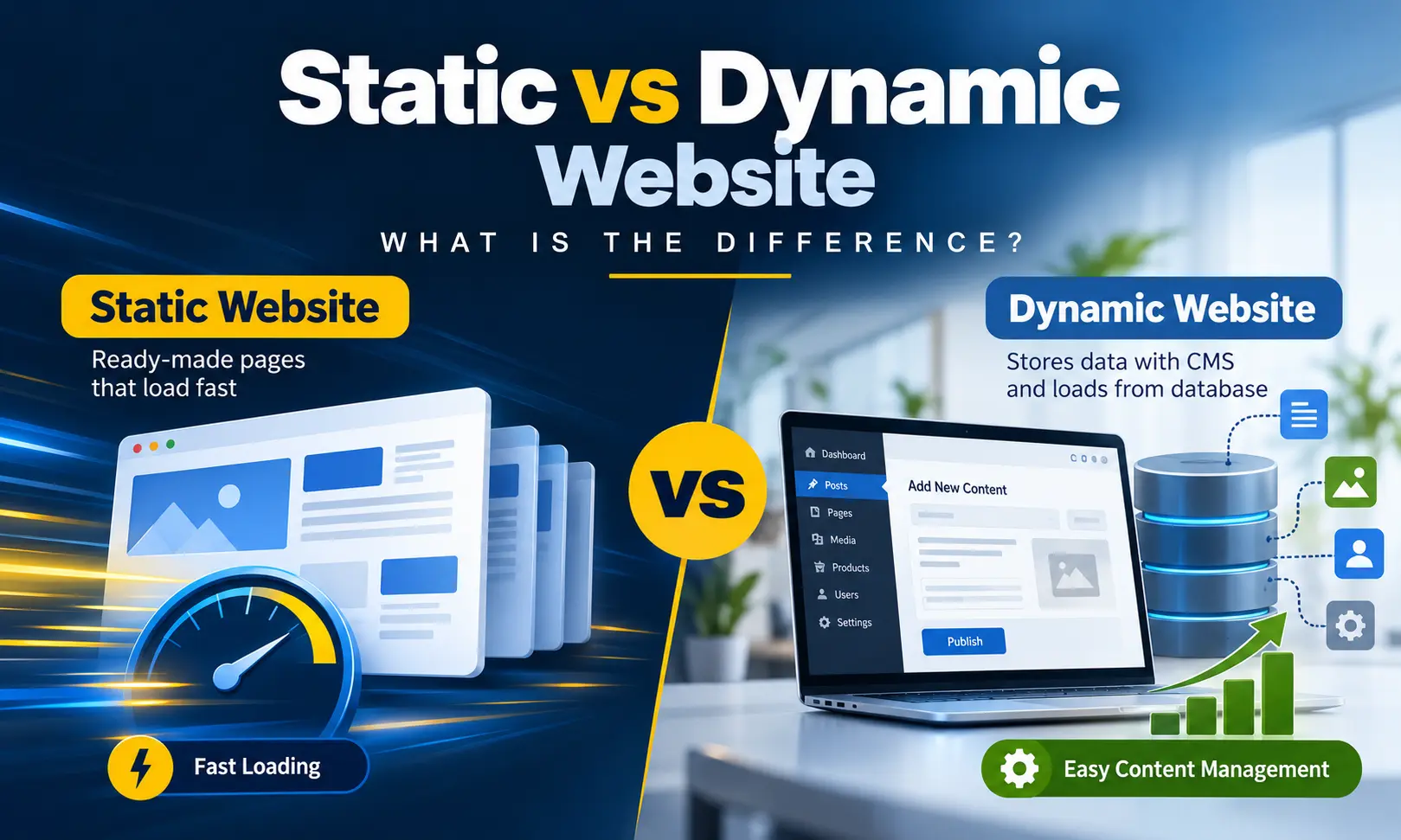
A static website is made up of ready-to-display pages. When a visitor opens a page, the server can send that prepared page directly to the browser.
A dynamic website works more like an information system. The website can store content in a database, retrieve the required information and then display it through a website template. A CMS, such as WordPress or another content management system, is commonly used to manage this information.
That small difference changes how a website is built, updated, maintained and sometimes how quickly it can respond.
So, if you are planning a new business website and someone asks you, “Do you need a static website or a dynamic website?”, this guide will help you understand what that actually means without drowning you in technical jargon.
What Is a Static Website?
Let us start with the simpler one.
A static website contains pages that are already prepared and stored on the server. When a visitor requests a particular page, the server can deliver that page without having to first fetch a set of records from a database and build the page for that request.
Imagine a printed company brochure.
Your brochure already contains your company name, services, photographs, address, phone number and other information. When someone asks for it, you simply hand it over.
A basic static website works in a somewhat similar manner.
The pages are already prepared. The visitor requests a page, and the server delivers it.
For a small business website with relatively fixed information, this can be a very practical approach.
Why Is It Called “Static”?
The word static does not mean the website is boring, old-fashioned or incapable of having animations.
It simply refers to how the main page content is delivered.
If a visitor opens your About Us page today and another visitor opens the same page tomorrow, the server can simply deliver the same prepared page to both visitors.
The page is not being rebuilt from a database every time someone opens it.
This is one of the most important ideas to remember:
Static does not mean simple-looking. It means the page content is generally prepared in advance rather than generated from database records for each request.
How Does a Static Website Work?
Let us imagine that you own a business in Bangalore and have a five-page website.
- Home
- About Us
- Services
- Projects
- Contact
Each page is already prepared.
When a visitor clicks Services, the browser asks the server for that page. The server finds the relevant file and sends it back to the visitor's browser.
The browser then displays the page.
There is no need for the website to search a large product database or retrieve dozens of content records just to show a simple company profile.
That straightforward journey is one reason static websites can be extremely quick when they are properly built and hosted.
Why Can Static Websites Be Very Fast?
Speed is one of the biggest reasons businesses consider a static website.
Think about the difference between ordering a ready-made item and asking someone to prepare the same item after you place the order.
If the item is already ready, it can be handed over quickly.
A static web page follows a similar idea.
The HTML page is already prepared. The server can deliver it instead of performing the full database-and-application journey that many dynamic pages require.
Of course, the website can still become slow if it contains enormous images, too many scripts, poorly optimised videos, slow hosting or other heavy resources.
So, static does not automatically mean fast.
Rather, static architecture can give a website a very clean starting point for achieving fast loading.
What Is a Dynamic Website?
Now let us move to the other side.
A dynamic website can create or assemble page content based on information stored on the server, often using a database.
Instead of keeping every piece of information as a separate ready-made page, the website can store the information as data.
For example, imagine an online store with 5,000 products.
It would be inconvenient to manually maintain thousands of completely separate pages where every product name, price, image, description and stock detail is hard-coded.
A dynamic website can store those details in a database.
When someone opens a particular product page, the website can identify the requested product, retrieve its information from the database and display that information using a common page design.
How Does a Dynamic Website Work?
Here is a simple example.
Suppose your website has a product called Premium Wooden Flooring.
Instead of keeping every product detail directly inside an individual page, the database may contain information such as:
- Product name
- Product description
- Product image
- Price
- Category
- Product code
- Available stock
When a visitor opens that product page, the website can retrieve the required information from the database and place it into the website's page structure.
The visitor sees a normal webpage.
They do not see the database or the programming behind it.
That entire process happens behind the curtain.
What Is a CMS?
CMS stands for Content Management System.
In simple terms, it is an administration system that allows authorised users to manage website content without manually editing every webpage's source code.
For example, suppose you have a company blog.
Without a CMS, adding a new article may involve creating or editing website files.
With a CMS, an administrator can usually log into an admin panel, add the article title, write the content, upload an image, choose a category and publish it.
The CMS then stores the information and the website displays it through its existing design.
This is particularly useful when a website has a large amount of regularly changing information.
Static Website vs Dynamic Website: A Simple Example
Here is an easy way to understand the difference.
Imagine a restaurant menu.
A static website is like having a beautifully printed menu. The dishes and prices are already printed. If you want to change the price, you need to update the menu itself.
A dynamic website is more like having a digital menu connected to a central system. The dish information and prices are stored as data. When you update the central information, the website can display the new information wherever it is required.
Neither approach is automatically right or wrong.
The important question is: How much information does your business need to manage, and how often will that information change?
Static vs Dynamic Website: Main Difference
The simplest distinction is this:
- Static website: Pages are generally prepared beforehand and delivered as ready-made files.
- Dynamic website: Pages can use application logic and database information to produce or assemble content when requested.
Both types still use familiar web technologies such as HTML, CSS, JavaScript and web servers. The difference mainly appears in what happens behind the page before the visitor sees it.
Static Website vs Dynamic Website: Speed
This is probably the first question many business owners ask.
Which one is faster?
A well-built static website can have an advantage because the server can deliver pre-existing page files with less processing.
A dynamic website may need additional work before returning the page. The server may need to run application code, retrieve information from a database and construct the required response.
That does not mean every dynamic website is slow.
A properly developed dynamic website can also be extremely fast.
Caching, efficient database queries, good hosting, image optimisation, modern server configuration and other performance techniques can make a major difference.
So the sensible conclusion is:
Static architecture can make fast delivery easier, while a well-optimised dynamic website can also deliver excellent performance.
Static Website vs Dynamic Website: Content Updates
This is where dynamic websites begin to show their strength.
Suppose your business has a website with 10 service pages.
If those pages rarely change, updating them occasionally may not be a major problem.
But imagine a website with:
- 500 products
- 200 blog articles
- 50 service locations
- Thousands of customer records
- Regular price changes
- Daily offers
Managing such information manually would quickly become tedious.
A CMS and database can make this type of work much easier because the information can be managed as structured data rather than as hundreds or thousands of individually maintained pages.
Why Do Businesses Use Dynamic Websites?
Dynamic websites become useful when the website is doing more than simply displaying company information.
For example, a business may need:
- Blog management
- Product management
- Customer accounts
- Online bookings
- Property listings
- Travel packages
- Job listings
- Membership systems
- Online payments
- Shopping carts
- Order management
- Customer dashboards
- Search and filtering
These functions usually require information to be stored, retrieved, updated or processed.
That is where a database-driven website becomes much more useful.
When Is a Static Website a Good Choice?
A static website can be a sensible option when your main requirement is to present your business clearly and quickly.
For example:
- Company profile websites
- Small business websites
- Consultant websites
- Professional portfolio websites
- Service-based businesses
- Corporate information websites
- Landing pages
- Event information websites
If your website mainly contains fixed information such as your company profile, services, team, projects, contact details and enquiry form, you may not need a complicated database-driven system.
In such cases, keeping the technology lean can be a sensible business decision.
When Is a Dynamic Website a Better Fit?
A dynamic website becomes more useful when your website has information that keeps moving.
For example, consider a real estate portal.
New properties are added. Old properties are sold. Prices change. Locations are updated. Photos are replaced. Visitors search by budget, location and property type.
Trying to manage all of that as individually maintained static pages would become cumbersome.
A database-driven website can store the property information and allow the website to retrieve and display the required listings.
The same principle applies to ecommerce websites, travel portals, job portals, membership websites and many other online systems.
Does a Dynamic Website Always Need a Database?
Not necessarily.
This is one area where the words static and dynamic can become confusing.
In everyday website discussions, dynamic websites are commonly associated with databases and server-side applications because databases are frequently used to store and retrieve changing information.
However, technically, “dynamic” can refer more broadly to content that is generated or changed based on a request or other conditions.
For a business owner, the practical explanation is easier:
If your website needs to store and regularly retrieve changing business information, a database-driven dynamic website is often the more suitable architecture.
Static Website vs CMS Website
Another common question is:
“Should I choose a static website or WordPress?”
The real comparison is not always as simple as static versus WordPress.
A static website focuses on delivering prepared pages, while WordPress is a content management system that allows website content to be managed through an administrative interface.
For a business that publishes blogs regularly, adds new services, manages products or wants non-technical staff to update content, a CMS can be very convenient.
For a business that mainly needs a compact, fast-loading online presence with relatively stable content, a simpler architecture may be sufficient.
Static Website vs Dynamic Website: Maintenance
Maintenance is another important factor that is often ignored during the initial website discussion.
A static website generally has fewer moving parts. If there is no database, CMS or complex backend application, there are fewer components involved in serving the basic pages.
A dynamic website can have more components to look after, such as:
- CMS software
- Database
- Server-side application
- Plugins or modules
- User accounts
- Security updates
- Backups
That additional machinery is not a disadvantage by itself.
It is simply the price of having additional functionality.
If your business needs those features, the extra infrastructure has a purpose.
Static Website vs Dynamic Website: Security
Security is another area where a simpler architecture can have an advantage.
A basic static website does not necessarily need a database, login system or complex administration panel for visitors to use the site.
That means there can be fewer server-side components that need protection.
Dynamic websites, on the other hand, may have databases, login systems, admin panels, plugins and other components that need regular security attention.
But this does not mean that every static website is secure or every dynamic website is insecure.
Security depends on the actual implementation, hosting environment, software, configuration, updates, access controls and many other factors.
Does Static Mean You Cannot Update the Website?
No.
This is a very common misunderstanding.
A static website can absolutely be updated.
The difference is mainly how the update is made.
With a traditional static website, a developer may update the relevant page files and publish the changes.
With a CMS-based dynamic website, an authorised person can often log into the admin panel and change the content themselves.
So the real question is not whether a static website can be updated.
It is whether you need a convenient content-management system for frequent updates.
Static Website vs Dynamic Website for a Small Business
For a small business owner, the decision can be surprisingly straightforward.
If you mainly want customers to find your company online, understand your services, see your work and contact you, a simple website may be enough.
You may not need a large database just to display your business address and service information.
But if your business is regularly publishing content, selling products, accepting bookings, managing customer accounts or maintaining hundreds of records, a dynamic website can make much more sense.
Do not choose technology simply because it sounds more advanced.
Choose the architecture according to what your business actually needs.
Static vs Dynamic Website for Ecommerce
An ecommerce website is a different story.
Products have names, descriptions, images, prices, categories, stock quantities and other information.
Customers create accounts, place orders, make payments and check order status.
All of this information needs to be managed.
That is why ecommerce platforms generally rely heavily on databases and dynamic functionality.
A static brochure-style website may explain your business and products, but a full ecommerce operation needs a system capable of handling changing business data.
Static vs Dynamic Website for SEO
Many people ask whether static websites are automatically better for Google.
The answer is no.
There is no magic SEO switch called “static website”.
A website needs useful content, good technical implementation, sensible page structure, mobile usability, strong performance and other SEO fundamentals.
A static website can be fast and technically clean, which can help provide a good experience.
A dynamic website can also be well optimised and perform very well in search.
The important point is that website architecture should support your business and SEO requirements rather than being selected purely because one label sounds better.
Which Website Is More Cost-Effective?
There is no universal price difference because the actual cost depends on what the website needs to do.
A simple static website may require fewer development components and less ongoing technical maintenance.
A dynamic website may cost more because it can involve a CMS, database, backend functionality, user management and additional development work.
But a dynamic website can also save time when you have hundreds or thousands of pieces of content to manage.
For example, paying slightly more for a proper CMS can be worthwhile if your staff would otherwise spend hours asking a developer to make routine content changes.
So instead of asking only, “Which one is cheaper?”, ask:
- How much content will the website have?
- How frequently will the content change?
- Who will update it?
- Does the website need user accounts?
- Does it need products or bookings?
- Does it need a database?
- Will the website grow significantly in the future?
Can a Static Website Become Dynamic Later?
Yes.
A business website does not have to remain exactly the same forever.
A company may begin with a small website containing six or seven pages.
After two years, it may decide to start publishing articles.
Later, it may add products, customer accounts, booking functionality or an online enquiry management system.
At that stage, the website can be rebuilt or extended with the required dynamic functionality.
This is one reason it is important to think about your expected business growth before selecting the website architecture.
A Practical Example: A Bangalore Business Website
Imagine a Bangalore-based interior design company.
The company needs:
- Home page
- About Us
- Interior Design Services
- Project Gallery
- Testimonials
- Contact page
If these pages mainly contain fixed information, a static website could be perfectly suitable.
Now imagine the same company expands its website and adds:
- Hundreds of projects
- Project categories
- Multiple locations
- Regular blog articles
- Customer login
- Online appointment booking
- Lead management
The requirements have changed.
A database-driven dynamic website may now be a much more practical choice.
The lesson is simple: the right website architecture depends on the job the website needs to perform.
Static vs Dynamic Website: Quick Comparison
- Page delivery: Static websites generally deliver prepared pages; dynamic websites can generate or assemble content based on data and requests.
- Database: A basic static website does not need a database for its main page content; dynamic websites commonly use databases for changing information.
- CMS: A traditional static website may not require a CMS; dynamic websites commonly use CMS or other backend systems.
- Speed: Static pages can be very fast because they can be served with less server-side processing.
- Content management: Dynamic websites are generally more convenient when large amounts of content need frequent updates.
- Complexity: Static websites can have a simpler technical setup; dynamic websites usually involve more components.
- Scalability of content: Dynamic websites are well suited to large collections of products, articles, listings or records.
- Maintenance: Static sites can have fewer backend components, while dynamic sites may require ongoing CMS, database and application maintenance.
So, Which One Should Your Business Choose?
Here is the simplest way to look at it.
If you need a website that mainly shows information, a static website may be a sensible choice.
If you need a website that manages information, a dynamic website may be more suitable.
A company profile website with a few service pages does not necessarily need the same technology as an ecommerce store with 10,000 products.
A property listing portal does not have the same requirements as a five-page consultancy website.
A travel booking website does not work like a simple corporate brochure.
The website should be built around the business requirement, not around technical buzzwords.
The Bottom Line
Static and dynamic websites are not really a battle between old technology and new technology.
They are two different approaches to delivering website content.
A static website keeps things relatively straightforward: pages are prepared and delivered to visitors. This can make it an excellent choice for businesses that want a clean, lightweight and fast website with relatively stable information.
A dynamic website adds a data-driven layer. Content can be stored in a database, managed through a CMS and displayed when required. This makes it useful for websites where information changes frequently or where visitors need to interact with the system.
The smartest choice is therefore not simply to ask, “Which one is better?”
Ask a more useful question:
“What does my business actually need the website to do?”
Once that answer is clear, choosing between a static and dynamic website becomes much easier.
Need Help Choosing the Right Website Structure?
If you are planning a new business website and are unsure whether a static website, CMS-based website or a fully database-driven solution is suitable for your business, it is worth discussing the actual requirements before development begins.
For businesses in Bangalore and across India, W3 Dream Solutions provides website design and development services based on the functionality, content and growth requirements of the business.
The goal should not be to add technology simply because it is available. A good website should have the right amount of technology behind it to do its job properly.
Other Blogs
Subscribe
Get the latest blog updates directly in your inbox.