




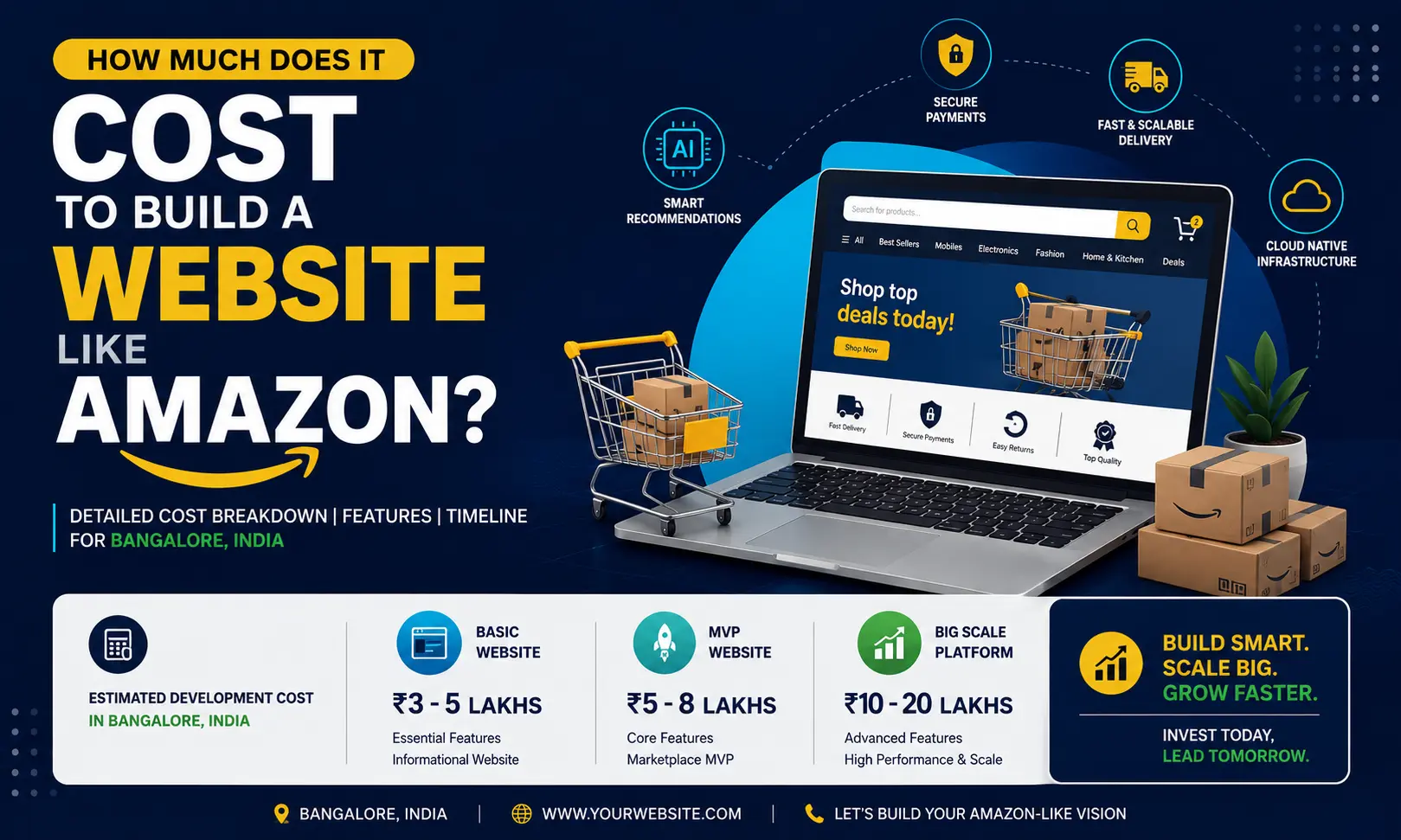
E-commerce Website Development Cost in India in 2026: At a Glance
If you are planning to start an online store in India, one of the first questions you will probably ask is simple: How much does it cost to build an e-commerce website?
There is no single price that applies to every online store. A small catalogue website with basic shopping functionality can be built at a relatively modest budget, while a large e-commerce platform with advanced search, customer accounts, multiple payment options, third-party integrations, delivery management and a custom admin panel can cost several lakhs.
In India, the cost of e-commerce website development in 2026 can broadly start from around ₹30,000–₹60,000 for a basic online store and can go beyond ₹5 lakh for a highly customised platform. The actual figure depends on the business model, number of products, design requirements, technology, integrations and the amount of custom development involved.
For a professionally developed small or mid-sized e-commerce business, a practical working budget is often somewhere between ₹1 lakh and ₹3 lakh, depending on the scope.
The important point is this: the development quote is only one part of the investment. Hosting, payment gateway charges, SMS, email services, maintenance, security, content, SEO and future improvements may also form part of the overall cost of running the store.
Typical E-commerce Website Development Cost in India
Before discussing individual features, it helps to understand the broad pricing bands used in the Indian market.
- Basic e-commerce website: ₹30,000 – ₹60,000
- Professional e-commerce website: ₹60,000 – ₹1,50,000
- Custom e-commerce website: ₹1,50,000 – ₹3,50,000+
- Advanced e-commerce platform: ₹3,50,000 – ₹5,00,000+
- Large-scale or enterprise e-commerce platform: ₹5,00,000 onwards
These figures are indicative rather than fixed market rates. Two companies may quote completely different prices for what appears to be the same website because their development approach, technology stack, design process, testing standards and scope of support may differ.
For example, a ₹50,000 website and a ₹2 lakh website may both have product listings, a cart and online payment. But the difference can appear in areas such as product management, order workflows, customer accounts, search, filtering, promotions, reporting, security, custom UI, integrations and future scalability.
Why E-commerce Website Prices Vary So Much
E-commerce websites are not simply a collection of web pages. They are small business systems that bring products, customers, payments, orders and administration into one place.
A customer may see only a product page and a checkout screen. Behind that simple experience, the website may be handling inventory, order status, discount rules, customer information, payment responses, shipping charges, email notifications and administrator actions.
This is why the number of pages alone should never be used to calculate an e-commerce website price.
A 20-page online store can sometimes require more development work than a 50-page corporate website because every commercial action needs to behave correctly.
What Do You Get for Different E-commerce Website Budgets?
1. Basic E-commerce Website – ₹30,000 to ₹60,000
This category is generally suitable for a small business that wants to establish an online selling presence without introducing complicated workflows.
A basic store may include:
- Responsive website design
- Home page
- About and contact pages
- Product categories
- Product listing pages
- Product detail pages
- Shopping cart
- Basic checkout
- Customer enquiry or contact forms
- Online payment integration
- Basic order management
- Basic administrator panel
This budget can work well when the product catalogue and business rules are straightforward. However, additional integrations or highly customised functionality can quickly move the project into a higher price bracket.
2. Professional E-commerce Website – ₹60,000 to ₹1,50,000
This range is more suitable for businesses that want a polished online store with better product management and a more refined buying experience.
The website may include:
- Modern responsive interface
- Customised homepage sections
- Advanced product categories
- Product variants such as size, colour or weight
- Product search
- Product filters
- Wishlist
- Customer registration and login
- Customer dashboard
- Order history
- Coupon and discount management
- Online payment gateway
- Shipping or delivery settings
- Order management
- Inventory management
- Email notifications
- Basic reporting
This is often a practical range for small and growing Indian businesses that want more than a starter store but do not yet need a large-scale commerce platform.
3. Custom E-commerce Website – ₹1,50,000 to ₹3,50,000+
A custom e-commerce project is generally planned around the company's actual operating process rather than simply installing a ready-made store and changing its appearance.
It may include:
- Custom user interface
- Custom customer journey
- Advanced product management
- Complex product attributes
- Multiple product variations
- Advanced search and filtering
- Custom pricing rules
- Bulk product management
- Advanced coupon and promotion logic
- Custom order workflows
- Shipping integration
- Payment gateway integration
- SMS and email notifications
- Customer account management
- Business reports
- Role-based administrator access
- Third-party API integrations
The advantage of this approach is that the website can be built around the way the business actually sells, fulfils and manages orders.
4. Advanced E-commerce Platform – ₹3,50,000 to ₹5,00,000+
This level is generally considered when the website has more complicated commercial requirements.
Examples may include:
- Large product catalogues
- Multiple customer types
- B2B and B2C purchasing
- Wholesale pricing
- Multiple warehouses
- Advanced inventory rules
- ERP or CRM integration
- Accounting software integration
- Shipping aggregator integration
- Advanced promotional rules
- Multiple administrator roles
- Advanced analytics
- Custom APIs
- Performance optimisation
- Large-scale data migration
At this stage, the project starts looking less like a conventional website and more like a dedicated commerce application.
Major Factors That Affect E-commerce Website Development Cost
When comparing quotations, it is useful to understand what is actually driving the price.
1. Number of Products
A store selling 30 products and a platform handling 30,000 products can have completely different technical requirements.
Large catalogues may require bulk uploads, import tools, advanced search, filtering, database optimisation and more efficient inventory management.
2. Product Variations
A simple product is easy to manage. A product available in five sizes, eight colours and different pack quantities creates a much larger set of combinations.
The website needs to handle these variations properly for pricing, stock, images, cart selection and order processing.
3. Design Requirements
Using a standard theme and making minor changes is different from creating a completely new interface.
Custom design usually involves more planning, UI development, responsive adjustments, testing and revisions. If the business wants a distinctive shopping experience, the design component can form a noticeable part of the development budget.
4. Payment Gateway
Indian e-commerce websites commonly support online payments through gateways that may provide options such as UPI, cards, net banking and wallets.
Payment gateway integration may appear straightforward to customers, but the website needs to correctly handle payment success, failure, cancellation, callbacks and order status.
5. Shipping Integration
If the business is manually calculating delivery charges, the website may need only basic shipping settings.
Businesses with automated delivery requirements may need integration with courier companies or shipping aggregators. This adds development and testing work.
6. Admin Panel
The administrator panel is the control room of an e-commerce website.
Depending on the project, administrators may need to manage:
- Products
- Categories
- Brands
- Product images
- Product variations
- Stock
- Customers
- Orders
- Payments
- Coupons
- Shipping
- Website content
- Reports
A carefully planned admin panel can save considerable time for the business team after launch.
Custom E-commerce Website vs Ready-made Solution
One of the biggest decisions is whether to build a custom website or use an existing e-commerce platform.
Ready-made platforms can be quicker to launch and may have many features available from the beginning. They can be useful for businesses that want to start selling quickly and are comfortable working within the platform's structure.
A custom-developed website takes a different route. The development team builds the functionality around the business requirements, which can be useful when the company has specific workflows or integration requirements.
The right choice depends on the business model, budget, expected growth, internal processes and technical requirements rather than simply choosing the option with the lowest initial price.
What Is Included in a Custom E-commerce Website Development Project?
A professionally planned project may cover several stages beyond coding.
- Requirement discussion
- Functional planning
- Database planning
- User interface design
- Frontend development
- Backend development
- Admin panel development
- Payment integration
- Third-party API integration
- Responsive optimisation
- Testing
- Bug fixing
- Server deployment
- Basic security configuration
- Website launch
However, the exact inclusions should always be mentioned clearly in the project proposal. A quote without a defined scope can create confusion later.
Common Features of a Modern E-commerce Website
A modern online store may contain far more than a product catalogue and shopping cart.
Customer-side Features
- Product search
- Category navigation
- Filters and sorting
- Product variants
- Wishlist
- Shopping cart
- Guest checkout
- Customer registration
- Customer login
- Order tracking
- Order history
- Coupon application
- Product reviews
- Related products
- Recently viewed products
Administrator Features
- Product management
- Category management
- Brand management
- Inventory management
- Order management
- Customer management
- Coupon management
- Shipping management
- Payment management
- Banner management
- Content management
- Reports and statistics
Cost of E-commerce Website Integrations
Third-party integrations are one of the areas where an initial estimate can change considerably.
Depending on the business, an e-commerce website may need connections with:
- Payment gateways
- Courier and shipping services
- SMS providers
- Email services
- Google services
- Accounting software
- ERP systems
- CRM systems
- Inventory software
- Marketing platforms
The cost depends not only on the integration itself but also on the quality of the available API, the number of workflows involved and whether the third-party service requires custom business logic.
Payment Gateway Charges Are Different from Development Cost
This is an important distinction for first-time e-commerce business owners.
The developer may charge a one-time amount for integrating a payment gateway into the website. The payment gateway provider may separately charge transaction-related fees according to its own commercial terms.
Therefore, when preparing your e-commerce budget, keep development charges and payment processing charges as separate items.
How Much Does E-commerce Website Hosting Cost in India?
Hosting requirements depend heavily on website traffic, database size, product volume and application architecture.
A small store may operate comfortably on an entry-level hosting environment. A growing store with higher traffic may require a VPS or cloud server with additional resources.
Depending on the setup, hosting expenses can range from a few thousand rupees per year for a basic setup to considerably higher amounts for managed VPS or cloud infrastructure.
Businesses should also consider SSL, backups, server security, monitoring and CDN requirements when calculating the running cost.
E-commerce Website Maintenance Cost in India
Launching the website is not the end of the project.
An e-commerce website needs ongoing attention because products change, software gets updated, security threats evolve and business requirements keep moving.
Annual maintenance may include:
- Bug fixing
- Security updates
- Server monitoring
- Backup management
- Minor content changes
- Technical support
- Performance checks
- Third-party integration support
Basic annual maintenance can start from approximately ₹10,000–₹30,000 per year for smaller websites, while larger or more actively maintained platforms can require a significantly higher support budget.
The exact AMC cost depends on what is included in the agreement. Always check whether the quoted AMC covers only technical support or also includes development hours, server management, security work and feature changes.
Additional Costs to Consider Before Starting an E-commerce Project
The website development quotation is not necessarily the complete online business budget.
Other expenses may include:
- Domain registration
- Web hosting or VPS
- SSL certificate, if not included with hosting
- Payment gateway charges
- SMS charges
- Email services
- Product photography
- Content writing
- Search engine optimisation
- Digital marketing
- Shipping charges
- Third-party software subscriptions
- Ongoing maintenance
Knowing these costs beforehand makes the financial planning far less foggy.
How Long Does It Take to Develop an E-commerce Website?
The development timeline depends on the scope rather than simply the number of pages.
A basic online store may be completed within a few weeks when the content, product information and requirements are ready.
A professional or custom e-commerce website can take several weeks because it involves design, development, integrations, testing, revisions and deployment.
Large projects involving ERP, CRM, shipping, inventory or legacy-data migration may require several months.
For this reason, it is better to agree on a realistic project schedule after the complete functionality has been documented.
Why a Cheap E-commerce Website Quote Can Become Expensive Later
A very low initial quotation can look attractive, especially when a business is starting out. But price alone does not tell you what you are actually buying.
A low-cost proposal may exclude important items such as custom design, advanced product management, payment integration, security work, responsive optimisation, testing, support or future development.
In some cases, businesses end up paying for additional features one by one after the project has already started.
A better approach is to compare scope against price, not price against price.
Questions to Ask an E-commerce Website Development Company
Before finalising a development partner, ask a few practical questions.
- Is the website custom-developed or based on a ready-made solution?
- What exactly is included in the quoted price?
- Is the admin panel included?
- Is payment gateway integration included?
- Are shipping integrations included?
- How many product categories and products can be added?
- Is the website mobile responsive?
- Is basic technical SEO included?
- Who owns the website source code?
- Who will manage hosting and deployment?
- Is post-launch support included?
- What is included in the annual maintenance package?
- How are additional feature requests charged?
These questions can prevent unpleasant surprises once development begins.
How to Prepare an E-commerce Website Budget
Instead of deciding a budget based on a single number found online, break the project into clear components.
- Website development: Core website, frontend, backend and admin panel
- Design: UI design and responsive layouts
- Integrations: Payment, shipping, SMS, email and other APIs
- Infrastructure: Hosting, SSL, CDN and backups
- Content: Product information, images and website copy
- Marketing: SEO, advertising and social media promotion
- Maintenance: Technical support and future updates
This gives you a much clearer picture of the real cost of running an online store rather than focusing only on the initial development invoice.
What Should You Prioritise If Your Budget Is Limited?
If you are launching your first online store, you do not necessarily need every possible feature on day one.
Start with the functions that directly affect buying and order processing:
- Clear product presentation
- Easy navigation
- Mobile-friendly design
- Reliable shopping cart
- Simple checkout
- Trusted payment options
- Accurate product information
- Basic order management
- Secure website setup
Features such as advanced loyalty programmes, complex recommendation engines or elaborate automation can be introduced later when there is a clear business reason for them.
E-commerce Website Development in Bangalore, India
Bangalore has a large technology and startup ecosystem, and businesses in the city range from small retailers to technology-driven companies selling across India and overseas.
For a Bangalore-based business, working with a local development company can make requirement discussions, meetings and project coordination easier. However, location should not be the only factor when selecting a developer. Portfolio quality, technical capability, communication, project scope and post-launch support also deserve attention.
W3 Dream Solutions provides e-commerce website development services in Bangalore for businesses looking to build online stores with product management, shopping cart, payment integration, order management and other business-specific functionality.
How to Get an Accurate E-commerce Website Development Quote
A developer can give a much more meaningful estimate when the project requirements are clearly documented.
Before requesting quotations, prepare information such as:
- Type of products you sell
- Approximate number of products
- Number of product categories
- Product variations required
- Target customers
- Delivery locations
- Preferred payment methods
- Shipping requirements
- Customer account requirements
- Coupon and discount requirements
- Third-party integrations
- Reference websites
- Expected launch date
If you already have an existing website, sharing its URL can also help the development team understand the current structure and identify what needs to be retained, changed or rebuilt.
Final Thoughts: What Should You Budget for an E-commerce Website in 2026?
There is no universal e-commerce website price in India because every online business has a different set of requirements.
A small store may begin with a budget of ₹30,000–₹60,000, while a professionally developed store can fall in the ₹60,000–₹1,50,000 range. Businesses requiring custom workflows, advanced integrations and specialised functionality may need ₹1,50,000–₹3,50,000 or more.
The smartest way to approach the budget is to first define what the website must accomplish and then select the technology and development approach around those requirements.
Do not judge an e-commerce development proposal by the final number alone. Look at the functionality, technology, ownership, integrations, testing, security, support and future development possibilities included in that number.
A well-planned online store should not merely look good. It should make it easy for customers to find products, place orders and complete payments while giving the business team a practical system to manage everything behind the scenes.
If you are planning an e-commerce website for your business in Bangalore or elsewhere in India, preparing a detailed requirement document before development can save both time and money.
Other Blogs
Subscribe
Get the latest blog updates directly in your inbox.