



How Much Does It Cost to Build a Website Like Amazon?
If you are thinking about launching an online marketplace, one question usually comes before everything else: How much does it cost to build a website like Amazon?
The answer is not a single number.
A website that simply displays products and accepts online payments is one thing. A marketplace where hundreds or thousands of sellers can register, upload products, manage orders, receive payments, handle returns and track their business is a completely different piece of software.
Amazon is not just an eCommerce website. It is a large technology ecosystem involving customers, sellers, product data, payments, order processing, logistics, recommendations, search, reviews, advertising and several back-office operations.
That does not mean you need to spend hundreds of crores to build your own Amazon-style platform.
A new business can start with a sensible version of the idea and increase the system's capabilities as customers and sellers arrive.
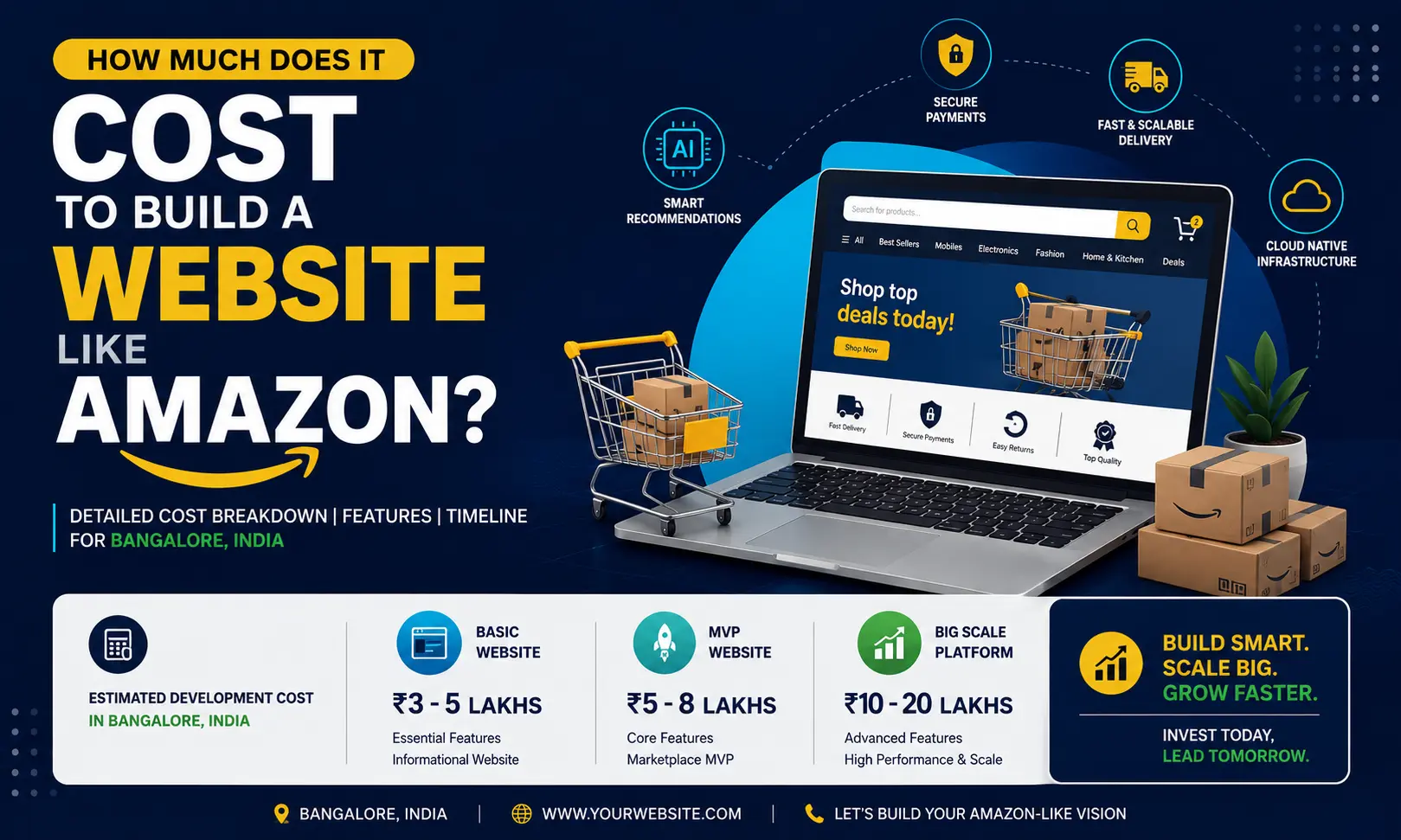
For businesses planning development in Bangalore, India, a practical starting budget can be approximately:
- Basic Amazon-style marketplace: ₹3 lakh – ₹5 lakh
- MVP marketplace: ₹5 lakh – ₹8 lakh
- Large-scale marketplace: ₹10 lakh – ₹20 lakh+
These are development estimates for Bangalore and can vary considerably depending on the technology, features, number of users, integrations, design requirements and development team. Pricing in countries such as the USA, UK, Australia or other regions can be considerably different.
The important point is this: you are not really paying for "a website". You are paying for the business engine running behind the website.
What Does "A Website Like Amazon" Actually Mean?
When someone says, "I want a website like Amazon", they could mean very different things.
For one business owner, it may mean a normal online store with thousands of products.
For another, it may mean a multi-vendor marketplace where independent sellers can create accounts and sell their own products.
For a third business, it could mean a marketplace with seller subscriptions, commissions, product approval, automated settlements, delivery integration, coupons, reviews, returns, refunds and mobile applications.
This difference can move the project cost from a few lakhs to several tens of lakhs.
Amazon itself operates at a gigantic scale. Its marketplace model involves multiple sellers and complex systems for managing product offers, seller performance and customer purchasing decisions.
Therefore, copying the visual appearance of Amazon is relatively easy.
Building the machinery underneath it is where the serious development work begins.
Amazon-Style Website vs Amazon Clone
There is an important distinction between these two ideas.
Amazon-style website
An Amazon-style website takes the major concepts customers already understand from large marketplaces and adapts them to your own business.
- Customer registration
- Seller registration
- Product catalogue
- Categories and subcategories
- Product search
- Shopping cart
- Online payment
- Order management
- Seller dashboard
- Admin dashboard
- Reviews and ratings
- Coupons
- Delivery management
- Returns and refunds
This is realistic for a startup or established business.
Exact Amazon clone
An exact Amazon clone is a completely different proposition.
Amazon has spent decades building technology, logistics networks, seller systems, recommendation engines, advertising products, data infrastructure and operational processes.
Trying to reproduce every Amazon feature from day one would be expensive, time-consuming and unnecessary for most businesses.
A better strategy is to identify the features your marketplace actually needs and build them in stages.
Website Like Amazon Development Cost in Bangalore
For a Bangalore-based development project, the following is a practical planning range.
1. Basic Amazon-Style Marketplace: ₹3 Lakh – ₹5 Lakh
This option is suitable for a business that wants to launch a marketplace without loading the first version with every advanced feature.
A basic version may include:
- Responsive website
- Customer registration and login
- Seller registration
- Seller profile
- Product categories
- Product listing
- Product detail pages
- Product search
- Shopping cart
- Checkout
- Payment gateway
- Order management
- Seller dashboard
- Customer dashboard
- Basic admin panel
- Coupon management
- Basic reports
- Mobile-friendly interface
- Basic SEO structure
This approach can be a sensible choice when the primary objective is to get the marketplace live and start testing the business model.
2. MVP Amazon-Style Marketplace: ₹5 Lakh – ₹8 Lakh
An MVP is more than a basic online store.
It is designed to test whether your marketplace can actually work with real customers and sellers.
An MVP in this price range may include:
- Customer accounts
- Seller accounts
- Seller onboarding
- Seller approval
- Product submission
- Product approval
- Product variants
- Inventory management
- Advanced product search
- Filters
- Shopping cart
- Wishlist
- Payment gateway
- Order processing
- Seller order management
- Commission management
- Seller earnings
- Admin reports
- Coupons and offers
- Product reviews
- Ratings
- Shipping integration
- Return request management
- Refund workflow
- Email notifications
- SMS or WhatsApp integration
- Basic analytics
- Security controls
This is generally a much better starting point for a serious marketplace business.
Instead of spending heavily on features nobody uses, you can launch the core marketplace, watch how customers behave and then decide what deserves the next round of investment.
3. Large-Scale Amazon-Style Marketplace: ₹10 Lakh – ₹20 Lakh+
A large marketplace requires considerably more planning.
The platform may need:
- Advanced seller management
- Multiple seller plans
- Complex commission rules
- Seller settlement system
- Advanced inventory
- Multi-location inventory
- Product variants
- Bulk product upload
- Advanced search
- Product recommendation
- Advanced filters
- Promotional campaigns
- Seller analytics
- Customer analytics
- Advanced order management
- Return and refund workflows
- Shipping API integrations
- Multiple payment methods
- Wallet or credit systems
- Invoice generation
- Tax-related workflows
- Role-based admin access
- Advanced reporting
- API architecture
- Third-party integrations
- Performance optimisation
- Stronger security controls
- Backup and monitoring systems
Depending on the exact specification, the project can move beyond ₹20 lakh.
For very large platforms, development cost should not be considered a fixed website budget. It becomes a technology investment involving infrastructure, engineering, testing, security, support and future feature development.
Amazon-Style Marketplace Cost Breakdown
The overall development budget can be divided into several major areas.
Website Design and User Experience
The front-end is the part customers see.
It includes:
- Homepage
- Category pages
- Product listing pages
- Product detail pages
- Search interface
- Cart
- Checkout
- Customer account
- Order tracking
- Seller pages
A marketplace with thousands of products needs a clean navigation structure. Customers should be able to find a product without feeling like they are walking through a crowded warehouse.
The design cost increases when you require a completely original interface, custom interactions, advanced filtering or highly polished mobile experiences.
Customer Module
The customer side may include:
- Registration
- Login
- OTP verification
- Profile
- Multiple addresses
- Wishlist
- Cart
- Orders
- Reorders
- Reviews
- Ratings
- Coupons
- Notifications
- Return requests
- Refund status
These features may look small individually, but together they create a sizeable application.
Seller Module
For a multi-vendor marketplace, the seller panel is one of the biggest development areas.
A seller may need to:
- Register
- Submit business information
- Upload products
- Edit products
- Add product images
- Manage stock
- View orders
- Process orders
- Update shipping status
- View earnings
- View commissions
- Download reports
- Handle returns
- Manage customer reviews
The more control sellers receive, the more complex the backend becomes.
Admin Panel
The administrator needs control over the entire marketplace.
Typical functions include:
- Dashboard
- Customer management
- Seller management
- Seller approval
- Category management
- Brand management
- Product approval
- Product management
- Order management
- Payment management
- Commission management
- Coupon management
- Review moderation
- Return management
- Refund management
- Reports
- Website content
- Notifications
- Settings
A good admin panel can save enormous amounts of operational time once the marketplace starts growing.
Payment Gateway Integration
An Amazon-style marketplace needs reliable payment processing.
Depending on the business model, you may need:
- Credit and debit cards
- UPI
- Net banking
- Wallets
- Cash on delivery
- Payment status tracking
- Refund processing
- Failed payment handling
- Payment reconciliation
For a marketplace, payment handling can become more complicated because money may need to be tracked against customers, sellers, commissions, refunds and settlements.
The payment gateway itself is usually a third-party service, so its transaction charges and commercial terms are separate from the website development cost.
Seller Commission and Settlement System
This is one of the features that separates a marketplace from a normal eCommerce website.
Suppose Seller A sells a product for ₹2,000.
The marketplace might charge a 10% commission.
The system then needs to understand:
- Product selling price
- Marketplace commission
- Applicable taxes or deductions
- Shipping charges
- Refunds
- Adjustments
- Seller payable amount
- Settlement status
Once hundreds of sellers and thousands of orders enter the system, manual calculation becomes impractical.
That is why commission and settlement logic should be planned carefully during development.
Product Search and Filters
Search becomes increasingly important as the catalogue grows.
A small store with 100 products can survive with simple database search.
A marketplace with tens of thousands of products may require more advanced search infrastructure.
Useful functions include:
- Keyword search
- Category filtering
- Brand filtering
- Price range
- Ratings
- Availability
- Location
- Product attributes
- Sorting
- Popular products
- New arrivals
The cost depends on how sophisticated the search needs to be.
Product Recommendation System
"Customers who bought this also bought..." is a familiar marketplace concept.
A basic recommendation module can be developed using purchase history and product relationships.
More advanced recommendation systems can consider:
- Browsing behaviour
- Search behaviour
- Purchase history
- Product similarity
- Customer preferences
- Seller information
- Popularity
- Location
- Seasonal behaviour
This is an area where costs can rise quickly because recommendation systems become more data-driven as the marketplace grows.
You do not necessarily need advanced artificial intelligence on day one.
Start with useful rules and improve the recommendation engine after sufficient customer data becomes available.
Shipping and Delivery Integration
Shipping is another major cost variable.
A marketplace may connect with courier and logistics providers through APIs.
The system may need to handle:
- Shipping charges
- Delivery locations
- Pincode serviceability
- Tracking number
- Shipment creation
- Pickup status
- Delivery status
- Failed delivery
- Return pickup
- Shipping cancellation
If you operate your own delivery network, the software requirement becomes considerably larger.
For a new marketplace, integrating established logistics providers is usually far more practical than building a delivery network from scratch.
Mobile Application Cost
If your plan includes Android and iOS applications, that should be treated as a separate budget item unless the development proposal specifically includes mobile apps.
You may eventually need:
- Customer Android app
- Customer iOS app
- Seller app
- Delivery executive app
You do not necessarily need all four applications at launch.
A common approach is to launch the responsive web platform first and introduce mobile applications after the marketplace gains traction.
Hosting and Server Cost
Development is only one part of the budget.
A marketplace also requires infrastructure.
Depending on the expected traffic, you may require:
- Cloud server
- Database server
- Object storage
- CDN
- SSL
- Backup
- Monitoring
- Email service
- SMS service
- Search infrastructure
- Image optimisation
- Security tools
Cloud services can be scaled as traffic increases. Your hosting expense may be modest initially but can rise as traffic, images, orders, database activity and integrations increase.
What Is Not Normally Included in the Development Cost?
When comparing quotations, check whether the following are included.
Some companies quote only the coding cost and leave other expenses outside the project.
Potential additional expenses include:
- Domain
- Hosting
- Premium APIs
- Payment gateway charges
- SMS charges
- WhatsApp charges
- Email service
- Shipping API charges
- Cloud storage
- CDN
- SSL
- Third-party software licences
- Mobile app development
- Annual maintenance
- Content creation
- Product data entry
- SEO
- Digital marketing
- GST
This is why two agencies can provide dramatically different quotations for what appears to be the same "Amazon-like website".
Why Can Two Amazon-Style Website Quotes Be So Different?
Imagine two companies quote:
- Company A: ₹4 lakh
- Company B: ₹12 lakh
It does not automatically mean one company is overcharging.
The difference could come from:
- Number of modules
- Custom UI design
- Technology stack
- Development team size
- Testing process
- Server architecture
- API integrations
- Seller functionality
- Commission logic
- Search technology
- Security requirements
- Project management
- Documentation
- Post-launch support
The correct question is not:
"Who is cheaper?"
The better question is:
"What exactly am I getting for the quoted amount?"
Custom Development vs Ready-Made Marketplace Software
Ready-Made Marketplace Software
A ready-made product can reduce the initial development cost.
It may already provide:
- Seller panel
- Customer panel
- Product management
- Orders
- Payments
- Commissions
- Admin panel
This can be useful if your requirements closely match the software.
The downside is that unusual business rules may require modifications. Some products may also have licensing restrictions or recurring charges.
Custom Development
Custom development starts with your business requirements.
You can decide:
- How sellers register
- How commissions work
- How orders are processed
- How products are approved
- How settlements happen
- How shipping is calculated
- What the customer sees
- What administrators can control
The initial cost may be higher, but it can make sense when your marketplace has a specific business model.
Technology Stack for an Amazon-Style Website
The technology stack should be selected according to the project rather than because a particular programming language is fashionable.
A marketplace may use combinations of:
- PHP / Laravel
- Node.js
- React
- Vue
- Flutter
- MySQL
- PostgreSQL
- Redis
- Elasticsearch or similar search technology
- REST APIs
- Cloud infrastructure
For a growing business, the architecture should leave room for future modules without turning every small change into a major rewrite.
How Long Does It Take to Build a Website Like Amazon?
Development time depends heavily on the scope.
Basic Version
3–4 months
Suitable for a smaller marketplace with core features.
MVP Version
4–6 months
Suitable when seller management, commissions, shipping and other marketplace functions are included.
Large-Scale Version
6–12 months or more
Suitable for a larger platform with advanced integrations, complex workflows, extensive testing and higher performance requirements.
These are planning estimates, not fixed delivery commitments.
A project with a clearly defined scope can move faster than a project where features continue changing during development.
Can You Build an Amazon-Like Website for ₹3 Lakh?
Yes, but expectations must be realistic.
At ₹3 lakh, you should not expect an exact replica of Amazon with every enterprise feature.
A sensible ₹3–₹5 lakh project would focus on the marketplace foundation.
- Customer module
- Seller module
- Product catalogue
- Cart
- Checkout
- Payment gateway
- Orders
- Basic commission
- Admin panel
- Basic shipping
- Responsive website
That can be enough to launch the first version.
The goal should be to build a working marketplace, not an oversized software project that consumes your budget before you have your first customer.
How to Reduce the Initial Development Cost
One of the smartest ways to control cost is to divide development into phases.
Phase 1: Marketplace Foundation
- Customer registration
- Seller registration
- Product catalogue
- Cart
- Checkout
- Payments
- Orders
- Seller dashboard
- Admin panel
Phase 2: Business Operations
- Commission
- Seller settlements
- Shipping integrations
- Returns
- Refunds
- Coupons
- Seller reports
Phase 3: Growth Features
- Advanced search
- Recommendations
- Seller analytics
- Customer analytics
- Promotional tools
- Mobile apps
- Loyalty programmes
- Advanced notifications
Phase 4: Scale
- Advanced cloud architecture
- Caching
- Search infrastructure
- Load optimisation
- Advanced analytics
- Personalisation
- Automation
- Larger API ecosystem
This approach gives you a much clearer relationship between money spent and business progress.
The Hidden Cost of Building a Marketplace
The development quotation is only the beginning.
Once the marketplace is live, you may spend money on:
- Server infrastructure
- Technical maintenance
- Security updates
- Bug fixing
- New features
- Payment gateway charges
- SMS
- Shipping
- Cloud storage
- Customer support
- Seller support
- SEO
- Advertising
- Content
- Product onboarding
There is another cost that is often ignored: operations.
A marketplace needs sellers.
Sellers need products.
Products need accurate information.
Customers need support.
Orders need fulfilment.
Returns need handling.
Payments need reconciliation.
So the marketplace is both a technology project and an operational business.
Should You Build an Amazon-Like Website from Day One?
For most startups, probably not.
Instead, build the smallest version that can genuinely conduct business.
If your business idea is a marketplace for a specific category, start there.
- Electronics marketplace
- Fashion marketplace
- Furniture marketplace
- Industrial products marketplace
- Local products marketplace
- B2B marketplace
- Automotive parts marketplace
- Handmade products marketplace
A focused marketplace can be easier to launch than a platform trying to sell everything to everyone.
Once the business gains sellers and customers, the technology can grow with it.
What Budget Should You Keep for an Amazon-Style Website in Bangalore?
For planning purposes, these are useful Bangalore development brackets:
₹3 Lakh – ₹5 Lakh
Basic marketplace
Good for launching the core concept with essential customer, seller and admin functions.
₹5 Lakh – ₹8 Lakh
MVP marketplace
A stronger choice for businesses that want seller management, commissions, shipping, returns and other operational features.
₹10 Lakh – ₹20 Lakh+
Large-scale marketplace
Suitable for more demanding platforms with advanced workflows, integrations, reporting, performance requirements and room for higher traffic.
These figures are intended as Bangalore, India development estimates. The final cost can move up or down depending on the project scope. Development rates in the USA, UK, Europe, Australia, Middle East and other markets can be very different.
Final Thoughts
Building a website like Amazon does not mean copying every screen of Amazon.
It means deciding which parts of the marketplace model your business actually needs.
If you are starting from scratch, a ₹3–₹5 lakh basic marketplace can establish the foundation.
If you need a more capable business-ready platform, an MVP budget of ₹5–₹8 lakh is a more sensible target.
If your requirements involve advanced seller operations, integrations, reporting, automation and higher traffic expectations, a ₹10–₹20 lakh+ budget may be more appropriate.
The best marketplace is not necessarily the one with the most features.
It is the one where customers can find products easily, sellers can manage their business without frustration, administrators can control the operation, and the software can grow without becoming a technical headache.
If you are planning an Amazon-style marketplace in Bangalore, explore our eCommerce website development services to discuss your requirements, technology choices, estimated budget and development roadmap.
The first step is not writing code.
The first step is deciding what your marketplace must do on day one — and what can wait for day 100.
```
Other Blogs
Subscribe
Get the latest blog updates directly in your inbox.