




Launching an eCommerce business often starts with an apparently simple question: “Should I build a website to sell my own products, or should I create a platform where other sellers can also sell?”
That one decision changes almost everything behind the website.
The product catalogue changes. The admin panel changes. Payment handling changes. Order processing becomes different. Customer support becomes more layered. Vendor management enters the picture. Even the way you earn money can be completely different.
A single-vendor eCommerce website is essentially your digital shop.
A multi-vendor eCommerce website is closer to a digital marketplace where you operate the platform and multiple independent sellers operate their own businesses inside it.
The two may look similar from a customer's screen, but behind the scenes, they are very different systems.
So before choosing a technology, developer or budget, it is worth understanding which business model you are actually trying to build.
What Is a Single-Vendor eCommerce Website?
A single-vendor eCommerce website has one primary seller.
That seller may be:
- A manufacturer
- A retailer
- A D2C brand
- A wholesaler
- A local business
- A startup
- A specialised product company
The products displayed on the website belong to one business. That business decides the pricing, maintains the inventory, manages orders and receives the customer payments.
Think of a clothing brand selling its own collection through its own website.
The customer visits the website → selects a product → makes payment → the business processes the order → the product is dispatched.
There is no third-party seller sitting between the website and the business.
That makes the operational structure comparatively straightforward.
Typical Single-Vendor Flow
Admin → Products → Customers → Orders → Payment → Delivery
The website owner controls the complete shopping experience.
This structure is commonly suitable for startups, manufacturers, retailers and established brands that want direct control over their products, pricing and customer relationship.
What Is a Multi-Vendor eCommerce Website?
A multi-vendor eCommerce website is not simply a bigger version of a normal online store.
It is a marketplace.
Instead of selling only your own products, you allow different sellers or vendors to register and sell their products through your platform.
For example, imagine creating a marketplace for:
- Handloom products
- Electronics
- Furniture
- Grocery
- Fashion
- Home decor
- Automobile accessories
- Local manufacturers
- B2B suppliers
- Regional speciality products
Each seller can have a separate account and, depending on the platform design, their own storefront, products, inventory and order information.
The marketplace owner controls the platform.
The vendors control their respective stores.
Typical Multi-Vendor Flow
Admin → Vendors → Products → Customers → Orders → Commission → Vendor Settlement
This introduces a completely new layer of business logic.
A marketplace may need seller registration, vendor verification, product approval, commission calculations, seller payouts, order routing, returns, disputes and vendor reports.
That is why a multi-vendor website should not be treated as “a normal eCommerce website with multiple logins”.
It is a different animal.
Single-Vendor vs Multi-Vendor: The Fundamental Difference
The easiest way to understand the difference is this:
A single-vendor website helps one business sell online.
A multi-vendor website helps you operate a platform where several businesses sell online.
That distinction sounds small.
Technically, it is enormous.
| Area | Single-Vendor | Multi-Vendor |
|---|---|---|
| Sellers | One business | Multiple independent sellers |
| Product ownership | Website owner | Individual vendors |
| Vendor dashboard | Not required | Required |
| Product approval | Usually not required | Usually required |
| Inventory | Centralised | Vendor-wise |
| Commission | Usually not required | Core marketplace function |
| Seller payout | Not required | Required |
| Vendor registration | Not required | Required |
| Seller verification | Usually not required | Often required |
| Order management | Simpler | More complex |
| Revenue model | Product margin | Commission, subscription, listing fees and other models |
| Platform complexity | Lower | Higher |
| Initial development cost | Usually lower | Usually higher |
How Does a Single-Vendor eCommerce Website Work?
In a single-vendor model, the business owns the entire catalogue.
Suppose a furniture company has 500 products.
The company uploads:
- Product name
- Images
- Description
- Price
- Stock
- SKU
- Specifications
- Delivery information
A customer places an order.
The admin receives the order, confirms it, packs the product and dispatches it.
There is no commission calculation between sellers because the website owner is the seller.
This produces a fairly clean operational chain.
Main modules normally include:
Customer Side
- Product listing
- Product search
- Filters
- Product details
- Cart
- Wishlist
- Checkout
- Online payment
- Order tracking
- Account section
- Reviews
Admin Side
- Dashboard
- Category management
- Product management
- Inventory
- Orders
- Customers
- Coupons
- Payments
- Reports
- Content management
For many traditional businesses, this is enough.
There is no reason to build vendor management machinery when there are no external vendors.
How Does a Multi-Vendor eCommerce Website Work?
Now take the same example and imagine allowing 500 furniture manufacturers to sell through the platform.
The architecture immediately becomes more involved.
A seller should be able to create an account.
The admin may need to approve that seller.
The seller needs a dashboard.
The seller uploads products.
The admin may approve those products.
A customer purchases products from Vendor A and Vendor B in one checkout.
The system needs to identify which items belong to which seller.
The marketplace calculates the applicable commission.
The seller's earnings are recorded.
The marketplace retains its commission.
The order is routed appropriately.
Then comes settlement.
And then returns, cancellations, refunds or disputes.
This is where the real complexity begins.
A multi-vendor marketplace may therefore require seller registration, seller dashboards, inventory separation, commission rules, payouts, order allocation, reviews, moderation and vendor analytics.
The Vendor Dashboard Is the Big Difference
One of the biggest differences people underestimate is the seller panel.
In a single-vendor website, the admin manages the products.
In a multi-vendor marketplace, each seller needs controlled access to their own business area.
A vendor dashboard may contain:
Product Management
- Add product
- Edit product
- Upload images
- Set price
- Set stock
- Manage variants
- Manage SKU
- Submit products for approval
Order Management
- New orders
- Processing orders
- Packed orders
- Shipped orders
- Delivered orders
- Cancelled orders
- Returned orders
Earnings
- Total sales
- Commission deducted
- Net earnings
- Pending settlement
- Completed payouts
Store Management
- Business details
- Logo
- Store profile
- Address
- Contact details
- Shipping settings
Reports
- Sales reports
- Product performance
- Order reports
- Revenue reports
The admin, meanwhile, needs visibility across the entire marketplace.
That creates two very different dashboards:
Vendor Dashboard and Marketplace Admin Dashboard.
Commission Management: The Marketplace's Financial Engine
This is another area where multi-vendor development becomes substantially different.
Imagine:
A customer purchases a product for ₹5,000.
Your marketplace charges the vendor a 10% commission.
Vendor's gross sale = ₹5,000
Marketplace commission = ₹500
Vendor share = ₹4,500
Now imagine hundreds or thousands of orders every month.
The system must correctly track:
- Product price
- Discount
- Coupon
- Tax
- Shipping charge
- Marketplace commission
- Payment gateway charges, where applicable
- Refunds
- Returns
- Seller earnings
- Final payout
Commission rules may also differ.
Category commission: 10% for electronics, 8% for furniture
or
Vendor commission: Vendor A = 10%, Vendor B = 7%
or
Product-specific commission: Different products carry different percentages.
This is why commission calculation is not merely an “admin setting”. It becomes an important part of the marketplace's financial logic.
Vendor Payouts Make the System More Complicated
A single-vendor website generally has one business receiving customer payments.
A marketplace has multiple businesses expecting their share.
Therefore, the system may have to maintain vendor balances and settlements.
For example:
| Transaction | Amount |
|---|---|
| Customer Payment | ₹10,000 |
| Marketplace Commission | ₹1,000 |
| Vendor Earnings | ₹9,000 |
But real-world transactions are rarely this clean.
Suppose the customer cancels one product, receives a partial refund and the vendor has already been paid.
Now your system must know:
What amount belongs to whom?
This is where payment architecture, settlement rules and gateway capabilities become important.
For an Indian marketplace, the payment and settlement structure should also be planned with the business's tax, accounting and legal setup in mind.
Product Approval Becomes Important in a Marketplace
On your own single-vendor website, you normally trust your own catalogue.
In a marketplace, hundreds of vendors may upload thousands of products.
Without controls, you may see:
- Duplicate products
- Incorrect descriptions
- Poor-quality images
- Improper pricing
- Wrong categories
- Restricted products
- Misleading information
Therefore, a marketplace may introduce a workflow such as:
Vendor Upload → Admin Review → Approval → Product Goes Live
Some platforms may allow auto-approval for trusted vendors while sending new sellers through manual moderation.
This gives marketplace owners greater control over the catalogue.
Inventory Management: One Store vs Many Stores
Single-vendor inventory is comparatively clean.
For example:
Red T-Shirt — Stock: 25
There is one seller.
In a multi-vendor marketplace, you could have:
- Vendor A → Red T-Shirt → 25 units
- Vendor B → Red T-Shirt → 12 units
- Vendor C → Red T-Shirt → 50 units
The product name may look similar, but inventory belongs to separate businesses.
The system therefore needs vendor-wise stock management.
When ERP, warehouse or external inventory systems are involved, the technical scope can increase further.
Order Management Is More Complicated Than It Looks
Consider a customer buying:
- A sofa from Vendor A
- A lamp from Vendor B
- A wall clock from Vendor C
The customer may feel that they placed one order.
Behind the scenes, your marketplace may need to create separate seller-level order records.
For example:
Master Order #5001
- Vendor A Order #5001-A
- Vendor B Order #5001-B
- Vendor C Order #5001-C
Now each seller can have a different:
- Shipping status
- Dispatch date
- Courier
- Delivery date
- Return status
The customer should still receive a coherent experience.
This is one of those areas where a website can look simple on the front end while hiding considerably more engineering underneath.
Returns and Refunds Need Extra Thought
Returns in a single-vendor store are generally handled by one business policy.
A marketplace could have several sellers with different return conditions.
One vendor might offer:
7-day return
Another:
No return on customised products
Another:
Replacement only
Your platform therefore needs rules around:
- Seller-specific return policies
- Product-level return eligibility
- Return requests
- Approval or rejection
- Pickup
- Refunds
- Replacement
- Marketplace commission reversal
This is not simply a page in the admin panel.
It affects order, payment and seller accounting logic.
Revenue Model: Where Does Your Money Come From?
This is perhaps the most important business difference.
Single-Vendor Model
Your primary income comes from:
Selling products.
If a product costs you ₹700 and you sell it for ₹1,200, your gross product margin is generated directly by the sale.
Multi-Vendor Model
You may earn through:
- Commission
- Vendor subscription
- Listing fee
- Featured product fee
- Advertising
- Promoted listings
- Seller service charges
- Logistics or fulfilment fees
A marketplace therefore creates more than one possible revenue stream.
But there is a catch.
You first need enough sellers and customers for those revenue streams to matter.
The Marketplace Has a Classic Chicken-and-Egg Problem
This is an important point that is sometimes ignored in development discussions.
A new marketplace needs vendors.
But vendors want customers.
Customers want useful products and sellers.
Sellers want sales.
So:
No vendors → limited catalogue → fewer customers
No customers → fewer sales → vendors lose interest
That means marketplace development is not only a software project.
It is also a vendor-acquisition and customer-acquisition business.
Your website can be technically strong and still struggle if there is no plan for bringing sellers and buyers onto the platform.
Single-Vendor vs Multi-Vendor: Which Is Easier to Launch?
From a development perspective, the single-vendor route generally has fewer moving parts.
The administrator controls:
- Products
- Pricing
- Inventory
- Orders
- Payments
- Customers
With a marketplace, you introduce another business entity into almost every one of those processes.
That means:
More users → more permissions → more rules → more exceptions → more testing.
This is why multi-vendor platforms generally require more development effort than ordinary single-vendor stores.
eCommerce Website Development Cost in India
There is no honest single price for either model.
A website with 20 products and basic checkout is not the same project as a marketplace with 1,000 vendors, seller subscriptions, split settlement, mobile apps, ERP integration and advanced logistics.
Still, a broad planning range can help.
Approximate Single-Vendor Development Cost
For a professionally developed Indian eCommerce website, the budget may broadly fall into the following territory:
- Basic store: ₹40,000 – ₹1,00,000+
- Custom professional store: ₹1,00,000 – ₹3,50,000+
- Advanced/custom eCommerce system: ₹3,00,000 – ₹8,00,000+
These are indicative planning figures rather than fixed market rates. The actual cost depends on design, custom functionality, integrations, number of products, payment requirements, shipping workflows, backend features and other project-specific factors.
Approximate Multi-Vendor Development Cost
A marketplace may broadly start around:
- Basic multi-vendor solution: ₹2,50,000 – ₹5,00,000+
- Custom multi-vendor marketplace: ₹5,00,000 – ₹15,00,000+
- Advanced marketplace: ₹15,00,000 – ₹25,00,000+
- Large enterprise marketplace: ₹25,00,000+
Again, the spread is huge because “multi-vendor website” can describe anything from a modest niche marketplace to a highly engineered platform with sophisticated payment, logistics, analytics and mobile infrastructure.
Why Does Multi-Vendor Cost More?
It is not simply because there are “more pages”.
The additional investment can come from:
- Vendor registration
- Vendor verification
- Vendor dashboards
- Vendor permissions
- Product approval
- Commission engine
- Vendor-wise inventory
- Vendor-wise order management
- Settlement logic
- Return handling
- Dispute management
- Seller reviews
- Marketplace reporting
- Additional security
- Additional testing
- Payment architecture
- Shipping allocation
Every new business rule creates additional development and testing work.
That is the part many first-time marketplace founders discover only after the project has started.
Development Cost Is Not the Whole Budget
Suppose someone quotes ₹4 lakh for your marketplace.
That does not automatically mean ₹4 lakh is your complete business investment.
You may also need:
- Domain
- Hosting/server
- SSL and security services
- Payment gateway charges
- SMS or WhatsApp communication costs
- Email services
- Courier integrations
- GST or accounting integrations
- Mobile applications
- Marketing
- Vendor acquisition
- Customer support
- Maintenance
- Content and product moderation
A marketplace, in particular, can carry significant operating costs because you are effectively running an ecosystem rather than just an online catalogue.
Single-Vendor eCommerce: When Does It Make Sense?
A single-vendor website can make sense when:
- You manufacture your own products.
- You own a retail business.
- You have a specific product range.
- You are building a D2C brand.
- You are testing an eCommerce idea before expanding.
- You do not need third-party sellers.
- You want full control over pricing and customer experience.
- You want to start with a smaller operational team.
For such businesses, adding a vendor system may create unnecessary complexity.
Multi-Vendor eCommerce: When Does It Make Sense?
A multi-vendor model becomes relevant when your actual business proposition depends on bringing multiple sellers together.
For example:
- You want to build a niche marketplace.
- You want local sellers to sell through one platform.
- You want manufacturers and retailers on the same website.
- You plan to earn a commission from sellers.
- You want several businesses to maintain their own catalogues.
- You are creating a B2B supplier marketplace.
- You are developing a regional marketplace connecting independent businesses with customers.
In these cases, the marketplace itself is the business.
What About Starting Single-Vendor and Adding Vendors Later?
This is a question many founders ask.
Technically, it is possible.
But there is an important difference between:
Designing a single-vendor website with future marketplace expansion in mind
and
Building a single-vendor website today and trying to convert everything later.
The second option can become expensive.
Imagine your original database assumes one seller.
Later you introduce:
- Vendor IDs
- Vendor permissions
- Vendor inventory
- Vendor commissions
- Vendor order splitting
- Vendor payouts
Now several parts of the original application may need restructuring.
Therefore, even when you are launching with only your own products, discuss your long-term plan with the development team.
A sensible architecture can leave room for future marketplace expansion without forcing you to pay for every marketplace feature on day one.
Single-Vendor vs Multi-Vendor: Don't Choose Based Only on Budget
Budget certainly matters.
But it should not be the only deciding factor.
Ask yourself:
Who is the seller?
If the answer is only your company, you may need a single-vendor system.
If the answer is “multiple independent businesses”, you are looking at a marketplace.
Then:
How will the platform earn money?
Selling your own products?
Or taking commission from other sellers?
Then:
Who manages inventory?
Your team?
Or each vendor?
Then:
Who fulfils the order?
Your warehouse?
Or different sellers?
These questions expose the correct model surprisingly quickly.
A Simple Decision Framework
You can think of the two models this way:
Choose a Single-Vendor Model
When you are building a store.
Choose a Multi-Vendor Model
When you are building a marketplace.
Build in Phases
Start with your own products.
Prove customer demand.
Build the seller infrastructure later.
This can be useful when the marketplace concept is clear but the business does not yet have enough vendors or capital to operate a large ecosystem.
The important thing is to make that decision before the software architecture becomes expensive to change.
Features Checklist: Single-Vendor eCommerce Website
A typical single-vendor website may require:
- Customer registration and login
- Product catalogue
- Categories
- Product search
- Filters
- Shopping cart
- Wishlist
- Checkout
- Online payments
- Coupons
- GST invoices
- Shipping integration
- Order tracking
- Product reviews
- Customer management
- Inventory management
- Reports
- Admin dashboard
- SEO-friendly product and category pages
Additional requirements can include subscriptions, memberships, product variants, ERP integration, WhatsApp notifications and mobile applications.
Features Checklist: Multi-Vendor eCommerce Website
A marketplace may additionally require:
- Vendor registration
- Vendor login
- Vendor dashboard
- Vendor KYC and verification
- Vendor profile and storefront
- Product submission
- Product approval
- Vendor-wise inventory
- Vendor-wise orders
- Commission management
- Seller settlements
- Payout tracking
- Vendor reports
- Seller ratings
- Return management
- Dispute handling
- Vendor notifications
- Admin moderation
- Marketplace analytics
- Vendor subscription plans
These additional layers are a major reason multi-vendor projects need more development effort.
Indian eCommerce Considerations
An Indian eCommerce website often needs to account for local customer behaviour and business requirements.
Examples include:
- UPI payments
- Razorpay and other payment gateway integrations
- Cash on Delivery
- GST invoice requirements
- Indian courier integrations
- WhatsApp and SMS notifications
- Pincode-based shipping
- Multiple Indian languages, where required
- Vendor GST details, where applicable
- Tax and marketplace accounting requirements
Indian customers also expect familiar payment and communication options.
For a marketplace, these expectations exist on both sides — the buyer and the seller.
The exact payment and tax structure should be finalised based on the legal and accounting structure of the business rather than copied from another marketplace.
Common Mistakes Businesses Make
Mistake 1: Calling Every eCommerce Website a Marketplace
A normal online store is not automatically a marketplace.
If only one company sells products, calling it a multi-vendor system adds confusion.
Mistake 2: Focusing Only on the Customer Website
A beautiful marketplace front end means very little if sellers have a frustrating dashboard.
Vendor experience is part of the product.
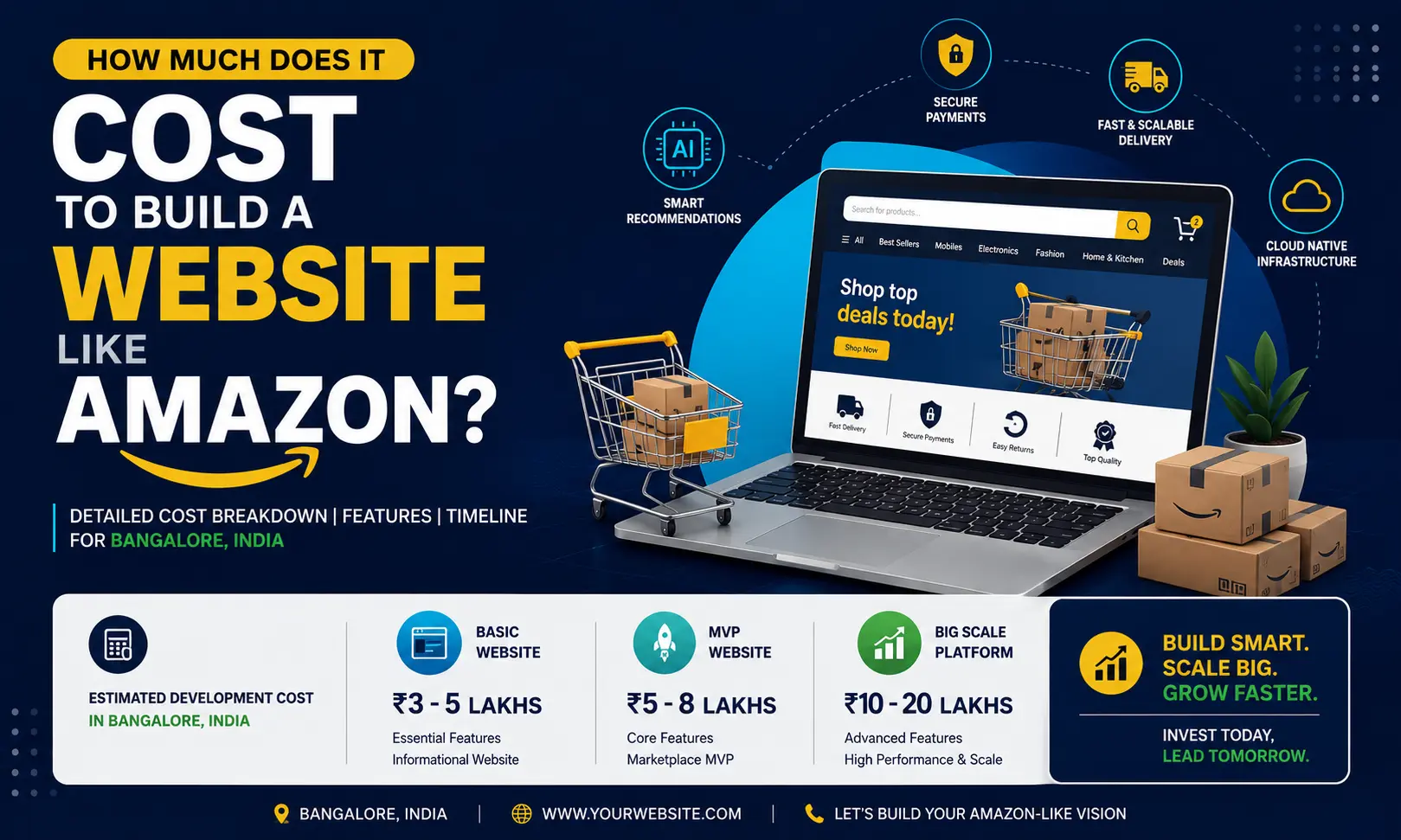
Mistake 3: Asking for a “Low-Cost Amazon”
A marketplace with sophisticated seller controls, commissions, logistics, mobile apps and advanced reporting cannot realistically be compared with a simple five-page eCommerce website.
The scope needs to be broken down feature by feature.
Mistake 4: Ignoring Seller Acquisition
A marketplace with no vendors is an empty shopping mall.
Vendor onboarding and seller acquisition should be part of the business plan.
Mistake 5: Building Too Much on Day One
A new marketplace does not necessarily need every conceivable feature immediately.
It can be wiser to identify the minimum system needed to onboard sellers, receive orders, collect payments, calculate commissions and deliver a reliable customer experience.
Then expand based on actual usage.
Which Model Is Right for Your Business?
There is no universal answer.
A manufacturer launching its own brand does not need the same technology as a founder building a regional marketplace.
A furniture retailer does not have the same workflow as a platform connecting 1,000 furniture sellers.
A local D2C fashion brand may need a streamlined store.
A B2B supplier marketplace may require vendor registration, RFQ functionality, company profiles, enquiries, commissions and seller dashboards.
So the correct question is not:
“Which eCommerce model is better?”
The better question is:
“Which model matches the business I am actually trying to operate?”
Once that is clear, the technology decision becomes much easier.
Final Thoughts
Single-vendor and multi-vendor eCommerce websites may share the same familiar elements — products, cart, checkout and payment — but their internal business mechanics are very different.
A single-vendor website is centred around one business selling its own products.
A multi-vendor marketplace is centred around a platform managing multiple independent sellers.
That difference affects development, operations, payment flows, inventory, customer support, order management and future expansion.
For a business that simply wants to sell its own products online, there is little value in unnecessarily building a marketplace.
For a business whose core idea is to connect multiple sellers and buyers, a basic single-vendor store may become a structural limitation later.
The smartest starting point is to define the business model first and then build the technology around it.
eCommerce Website Development in Bangalore
Planning an eCommerce website development or a multi-vendor marketplace in Bangalore India? W3 Dream Solutions, based in Bangalore, develops eCommerce websites and custom web platforms for businesses with different requirements — from single-seller online stores to larger marketplace systems with vendor management and custom admin functionality.
Whether you are planning a focused online store or a marketplace with multiple sellers, the right development approach should begin with your business workflow, not just the list of website pages.
Other Blogs
Subscribe
Get the latest blog updates directly in your inbox.