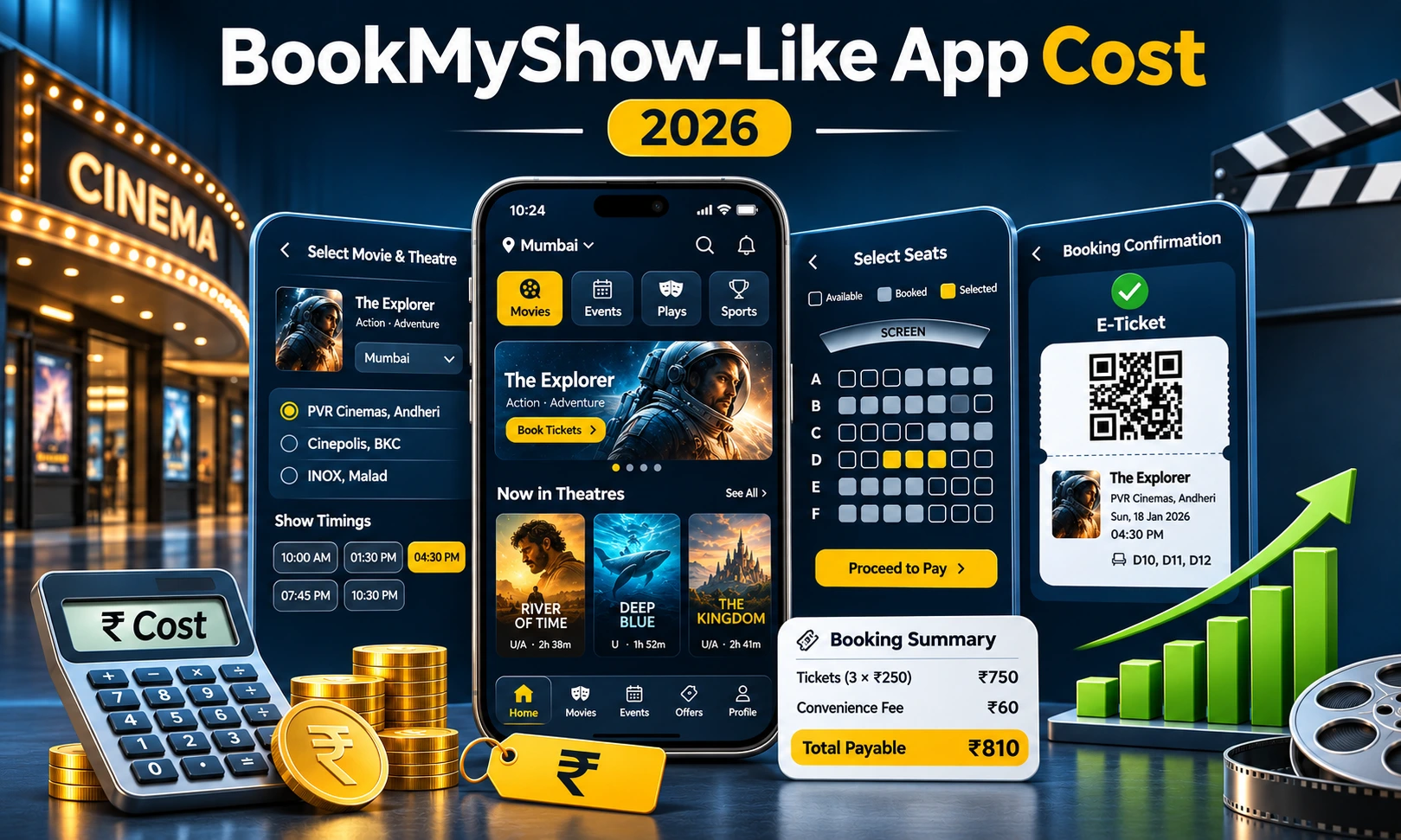
BookMyShow-Like App Development Cost in India: What Should You Expect in 2026?
It's Friday evening in Bangalore. A much-awaited Kannada movie is releasing, a popular stand-up comedian has announced a weekend show, and thousands of people are searching for tickets on their phones.
Some want the best seats in a cinema. Others want to compare show timings, check ticket prices, find attractive offers or book an event before it sells out.
Most customers expect the entire process to take just a few minutes.
Behind that seemingly simple booking experience lies a complicated network of cinema schedules, seat inventories, payment transactions, venue agreements, ticket validation and real-time data processing.
This is the business model that makes platforms like BookMyShow interesting for startups, cinema operators and entertainment businesses.
However, developing a movie ticket booking app is not the same as building an ordinary e-commerce application. A ticket is linked to a particular event, venue, date, time and sometimes a specific seat. Once that event begins, the unsold inventory may lose its commercial value.
That creates unusual technical and business challenges.
In India, a basic event ticket booking app may cost approximately ₹6 lakh to ₹12 lakh, while a movie ticket booking application with interactive seat selection can require ₹15 lakh to ₹35 lakh. A multi-city entertainment booking platform with cinema integrations, organiser dashboards and advanced features may cost ₹35 lakh to ₹1 crore or considerably more.
These are indicative 2026 development estimates. Actual costs depend on the scope, number of applications, cinema partnerships, technical architecture and expected booking volume.
Let's explore what goes into building an app like BookMyShow, how the costs are calculated and where new businesses should invest their money.
What Is a BookMyShow-Like App?
A BookMyShow-like app is an online entertainment ticket booking platform that allows users to discover and book tickets for movies, live events, concerts, plays, comedy shows and other experiences.
Instead of visiting individual cinema websites or purchasing tickets at physical counters, customers can explore available entertainment options through one digital application.
A typical booking process includes selecting a city, choosing an event, checking available dates, selecting tickets or seats, making payment and receiving a booking confirmation.
Depending on the platform, additional functions may include event recommendations, discount offers, food and beverage booking, ticket cancellation, gift vouchers and loyalty programmes.
From a business perspective, this type of application connects several participants:
- Customers looking for movies and entertainment events
- Cinema halls and multiplex operators
- Event organisers and promoters
- Venue owners and management teams
- Platform administrators and support teams
Each participant needs different functionality.
Customers need a convenient booking experience. Cinema operators need accurate seat availability. Event organisers need ticket sales and attendance reports. Administrators need transaction monitoring, partner management and operational controls.
The challenge is not simply displaying available tickets. It is ensuring that every confirmed ticket represents a valid booking that can actually be honoured at the venue.
How Much Does It Cost to Develop an App Like BookMyShow in India?
The cost of developing an entertainment booking application depends on whether you want to serve a single venue, multiple cinema halls or an entire network of entertainment partners.
For initial budgeting, projects can be divided into four categories.
| Application Type | Estimated Development Cost | Approximate Timeline |
|---|---|---|
| Basic Event Ticket Booking App | ₹6,00,000 – ₹12,00,000 | 2–3 Months |
| Movie Booking App with Seat Selection | ₹15,00,000 – ₹35,00,000 | 4–6 Months |
| Multi-Cinema and Event Booking Platform | ₹35,00,000 – ₹80,00,000 | 6–9 Months |
| Advanced Multi-City Entertainment Platform | ₹80,00,000 – ₹2,00,00,000+ | 9–15 Months or More |
These figures are broad Indian development planning estimates for 2026, not guaranteed market rates. They exclude cinema partnership expenses, licensing arrangements, marketing, ongoing cloud infrastructure, payment processing and other third-party charges unless specifically included in a development contract.
1. Basic Event Ticket Booking App – ₹6 Lakh to ₹12 Lakh
A basic ticket booking app is suitable for businesses that want to sell tickets for events where customers purchase a ticket category or quantity rather than choosing an individual numbered seat.
For example, a regional event organiser may want to sell tickets for comedy performances, workshops, music programmes or local exhibitions.
Common features include:
- User registration and login
- Event listing and search
- Event details and schedules
- Ticket category selection
- Basic availability management
- UPI and payment gateway integration
- Digital booking confirmation
- QR-based event tickets
- Booking history
- Basic organiser and administrator dashboard
Suitable for: Local event organisers, small entertainment startups, community events and single-venue ticketing businesses.
This approach can provide a useful first version without the complexity of individual seat selection and cinema inventory integrations.
2. Movie Ticket Booking App with Seat Selection – ₹15 Lakh to ₹35 Lakh
A cinema ticket booking application requires additional functionality because customers expect to choose particular seats for a particular show.
The application must display seat layouts, calculate ticket prices, temporarily reserve selected seats and prevent other customers from purchasing the same inventory.
It also needs accurate show schedules and a reliable connection to the venue's booking records.
Common features include:
- Movie listings and show schedules
- City and theatre selection
- Interactive cinema seat layouts
- Real-time seat availability
- Temporary seat reservation
- Seat-category pricing
- Secure payment processing
- Booking confirmations
- QR tickets and booking history
- Theatre management dashboard
- Refund and cancellation workflows
Suitable for: Independent cinema operators, regional multiplex groups and startups working with selected theatre partners.
The most important development work in this category is the booking engine. If seat availability is not managed correctly, two customers may attempt to purchase the same seat.
3. Multi-Cinema and Event Booking Platform – ₹35 Lakh to ₹80 Lakh
A multi-partner booking platform brings together movie theatres, concert organisers, comedy venues and other entertainment businesses.
Unlike a single-cinema application, it must support different partners, pricing rules, seating arrangements, booking policies and settlement processes.
Common features include:
- Multiple cities and locations
- Multiple cinema and event partners
- Advanced movie and event search
- Different ticketing and seating models
- Real-time inventory management
- Organiser onboarding and approval
- Partner-specific dashboards
- Offer and coupon management
- Payment and refund tracking
- Commission and settlement reporting
- Customer support management
- Advanced business analytics
Suitable for: Entertainment booking startups, regional ticketing platforms and businesses planning partnerships across several cities.
Development costs increase because the system must coordinate multiple venues and maintain dependable booking information across different sources.
4. Advanced Entertainment Booking Platform – ₹80 Lakh to ₹2 Crore+
Developing a platform that aims to operate at the scale of a major entertainment marketplace requires substantial investment beyond the mobile interface.
Such applications must be prepared for high-demand ticket releases, large numbers of simultaneous users and complicated business operations.
Advanced capabilities may include:
- Large-scale cinema and organiser integrations
- High-concurrency ticket reservation systems
- Waiting-room and virtual queue management
- Personalised movie and event recommendations
- Advanced promotional campaigns
- Dynamic ticket pricing support
- Multiple payment and refund workflows
- Multi-city business management
- Fraud and suspicious booking detection
- Detailed partner settlement reporting
- Customer loyalty programmes
- Advanced performance monitoring
Suitable for: Funded startups, large entertainment businesses and companies planning a substantial multi-region ticketing operation.
These systems require experienced engineering teams, production monitoring, transaction testing and ongoing operational support.
Essential Features of a BookMyShow-Like Mobile Application
Building a successful ticket booking app requires more than copying the appearance of an existing platform.
The features should help customers discover entertainment, select tickets confidently and complete bookings without unnecessary confusion.
1. User Registration and Profile Management
Customers should be able to register using supported methods such as mobile number OTP verification, email or compatible social sign-in options.
The user profile can store relevant booking details, saved preferences and previous transactions.
A practical design should avoid collecting unnecessary personal information during registration.
2. City-Based Movie and Event Discovery
Entertainment options differ from one location to another.
A user in Bangalore should be able to discover relevant movies, theatres and events without searching through listings from unrelated cities.
City selection, location preferences and useful category filters can improve event discovery.
For larger platforms, the search experience may include languages, genres, dates, venues and ticket price ranges.
3. Movie Listings and Detailed Information
Movie pages should provide enough information to help users make a booking decision.
Useful information may include:
- Movie title and poster
- Language and available formats
- Genre and running time
- Release information
- Age classification where applicable
- Cast and crew details
- Synopsis and approved promotional content
- Participating cinemas
- Available show timings
Movie information, posters and trailers should be obtained through authorised sources or suitable licensing arrangements.
4. Cinema and Show Timing Selection
Customers should be able to compare available theatres and show timings in their chosen city.
For example, a user may want a Kannada movie after 7 PM near Whitefield rather than travelling to the opposite side of Bangalore.
Useful filters may include theatre location, timing, language, format and available ticket categories.
Accurate schedules are essential because even a small mismatch between displayed timings and actual cinema data can create booking disputes.
5. Interactive Seat Selection
Seat selection is one of the defining features of a movie ticket booking application.
Customers should be able to view a seating layout and distinguish available, occupied, selected and temporarily reserved seats.
Different pricing categories may be represented through clearly labelled sections.
The layout must work on smaller mobile screens without forcing users to zoom repeatedly.
Accessibility considerations should also be included so that seat information is not communicated through colour alone.
6. Real-Time Seat Locking
Seat locking is a critical part of the booking engine.
Imagine two customers selecting seat G12 for the same movie at almost exactly the same time.
The system must ensure that only one customer can successfully reserve and purchase that seat.
A temporary reservation period may be used while the customer completes payment.
If the reservation expires or the booking fails, the seat should become available again only after the system has verified its actual transaction state.
This requires reliable database transactions, reservation expiry rules and careful handling of concurrent requests.
7. Payment Gateway Integration
Indian customers generally expect familiar digital payment methods.
The application may support UPI, cards, net banking and other payment options available through its chosen provider.
The payment process should clearly display the ticket price, applicable taxes, additional fees and final payable amount before confirmation.
The booking system should verify payment status through secure server-side mechanisms rather than relying only on the message displayed on a customer's device.
8. QR Code and Digital Ticket Generation
After a successful booking, the application should generate a digital ticket containing the information required for entry verification.
Depending on the venue's requirements, this may include a unique booking identifier, show details, ticket count and a secure QR code.
Tickets should be designed to prevent unauthorised duplication or reuse.
At the venue, authorised staff can scan the ticket and verify whether it is valid for the relevant event.
9. Booking History and Ticket Management
Customers should be able to view their upcoming and previous bookings from one place.
The application may offer ticket downloads, booking references, receipts and support options.
Keeping booking information accessible can reduce repeated customer support enquiries.
10. Ticket Cancellation and Refund Management
Cancellation rules differ between cinemas, event organisers and ticket categories.
Some bookings may allow cancellation before a specified deadline, while others may be non-refundable.
The application should display relevant policies before payment and apply the correct rules when processing eligible cancellations.
Refund requests, payment reversals and settlement records must be handled carefully to avoid financial discrepancies.
11. Offers, Coupons and Promotional Campaigns
Entertainment booking businesses may use discount campaigns to attract customers and encourage repeat purchases.
Features may include promotional codes, selected payment offers, referral benefits and limited-period campaigns.
Promotional rules should be configurable through an authorised administrator dashboard.
The system must also prevent invalid coupon combinations and repeated misuse of restricted offers.
12. Push Notifications and Booking Reminders
Notifications can help customers receive booking confirmations, event reminders, schedule changes and relevant promotional information.
Examples include:
- Booking confirmation
- Payment status updates
- Upcoming show reminders
- Event cancellation notifications
- Eligible refund updates
- Selected entertainment recommendations
Promotional messages should respect customer preferences and applicable communication requirements.
13. Food and Beverage Pre-Booking
Selected cinema operators may want customers to add snacks and beverages to their ticket orders.
This feature requires compatible cinema operations and a clear process for collecting or fulfilling orders.
Food availability, pricing, taxes and cancellation rules may differ from the ticket itself.
14. Customer Support and Helpdesk
Payment failures, missing confirmations, cancellation questions and incorrect booking details can generate customer support requests.
A useful ticketing application should provide support categories and clear escalation options.
Depending on the business, support may be delivered through tickets, live chat, email or an AI-assisted help centre.
Additional Features for Event Organisers and Cinema Partners
A ticket booking marketplace requires a reliable operational system for the businesses supplying tickets.
Without effective partner management, even an attractive customer application can struggle to operate consistently.
Event Creation and Management
Approved organisers should be able to create events, upload authorised promotional material, configure ticket categories and manage schedules.
Cinema and Screen Management
Cinema partners may need to manage screens, seating configurations, showtimes and applicable pricing rules.
Where the cinema uses an existing ticketing system, integration may be necessary to maintain one authoritative inventory.
Ticket Inventory and Availability
Partners should be able to monitor available and sold inventory according to their authorised permissions.
For reserved seating, every ticket must correspond to a valid seat and show.
QR Ticket Scanning
Venue staff can use a compatible scanning application to validate tickets at entry.
Duplicate, expired and invalid tickets should be identified clearly.
Sales and Settlement Reports
Organisers may need reports showing ticket sales, booking fees, applicable deductions, refunds and amounts due for settlement.
The exact structure depends on contractual agreements and the payment arrangement used by the platform.
Partner Access Controls
Every organiser should see only the information and functions authorised for their account.
A partner managing one venue should not have access to another organiser's confidential financial or customer information.
How Does a BookMyShow-Like Ticket Booking App Work?
A typical booking process involves several connected operations.
Step 1: The Customer Selects a City
The application displays relevant movies, events and participating venues according to the selected location.
Step 2: The Customer Chooses an Event
The user reviews event information, available dates and ticket prices.
Step 3: The Customer Selects a Show and Seats
For reserved-seating events, the application retrieves the latest inventory and displays an interactive seat map.
Step 4: The Booking Engine Reserves Inventory
Selected seats or tickets are temporarily reserved according to the platform's booking rules.
The system must prevent conflicting reservations during this period.
Step 5: The Customer Completes Payment
The user reviews the final amount and completes payment through an integrated provider.
Step 6: The Server Confirms the Transaction
The backend verifies the payment result and confirms the ticket inventory.
Duplicate payment notifications and delayed confirmations must be handled safely.
Step 7: A Digital Ticket Is Generated
Once the booking is confirmed, the system creates the digital ticket and makes it available through the application.
Step 8: The Venue Validates the Ticket
At the venue, authorised staff verify the ticket before allowing entry.
The system records the validation result to help prevent duplicate admission.
The Biggest Technical Challenge: Preventing Double Booking
One of the costliest mistakes in a ticket booking application is selling the same seat to more than one person.
This problem becomes more likely during popular movie releases and high-demand concert bookings.
Suppose 5,000 customers attempt to book tickets for a show with only 300 available seats.
The application must handle numerous simultaneous requests without allowing the inventory count to become inaccurate.
A reliable booking engine generally needs:
- Database transactions that prevent conflicting confirmations
- Unique constraints for individual seat reservations
- Temporary reservation expiry rules
- Idempotent payment and booking confirmation
- Consistent inventory status updates
- Recovery processes for interrupted payments
- Appropriate monitoring and error handling
High-speed caching systems such as Redis may help with reservation coordination and performance, but the authoritative booking database must still enforce inventory correctness.
For larger applications, waiting rooms and request-rate controls may be needed during exceptionally high traffic.
A ticket booking platform can survive a slightly slower search result. It cannot afford to routinely confirm seats that are already sold.
Technology Stack for Developing an App Like BookMyShow
Choosing the right technologies depends on expected traffic, development budget, available engineering expertise and future expansion plans.
The following options can be considered for a custom entertainment booking platform.
| Application Component | Technology Options |
|---|---|
| Android Application | Kotlin, Java or Flutter |
| iOS Application | Swift, Flutter or React Native |
| Cross-Platform Development | Flutter or React Native |
| Admin and Organiser Dashboards | React, Vue or server-rendered web applications |
| Backend Development | PHP, Laravel, Node.js, Java, Go or Python |
| Primary Database | PostgreSQL or MySQL |
| Caching and Reservation Coordination | Redis with reliable database constraints |
| Real-Time Updates | WebSockets or suitable event-based services |
| Search | Database search, Meilisearch or Elasticsearch |
| Cloud Infrastructure | AWS, Google Cloud or Microsoft Azure |
| Payments | Compatible Indian payment gateway APIs |
| Notifications | Firebase Cloud Messaging, SMS and email services |
For a startup developing Android and iOS applications together, Flutter or React Native may reduce duplicated interface development compared with maintaining two completely separate native applications.
PHP, Java, Node.js and other backend technologies can support ticketing applications when the architecture is designed correctly.
However, the booking engine should not depend on the programming language alone. Database consistency, transaction handling, infrastructure monitoring and reliable integrations are far more important.
BookMyShow-Like App Development Cost: Feature-Wise Breakdown
A detailed project quotation should divide the work into functional modules.
The following estimates illustrate how development costs may be distributed across a custom ticket booking project.
| Feature or Module | Estimated Cost |
|---|---|
| UI/UX Design | ₹1,00,000 – ₹3,00,000 |
| User Registration and Profiles | ₹50,000 – ₹1,50,000 |
| Movie and Event Discovery | ₹1,00,000 – ₹3,00,000 |
| Seat Selection and Inventory | ₹2,00,000 – ₹5,00,000 |
| Seat Reservation and Booking Engine | ₹2,00,000 – ₹5,00,000 |
| Payment and Refund Integration | ₹1,00,000 – ₹3,00,000 |
| QR Ticket Generation and Validation | ₹75,000 – ₹2,00,000 |
| Organiser and Admin Dashboards | ₹2,00,000 – ₹6,00,000 |
| Offers and Notification Features | ₹75,000 – ₹2,50,000 |
| Testing, Security and Deployment | ₹1,50,000 – ₹4,00,000 |
These module estimates are illustrative. They are not a complete fixed-price quotation and should not simply be added to determine every project's total cost. Shared infrastructure, implementation approach, existing components and project scope can substantially affect the final budget.
Android App vs iOS App vs Flutter: Which Is More Cost-Effective?
One important decision is whether to begin with Android, launch on both Android and iOS, or use a cross-platform framework.
Android-First Development
An Android-first launch may be practical for an Indian startup testing demand in a limited location.
It allows the business to focus on one mobile platform while continuing to use a web dashboard for administrators and event organisers.
However, iPhone users will need another booking channel until an iOS application is introduced.
Separate Android and iOS Applications
Native Android and iOS development gives teams direct access to platform-specific technologies and separate control over each application.
The trade-off is that maintaining two codebases can increase development and testing expenses.
Flutter or React Native Development
Cross-platform frameworks allow teams to share a substantial amount of application code between Android and iOS.
This can make development more economical when both platforms need similar booking features.
For many new entertainment booking businesses, a cross-platform customer application combined with a well-designed backend and web-based partner dashboards is worth considering.
The final choice should depend on application requirements, performance expectations and the development team's capabilities.
What Is the Monthly Maintenance Cost of a BookMyShow-Like App?
The initial development cost is only one part of operating a ticket booking business.
Once the application is live, recurring expenses may include servers, payment processing, notifications, technical support and maintenance.
A small pilot platform may operate with a modest infrastructure budget, while a multi-city booking business handling frequent ticket releases will require significantly greater resources.
| Monthly Expense | Illustrative Planning Allowance |
|---|---|
| Cloud Hosting and Database | ₹10,000 – ₹75,000+ |
| SMS, Email and Notifications | ₹2,000 – ₹20,000+ |
| Technical Maintenance and Monitoring | ₹15,000 – ₹1,00,000+ |
| Customer Support Operations | Depends on staffing and booking volume |
| Payment Gateway Charges | Depends on payment value and provider agreement |
| Marketing and Customer Acquisition | Depends on the business strategy |
These are planning allowances rather than mandatory monthly charges. Enterprise deployments may require considerably higher operating budgets.
Example: How Payment Gateway Charges Affect Ticket Sales
Suppose your application processes 10,000 ticket-booking transactions in a month.
If the average payment is ₹500, the total payment value would be:
10,000 × ₹500 = ₹50,00,000.
At an illustrative effective payment processing charge of 2%, the corresponding fee would be approximately ₹1,00,000 before any additional applicable taxes or charges.
The actual amount depends on the payment provider, negotiated rates, payment methods and fee structure.
This illustrates why payment processing expenses should be considered separately from application hosting and development costs.
How Do Apps Like BookMyShow Make Money?
Developing a ticket booking platform is only the beginning. The business also needs a workable revenue model.
Entertainment ticketing platforms may generate income through several arrangements.
1. Booking and Convenience Fees
A booking platform may charge an additional fee for providing online reservation and related transaction services.
The fee structure should be disclosed clearly before the customer completes payment.
The amount retained by the platform depends on its agreements, pricing policies and applicable requirements.
2. Commission from Cinema and Event Partners
The platform may receive an agreed commission or service fee for tickets sold through its application.
Commission structures may vary between cinema groups, independent venues and event organisers.
3. Promoted Event Listings
Organisers may pay for selected promotional placements within the application.
These can include featured event positions, sponsored banners and other clearly identified promotional opportunities.
4. Brand Partnerships and Advertisements
Entertainment platforms may work with brands on campaigns, promotions and audience engagement activities.
Advertising should not interfere with the customer's ability to discover events and complete bookings.
5. Food and Beverage Partnerships
Where cinema partners support online food ordering, the platform may earn revenue according to its commercial agreement.
6. Corporate and Group Booking Services
Businesses may require tickets for employee events, client entertainment or group experiences.
A ticketing platform can develop separate workflows for corporate enquiries and bulk bookings.
Example: Revenue Calculation for a New Ticket Booking Platform
Consider a startup that processes 20,000 bookings in one month.
Suppose the platform earns an average gross service fee of ₹25 per completed booking.
The illustrative monthly gross service-fee revenue would be:
20,000 bookings × ₹25 = ₹5,00,000.
Over twelve months, this would represent ₹60,00,000 in gross service-fee revenue if the same booking volume were maintained.
However, gross revenue should not be confused with profit.
The business may still need to account for payment processing, taxes, refunds, promotional discounts, partner settlements, customer support, infrastructure and marketing expenses.
Actual revenue also depends on whether the company can establish suitable agreements with cinemas and event organisers.
This calculation is hypothetical and does not represent BookMyShow's actual revenue or business performance.
The Business Challenge Most Developers Do Not Talk About: Cinema Partnerships
Building an attractive movie ticket booking application does not automatically give the business access to cinema tickets.
This is one of the most important commercial realities behind entertainment booking platforms.
To sell tickets for a cinema, the business generally needs an appropriate commercial arrangement with the cinema operator or an authorised ticket inventory provider.
The agreement may determine which shows can be sold, how seats are allocated, whether bookings can be cancelled and how payments are settled.
Some cinema operators use existing ticketing systems that require specific integrations.
Others may have contractual restrictions concerning third-party booking channels.
A new platform should therefore clarify the following before investing heavily in development:
- Which cinemas or event organisers will supply tickets?
- Will partners provide authorised inventory APIs?
- Who controls the authoritative seat inventory?
- How will booking confirmations be synchronised?
- Who handles cancellations and customer disputes?
- How will partner payments be settled?
- Who is responsible for ticket validation at the venue?
- What happens if a cinema changes or cancels a show?
A booking app without reliable ticket inventory is only an entertainment catalogue.
For a startup, obtaining even a few dependable venue partnerships may be more valuable than launching dozens of features before the supply arrangements are ready.
Legal and Operational Considerations for Ticket Booking Apps in India
Ticket booking applications handle payments, customer information and commercial transactions involving third-party partners.
Businesses should review the applicable legal and operational requirements before launch.
Customer Data and Privacy
Applications should collect only necessary personal information and implement appropriate security, privacy notices and data handling practices under applicable Indian law.
GST and Invoice Management
The tax treatment of tickets, booking fees and event services can differ depending on the transaction and the responsible supplier.
The platform should obtain qualified tax advice on invoicing, GST, marketplace responsibilities and partner settlements.
Refund and Cancellation Policies
Customers should be able to review relevant ticket cancellation terms before payment.
The application should maintain records of refunds and clearly communicate the applicable process.
Payment Processing and Settlements
Payment flows involving multiple partners should use appropriate authorised payment arrangements.
A ticket marketplace should not assume it can collect and redistribute funds in any manner without considering applicable payment-service rules.
Event and Content Rights
Movie posters, trailers, event images, artist photographs and other promotional materials may be protected by intellectual property rights.
Businesses should use properly licensed or authorised content.
How Long Does It Take to Develop an App Like BookMyShow?
The development timeline depends on the application's functionality, the number of platforms and the availability of partner integrations.
| Project Type | Estimated Timeline |
|---|---|
| Basic Event Ticketing Application | 2–3 Months |
| Movie Booking App with Seat Selection | 4–6 Months |
| Multi-Cinema and Event Booking Platform | 6–9 Months |
| Advanced Multi-City Entertainment Platform | 9–15 Months or More |
These timelines assume that project requirements are defined and the required partner information and technical access are available.
Delayed cinema approvals, unavailable APIs, additional security testing and changes to booking rules can extend development.
Step-by-Step Process to Develop a BookMyShow-Like App
Step 1: Identify Your Ticketing Business Model
Decide whether the application will focus on movies, live events, sports, concerts or a combination of categories.
Also determine whether the business will serve one city, selected partners or multiple regions.
Step 2: Establish Initial Venue Partnerships
Discuss ticket availability, commercial terms, booking rules and technical integration with the relevant cinema or event partners.
These arrangements should be evaluated before building complicated inventory features.
Step 3: Prepare the Feature Requirements
Define the customer booking process, ticket categories, payment methods, cancellation policies, dashboards and administrative responsibilities.
Separate essential launch features from later improvements.
Step 4: Design the User Experience
Create application screens for entertainment discovery, show selection, seat booking, payment and booking history.
Pay particular attention to the mobile seat selection experience.
Step 5: Develop the Booking Engine
Build the backend functionality responsible for inventory management, temporary reservations, booking confirmation and transaction records.
Ensure that conflicting bookings are prevented through dependable database controls.
Step 6: Integrate Payments and Partner Systems
Connect approved payment services and the available cinema or organiser APIs.
Implement secure transaction verification and exception handling.
Step 7: Develop the Admin and Partner Dashboards
Provide authorised tools for managing events, schedules, inventory, offers, bookings and reports.
Step 8: Test Under Realistic Booking Conditions
Test the application with multiple customers attempting to reserve the same seats.
Also test expired reservations, interrupted payments, duplicate notifications, refund requests and unavailable partner systems.
Step 9: Launch with a Limited Set of Partners
A pilot launch in one city or with selected venues can help identify operational problems before larger expansion.
Step 10: Improve Based on Actual Booking Behaviour
Analyse search activity, booking completion rates, payment failures, support requests and partner feedback.
Introduce new features based on genuine requirements rather than assuming every major platform feature is necessary from day one.
How to Reduce BookMyShow-Like App Development Costs
A new ticket booking business does not need to compete with an established national platform on every feature from the first day.
Several practical decisions can help control the initial development budget.
1. Start with One Entertainment Category
Launching with local events or selected cinema partners may be easier than introducing movies, concerts, sports and activities simultaneously.
2. Consider General Admission Before Reserved Seating
Events that sell tickets by quantity or category have simpler inventory requirements than cinema bookings involving specific seats.
This can reduce development complexity for an early-stage ticketing business.
3. Use Cross-Platform Mobile Development
Flutter or React Native can help businesses develop Android and iOS applications with substantial shared code.
4. Begin with a Limited Geographic Market
Starting in Bangalore or another selected city allows the team to focus on local partnerships, operational processes and customer feedback.
5. Avoid Expensive Personalisation Features Initially
Advanced recommendation engines and loyalty systems can be introduced after the application has enough real customer activity to justify them.
6. Reuse Reliable Third-Party Services
Using suitable payment, notification and authentication services can reduce the need to develop every technical component from scratch.
7. Prioritise the Booking Engine
Money spent on accurate seat inventory, dependable transactions and clear booking confirmations is usually more important than elaborate animation or decorative interface features.
Common Mistakes to Avoid When Building a Ticket Booking App
Developing the App Before Confirming Ticket Supply
Without cinema or event partners, the platform may have no authorised inventory to sell.
Ignoring Real-Time Seat Availability
Outdated seat information can lead to failed bookings, customer complaints and payment disputes.
Using Payment Success Screens as Booking Confirmation
A payment message shown on the customer's device is not enough to confirm a transaction.
The server should verify the actual payment result and booking status.
Overlooking Refund and Cancellation Rules
Different partners may follow different ticket policies.
These rules should be supported by the booking engine rather than handled entirely through manual work.
Underestimating Peak Traffic
A popular movie release may generate considerably more booking activity than an ordinary weekday.
The system should be tested against realistic peak demand before larger launches.
Spending Too Much on Features Before Launch
Advanced recommendations, loyalty programmes and promotional features may not provide immediate value if the basic booking process is unreliable.
Is Building a BookMyShow-Like App Profitable in India?
An entertainment ticket booking business can generate revenue, but profitability depends on several factors beyond application development.
The business needs a dependable supply of tickets, competitive commercial agreements, a clear fee structure and enough customer activity to cover operating costs.
Customer acquisition can also be expensive because established booking platforms already have strong recognition and existing cinema relationships.
For a new business, a focused approach may provide a more realistic starting point.
Examples include:
- A regional movie booking application
- A ticketing platform for Kannada theatre and cultural programmes
- A booking app for stand-up comedy and live performances
- A college and community event ticketing platform
- A private ticketing application for a cinema group
- An event booking platform for a specific city or audience
These models allow startups to develop specialised partner relationships rather than immediately competing across every entertainment category.
Profitability should be evaluated using actual booking commissions, operating costs, partner terms and customer acquisition expenses.
Future Opportunities in Movie and Event Ticket Booking Applications
Entertainment booking platforms may continue introducing features that improve discovery, booking convenience and venue operations.
Personalised Entertainment Discovery
Recommendation systems can help customers find movies and events based on relevant preferences, booking history and location, subject to appropriate privacy controls.
Smart Event Search
Natural-language search may allow customers to discover events through questions such as "What comedy shows are available in Bangalore this weekend?"
Digital Entry and Ticket Verification
Secure digital tickets and compatible scanning systems can help organisers manage event entry and reduce duplicate ticket usage.
Better Venue and Seat Information
Detailed seating maps, accessibility information and venue guidance can help customers choose tickets with greater confidence.
Connected Food and Beverage Ordering
Participating cinemas may integrate food ordering with ticket purchases to support convenient collection or other available fulfilment options.
Improved Demand and Attendance Analytics
Organisers can use booking information to understand ticket demand, attendance patterns and sales performance.
These insights can support future event planning and capacity decisions.
Questions to Ask Before Hiring a Ticket Booking App Development Company
Before choosing a technology partner, businesses should examine the development team's ability to handle transactions and real-time inventory.
Important questions include:
- Can the team develop reliable seat reservation functionality?
- How will the application prevent duplicate bookings?
- Can the software integrate with our cinema or event ticketing provider?
- Will both Android and iOS applications be included?
- What administrator and organiser dashboards are provided?
- How are unsuccessful payments and delayed confirmations handled?
- Can the platform support different ticket cancellation rules?
- What happens during high-demand booking periods?
- Who owns the application code and cloud accounts?
- What technical support is available after deployment?
A detailed development proposal should clearly explain functionality, third-party dependencies, testing responsibilities, maintenance and excluded expenses.
BookMyShow-Like Mobile App Development Services in Bangalore
Building an entertainment ticketing application requires careful coordination between mobile development, backend systems, payment services and venue operations.
Businesses planning this type of platform should begin with a clear booking model, realistic development budget and dependable arrangements for obtaining ticket inventory.
W3 Dream Solutions is a Bangalore-based website, software and mobile application development company working with startups and businesses on custom digital development requirements.
Organisations exploring entertainment booking applications can learn more about the company's mobile app development services in Bangalore.
For company information and other website and software development services, visit W3 Dream Solutions.
Final Thoughts: How Much Should You Invest in a BookMyShow-Like App in 2026?
Developing an entertainment ticket booking platform can be an interesting business opportunity, but the investment depends on the kind of booking experience you want to provide.
A basic event ticketing application may cost approximately ₹6 lakh to ₹12 lakh, while a cinema booking application with interactive seat selection and reliable inventory management may require ₹15 lakh to ₹35 lakh.
Larger platforms connecting multiple cinemas, event organisers and cities can cost ₹35 lakh to ₹1 crore or considerably more.
These estimates cover software development scenarios. Commercial partnerships, marketing, ongoing infrastructure and operational expenses require separate financial planning.
The most important part of the project is not the number of movies displayed or the appearance of the homepage.
It is the ability to show genuine ticket availability, complete payments correctly, prevent duplicate bookings and provide valid tickets that customers can use at the venue.
For startups, beginning with a clearly defined market and selected entertainment partners can be more practical than attempting to reproduce every feature of a national platform immediately.
A great ticket booking app does more than sell seats. It earns customer confidence between the moment a ticket is selected and the moment the venue accepts it.
With dependable inventory, careful development and a workable business model, an entertainment booking application can become a valuable long-term digital business.
Other Blogs
Subscribe
Get the latest blog updates directly in your inbox.