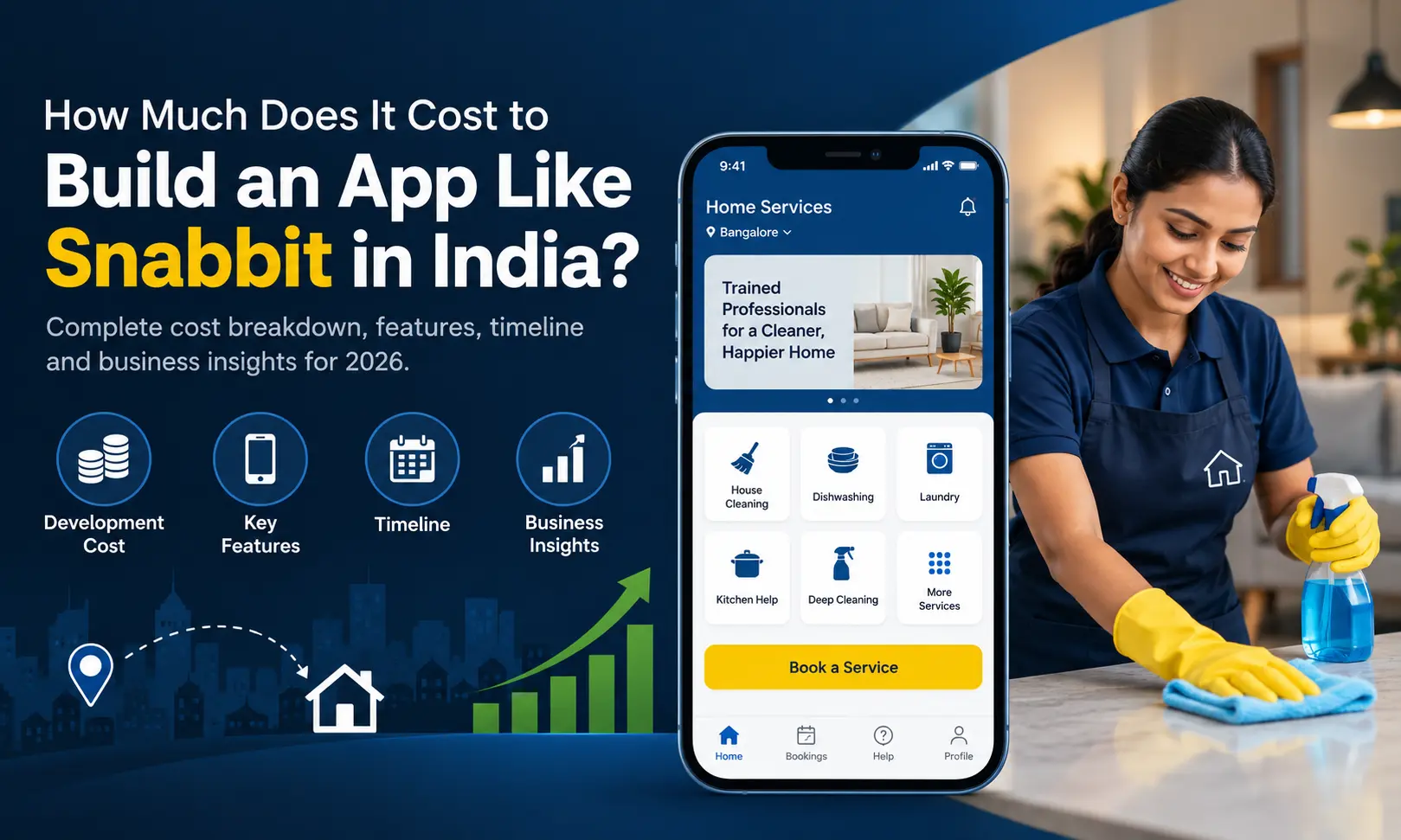
What if a customer could open an app, book a trained home-help professional, and get everyday household work done without spending half the morning making calls? That is the business idea behind quick home services platforms such as Snabbit. For entrepreneurs, the interesting question is not just how the app works, but how much it would cost to build a similar platform, what the first version should include, and how much money is needed beyond software development.
In India, an on-demand home services app can range from a relatively lean minimum viable product (MVP) to a sophisticated platform with separate customer and professional apps, automated job allocation, online payments, location tracking, and a central operations dashboard. Each version carries a different price tag.
For a startup planning to enter this market in 2026, the sensible approach is to understand the numbers before committing to development. This guide breaks down the estimated investment, features, technology, timeline, and operating expenses involved in building an app like Snabbit in India.
What Is Snabbit, and Why Is Its App Model Interesting?
Snabbit is an Indian quick home services platform that connects households with trained and verified professionals for everyday domestic tasks. Its offering includes activities such as house cleaning, dishwashing, laundry, and basic kitchen preparation. Customers can book services through an app, with availability and arrival times depending on the location and supply of professionals.
What makes this model interesting is its emphasis on speed, hourly pricing, and convenience. Instead of relying entirely on advance bookings or lengthy negotiations, the platform aims to make everyday household assistance available when customers need it.
Snabbit's official website describes its model around trained professionals, hourly pricing, verification, and quick fulfilment. These are useful reference points for entrepreneurs planning a similar service, although a new business does not need to reproduce every feature or operational decision made by Snabbit.
The underlying product is more than a booking screen. It needs to coordinate customers, available professionals, service areas, payments, schedules, cancellations, customer support, and quality checks. The challenge is to make these moving parts work together without creating confusion for either customers or the operations team.
For a new entrant, the opportunity lies in choosing a specific customer segment or geographical area, understanding its household needs, and building software around that business model.
How Much Does It Cost to Build an App Like Snabbit in India?
The cost of developing an app like Snabbit in India in 2026 can be estimated at around ₹8 lakh to ₹15 lakh for a lean custom MVP, ₹15 lakh to ₹30 lakh for a more developed platform, and ₹30 lakh to ₹60 lakh or more for a feature-rich, multi-city system.
These figures are indicative budgets for software development. The final quotation depends on the number of applications, business rules, integrations, user roles, interface requirements, testing scope, and complexity of the booking and dispatch system.
| Development level | Estimated cost | Indicative timeline | Best suited for |
|---|---|---|---|
| Lean MVP | ₹5 lakh–₹10 lakh | 10–16 weeks | Testing the idea in one city or a limited service area |
| Growth-ready platform | ₹10 lakh–₹15 lakh | 16–24 weeks | Startups preparing to handle regular bookings and a larger professional network |
| Advanced platform | ₹15 lakh–₹30 lakh+ | 24–36+ weeks | Businesses requiring advanced dispatch, multiple service areas, and deeper operational controls |
The timelines are broad planning estimates and may overlap depending on the project team, platform choices, client approvals, and third-party integrations. They are not guaranteed delivery commitments.
One important distinction: these are not official prices published by Snabbit, nor do they represent what Snabbit originally spent to develop its own software. Its actual development expenditure is not established by these estimates.
1. Lean MVP: ₹ 5 lakh to ₹10 lakh
A lean MVP is designed to answer one important question: will customers in your chosen market regularly book and pay for the service?
At this stage, the objective is not to launch with every feature imaginable. The focus should be on a reliable booking journey, a straightforward professional workflow, and an admin panel that gives the business owner control over day-to-day operations.
A typical MVP could include:
- Customer registration and login.
- Service categories, descriptions, duration, and pricing.
- Instant and scheduled booking options, subject to availability.
- Address selection and service-area validation.
- Basic professional registration and profile management.
- Admin-assisted or rule-based assignment of professionals.
- Online payment integration and booking status updates.
- Booking history, cancellations, and customer feedback.
- An administrative dashboard for bookings, users, professionals, and reports.
The MVP can use a simpler assignment mechanism instead of a sophisticated, automated dispatch engine. For example, the operations team may allocate a suitable professional from a list of available people within the service area.
This approach helps validate booking frequency, customer willingness to pay, professional availability, and repeat usage before investing in complex automation.
2. Growth-ready platform: ₹10 lakh to ₹15 lakh
A growth-ready version makes sense when the business has moved beyond a small pilot and needs to manage bookings more consistently. Manual coordination may work with a handful of professionals, but it becomes difficult to sustain as bookings, cancellations, service areas, and support requests increase.
Depending on the scope, this version may include:
- Dedicated Android and iOS customer applications, potentially using a cross-platform framework.
- A dedicated application for service professionals.
- Availability calendars, shift management, and leave handling.
- Location-based professional matching and dispatch rules.
- Live location updates during an active booking, where required.
- Booking reminders, push notifications, and status alerts.
- Discount coupons, referral codes, and promotional campaigns.
- Professional earnings, incentives, and payout records.
- Refund, complaint, cancellation, and support workflows.
- Operational reports for bookings, revenue, utilisation, and repeat customers.
Not every project in this budget will include every item. A single cross-platform codebase, a simpler dispatch mechanism, or fewer integrations may help keep the investment towards the lower end.
The main advantage is greater control over the customer experience and the operational work happening behind the app.
3. Advanced platform: ₹ 15 lakh to ₹ 30 lakh or more
An advanced platform is intended for businesses that need more than a functioning booking system. It may serve several cities, manage a large professional network, and coordinate bookings across multiple service zones with different pricing and availability rules.
Depending on the business requirements, the scope may include:
- Automated dispatch based on location, availability, skills, and service duration.
- Dynamic or time-slot-based pricing rules.
- Multi-city and multi-zone administration.
- Demand forecasting and workforce scheduling tools.
- Advanced fraud prevention and booking-abuse controls.
- Detailed professional verification and document-management workflows.
- Customer safety features, incident reporting, and escalation processes.
- Automated reconciliation, settlement, and financial reporting.
- Advanced analytics, audit logs, and role-based access controls.
- Infrastructure and monitoring designed for higher booking volumes.
Some of these capabilities may be unnecessary during the first few months of a new venture. Building them before the business has enough bookings and operational data can increase development costs without producing a corresponding business benefit.
A better strategy is to establish the core service first, measure what is slowing the operation down, and introduce advanced features where they solve a proven problem.
What Actually Drives the Development Cost?
Two apps may look almost identical on a mobile screen and still require very different development budgets. The difference usually lies in what happens after a user taps the Book Now button.
1. Number of applications and user roles
A customer-only application is considerably simpler than a platform that serves customers, professionals, operations managers, support executives, and administrators.
Each additional role brings its own screens, permissions, workflows, validation rules, and testing requirements. A professional application, for instance, may need availability controls, job acceptance, navigation, attendance, earnings, and support features that do not belong in the customer app.
When preparing a quotation, it is important to define whether the project includes Android, iOS, a web-based admin dashboard, a professional app, or all of these components.
2. Booking and assignment logic
A basic booking system records the customer's request and allows an administrator to assign a professional. An automated dispatch system must also consider distance, availability, service duration, shift timings, overlapping bookings, acceptance rates, and cancellation scenarios.
Suppose a customer requests a one-hour cleaning service at 6 PM. The system must identify which professionals can realistically reach the address, complete the job, and remain available for their next booking. If the nearest professional is already occupied, the system must consider the next suitable option.
These decisions require business rules, careful backend development, and testing against real-world situations. The more complex the dispatch logic, the higher the development effort.
3. Maps and location services
Location is central to a quick home services business. The platform needs to determine whether a customer falls within the service area, display the correct address, and identify suitable professionals nearby.
Basic address selection may be relatively inexpensive. Continuous location updates, route calculations, service-zone boundaries, location permissions, and live tracking add further work and may also create ongoing third-party usage charges.
A startup should not promise a fixed arrival time merely because the app displays a map. Actual fulfilment depends on professional availability, travel conditions, service duration, and the density of the workforce in each area.
4. Payment gateway and refund workflows
Payment integration involves more than adding a checkout screen. The backend must handle successful payments, failed transactions, duplicate requests, cancellations, refunds, booking adjustments, and reconciliation.
UPI, cards, net banking, and other payment options may be supported through a suitable payment provider. The choice of provider, its transaction charges, settlement policies, and integration requirements should be considered separately from the development quotation.
5. Design, testing, and reliability
A home services app must remain easy to use for people with different levels of digital familiarity. Customers should understand the price, duration, address, and booking status without navigating through unnecessary screens. Professionals need an equally clear workflow for accepting and completing jobs.
Testing must cover more than the normal booking journey. It should include poor network conditions, location permission issues, duplicate bookings, failed payments, late arrivals, cancellations, and situations where no professional is available.
These details are easy to overlook during the initial planning stage, but they can determine whether the product works reliably after launch.
Feature-Wise Cost Breakdown for a Snabbit-Like App
The following table provides an indicative way to understand where the development budget may go. The figures are planning allowances for feature groups, not fixed standalone prices. They assume a reasonably coordinated project and may vary according to the technology, integrations, and existing code.
| Component | Estimated cost | What it covers |
|---|---|---|
| Product planning and UI/UX | ₹50,000–₹1.5 lakh | User journeys, wireframes, interface design, and requirements planning |
| Customer application | ₹2 lakh–₹4 lakh | Registration, services, pricing, booking, payments, and booking history |
| Professional application | ₹1.5 lakh–₹3.5 lakh | Availability, job management, booking updates, and earnings |
| Backend and APIs | ₹1.5 lakh–₹3.5 lakh | Business logic, databases, authentication, and integrations |
| Admin dashboard | ₹1 lakh–₹2.5 lakh | Users, professionals, bookings, service areas, and operational controls |
| Maps and dispatch | ₹75,000–₹2 lakh | Location services, service-zone rules, and basic assignment logic |
| QA, deployment, and release preparation | ₹75,000–₹1.5 lakh | Testing, defect fixes, deployment, and launch preparation |
Important: These line items should not simply be added together and treated as a guaranteed project quotation. Some work may overlap, and the scope of each item can differ. A lean MVP may combine certain components, simplify the professional workflow, or defer live tracking and advanced dispatch. The feature breakdown is intended to explain cost drivers, not to imply that all listed features fit into the lowest budget.
Essential Features of an App Like Snabbit
A successful home services platform must work for three groups: the customer requesting the service, the professional delivering it, and the operations team coordinating both sides. If any one of these groups is neglected, the entire service can suffer.
Customer app features
- Registration and login: Allow customers to create an account and verify their mobile number.
- Service catalogue: Display available household services, inclusions, exclusions, and duration options.
- Transparent pricing: Show the final payable amount before the customer confirms the booking.
- Address management: Save home addresses and check whether the location falls within a supported service area.
- Instant and scheduled bookings: Allow customers to request immediate service when available or choose a later slot.
- Booking status: Show whether a booking is confirmed, assigned, in progress, completed, or cancelled.
- Payments and invoices: Support the selected payment methods and provide transaction records.
- Ratings and support: Let customers share feedback and raise concerns about a booking.
- Rebooking: Make it easy to repeat a previous service without entering the same information again.
Service professional app features
- Registration, identity verification, and document submission.
- Profile details, service capabilities, and assigned service areas.
- Availability, shifts, leave requests, and attendance records.
- New booking alerts and job acceptance or rejection.
- Customer address and navigation support.
- Booking start and completion confirmation, including OTP verification if required.
- Earnings summaries, incentives, and payout status.
- Helpdesk access and an incident-reporting mechanism.
The exact verification process and safety procedures should be designed around the company's operating model. Software can record checks and enforce workflows, but it cannot replace the actual background verification, training, supervision, and workforce management that the business must carry out.
Admin dashboard features
- Manage customers, professionals, and administrator accounts.
- Create service categories, duration options, prices, and availability rules.
- View bookings and assign or reassign professionals.
- Manage service zones, operating hours, and capacity.
- Review cancellations, refunds, complaints, and customer feedback.
- Monitor payments, professional earnings, and settlement records.
- Manage offers, referral codes, and promotional campaigns.
- View operational reports and export relevant business data.
The admin dashboard deserves particular attention. A polished customer app will not rescue a business whose team cannot see available professionals, resolve a failed booking, or identify why a service was delayed. Operational visibility should be part of the initial product plan, not an afterthought.
Which Technology Stack Should You Choose?
The technology stack should suit the product's feature requirements, budget, expected growth, and the team's ability to maintain it. Choosing a fashionable framework without considering these factors can create unnecessary cost.
| Layer | Possible technologies | Purpose |
|---|---|---|
| Mobile applications | Flutter or React Native | Build Android and iOS apps using a shared codebase where suitable |
| Backend | Laravel, Node.js, or another suitable framework | Booking rules, authentication, dispatch, payments, and APIs |
| Database | MySQL or PostgreSQL | Store customers, bookings, professionals, payments, and service records |
| Admin dashboard | Web application using a suitable frontend framework | Provide operational controls and business reporting |
| Maps | Google Maps Platform or an appropriate alternative | Address selection, geolocation, and routing where needed |
| Payments | Razorpay or another suitable payment provider | Collect payments and support transaction workflows |
| Notifications | Firebase Cloud Messaging, email, or SMS services | Booking alerts, reminders, verification, and service updates |
| Hosting and monitoring | Cloud hosting and appropriate monitoring tools | Run the backend, manage deployments, and detect service issues |
A cross-platform framework may reduce duplicated mobile development work, but it does not eliminate the need for a properly designed backend, application-specific testing, or native integrations where required. The final technology choices should follow the actual scope rather than a fixed technology checklist.
How Long Does It Take to Develop a Snabbit-Like App?
For a custom application, the development timeline depends on how many components must be built, how quickly requirements are approved, and how complicated the booking and dispatch workflows become.
| Project stage | Indicative duration |
|---|---|
| Requirements and product planning | 1–2 weeks |
| UI/UX design | 2–3 weeks |
| Backend and database development | 3–6 weeks |
| Mobile applications and admin dashboard | 5–9 weeks |
| Integration, testing, and release preparation | 2–4 weeks |
These activities can overlap, so the durations should not be added mechanically. A lean MVP may be ready in roughly 10–16 weeks, while a larger platform can take several months longer. App-store reviews, third-party approvals, delayed content, and changes to requirements can affect the release date.
For a startup, it is usually better to launch a smaller product that has been properly tested than to rush a large feature list into production. Booking failures and payment disputes can damage customer confidence much faster than a missing secondary feature.
Hidden Costs Beyond App Development
Software development is only one part of the investment required to operate a quick home services business. A working app does not automatically create a reliable supply of professionals, attract customers, or make each booking profitable.
1. Hosting, maintenance, and monitoring
The platform needs hosting, database backups, security updates, error monitoring, and ongoing technical support. Costs will depend on traffic, data usage, infrastructure choices, and the level of service required.
2. Maps, SMS, and other third-party charges
Map requests, route calculations, SMS verification, email delivery, payment processing, and notification services may carry usage-based or transaction-based charges. These expenses can rise as bookings increase and should be budgeted separately from the initial development cost.
3. Professional recruitment and verification
Professionals must be recruited, verified, trained, and prepared to deliver the promised service. This may involve recruitment campaigns, identity checks, training materials, uniforms, onboarding staff, and ongoing quality monitoring.
4. Workforce availability and service fulfilment
A quick-service promise requires enough professionals to be available close to customers at the right time. The business may need to cover idle periods, shift gaps, travel time, cancellations, and incentives to keep supply available. These are operating costs rather than software development charges.
5. Marketing and customer acquisition
Launching an app is not the same as building demand. A startup may need local advertising, referral offers, introductory discounts, partnerships, and neighbourhood-level campaigns to acquire its first customers.
6. Customer support and refunds
Late arrivals, cancellations, incomplete work, payment disputes, and complaints need clear resolution procedures. The company should budget for the people and processes needed to handle these situations, even if the initial volume is modest.
For this reason, a founder should prepare two separate budgets: one for building the technology and another for running the business during its early months.
Why the Snabbit Business Model Needs More Than Good Software
The most important lesson from quick home services is that customer convenience depends on operational discipline. A platform can have excellent design and fast servers, yet still disappoint customers if the nearest professional is unavailable.
In an instant-service model, supply must be positioned close enough to demand. If professionals are spread too widely, travel time increases and fewer bookings can be completed during a shift. If too many professionals wait in an area with little demand, the business carries avoidable costs.
Pricing also needs careful thought. The company must account for professional compensation, service duration, travel, cancellations, discounts, payment charges, customer support, and other fulfilment expenses. A low introductory price may attract users, but it does not prove that the model can support itself over time.
For an entrepreneur, the first target should be a small service area with a realistic supply plan. Study when customers book, how frequently they return, which services are most popular, how long jobs take, and how many bookings each professional can complete without compromising quality.
These figures will help the business decide whether to expand the service area, add more categories, introduce subscriptions, or invest in a more advanced dispatch system. Technology should support decisions backed by operating data rather than assumptions.
How to Reduce Development Cost Without Weakening the Product
Controlling the budget does not mean removing every useful feature. It means separating the capabilities needed to run the first version from the additions that can wait until the business has real customers.
- Start with one city or a small service zone. A limited launch reduces the number of service-area rules and operational scenarios that must be supported initially.
- Launch a focused service catalogue. Begin with a few well-defined household services instead of trying to support every category from day one.
- Use a shared mobile codebase where practical. Cross-platform development can reduce duplicated effort for Android and iOS.
- Keep the first dispatch system simple. Start with administrator-assisted or basic rules-based allocation if fully automated dispatch is not yet necessary.
- Build only the essential dashboards. Give the operations team the controls it needs for bookings, users, professionals, payments, and complaints before adding elaborate reporting.
- Use established third-party services. Payment, messaging, and maps integrations can avoid the cost of building those systems from scratch.
- Write down the scope before development begins. Clear deliverables, exclusions, acceptance criteria, and milestone approvals help reduce expensive misunderstandings.
- Keep security and essential testing in scope. Saving money by skipping payment testing, access controls, backups, or booking validation can create far greater costs later.
The objective is to postpone unnecessary complexity, not to postpone essential reliability. A small app should still handle bookings, payments, user information, and professional assignments correctly.
Should You Build a Snabbit-Like App from Scratch or Use a Ready-Made Solution?
A ready-made platform may appear cheaper because it provides an existing foundation for bookings, user accounts, and administrative controls. It can be useful when the business model is conventional and the software allows the required changes.
However, a low initial price does not always mean a lower long-term cost. Some solutions have limitations around dispatch rules, custom pricing, professional workflows, integrations, source-code access, or future expansion. Customisation can become difficult if the underlying code is poorly structured or the vendor controls essential parts of the system.
Building from scratch gives the business greater control over the product and its business rules, but usually requires a higher initial investment and more planning. It makes sense when the proposed service model has distinctive requirements that cannot be handled efficiently by an existing solution.
Before deciding, compare the full cost of ownership: setup, customisation, licensing, hosting, maintenance, transaction charges, support, and future changes. The right choice is the one that fits the business plan, not simply the one with the lowest advertised starting price.
How W3 Dream Solutions Can Help You Build an On-Demand Service App
Building a home services platform requires a clear understanding of the business process as well as the technology. The project team must translate the booking journey, professional workflow, payment rules, and administrative requirements into software that can be tested and maintained.
At W3 Dream Solutions, based in Bangalore, India, businesses can discuss their mobile application requirements, define the first release, and plan the development work according to their objectives and budget.
Our mobile app development services in Bangalore provide a starting point for businesses exploring a custom mobile application. For a Snabbit-style platform, the initial discussion should cover the customer app, professional app, admin dashboard, booking and assignment rules, payment integrations, and the operating model that the software needs to support.
Rather than assuming every business needs a large platform immediately, it is worth identifying which features are essential for launch and which can be introduced after the first round of customer feedback. This creates a clearer development scope and makes the budget easier to evaluate.
Before requesting a quotation, prepare a brief covering the target city, intended services, user roles, booking durations, payment methods, and whether professional allocation will be manual or automated. These details help a development team estimate the effort more accurately.
Final Thoughts: What Budget Should You Prepare?
Building an app like Snabbit in India is a meaningful software project because it brings together mobile applications, backend development, booking management, professional coordination, payments, and operational reporting. The right budget depends on how much of this functionality must be available at launch.
As a starting point, an indicative budget of ₹5 lakh to ₹10 lakh may suit a lean custom MVP. A more developed platform may require ₹10 lakh to ₹15 lakh, while a larger system with advanced dispatch and multi-city operations can reach ₹15 lakh to ₹30 lakh or beyond.
These estimates cover software development planning, not the full cost of launching and operating a home services company. Recruitment, training, marketing, professional compensation, hosting, third-party charges, and customer support must be considered separately.
The smartest first move is to define the smallest version of the business that can deliver a dependable service, test it in a manageable area, and use real booking data to decide what should come next. That way, every additional feature has a clear purpose rather than becoming another item on an expensive development checklist.
If you are planning an on-demand home services app, contact W3 Dream Solutions for mobile app development in Bangalore to discuss your requirements and work towards a project estimate based on your intended features, launch plan, and business goals.
Other Blogs
Subscribe
Get the latest blog updates directly in your inbox.