
Choosing the right technology for a mobile application is not a decision that should be made simply because one framework is popular.
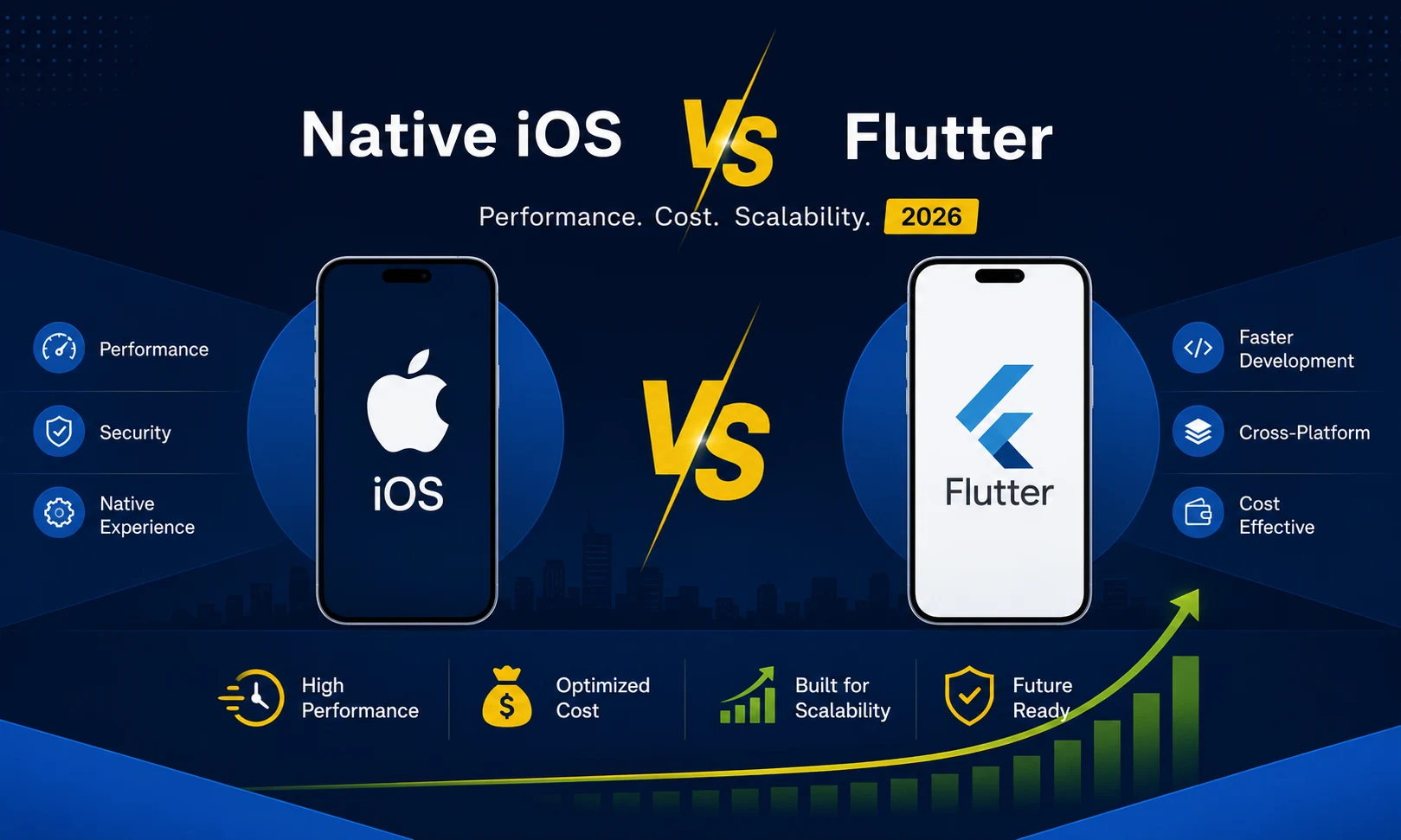
For a business planning an iPhone or iPad application, two options often come into the discussion: Native iOS development and Flutter development.
Native iOS development focuses specifically on Apple's ecosystem, generally using technologies such as Swift and SwiftUI. Flutter, on the other hand, takes a cross-platform route, allowing developers to build applications for iOS and Android from a shared codebase.
At first glance, Flutter may appear to be the obvious choice because one codebase can serve multiple platforms. Native iOS, meanwhile, can look like the expensive route.
But mobile app development is rarely that straightforward.
An application with advanced animations, Apple-specific features, Bluetooth communication, background processing, biometric authentication or complex device integrations may have very different technical requirements from a simple business application.
That is why the real question is not:
"Which technology is better?"
The better question is:
"Which technology is better for this particular application?"
In this guide, we compare Native iOS and Flutter across the areas that matter most in 2026 — performance, cost, scalability, UI, development time, maintenance, security, native features and long-term business requirements.
What Is Native iOS App Development?
Native iOS development means creating an application specifically for Apple's platforms using Apple's own development ecosystem.
Developers commonly use:
- Swift
- SwiftUI
- Xcode
- Apple's SDKs and frameworks
- UIKit where required
- Core Location
- Core Bluetooth
- Apple Pay
- HealthKit
- ARKit
- MapKit
- Push Notifications
- Face ID and Touch ID
- Other Apple platform services
The major advantage is direct access to Apple's ecosystem.
Rather than building an abstraction layer between the application and the operating system, developers work closely with the technologies provided by Apple.
This makes Native iOS particularly interesting for applications where platform behaviour, device performance and Apple-specific functionality matter heavily.
For businesses that need an application designed exclusively for iPhone and iPad users, Native iOS can be a very strong choice.
What Is Flutter App Development?
Flutter is Google's open-source UI framework for building applications across multiple platforms.
Flutter uses Dart as its programming language and allows developers to maintain a largely shared codebase for platforms such as:
- iOS
- Android
- Web
- Desktop platforms
For businesses planning both iOS and Android applications, this approach can reduce duplicated development work.
Instead of maintaining completely separate application projects for every platform, a significant portion of the application can be developed from a common codebase.
Flutter is particularly attractive for:
- Startup applications
- E-commerce apps
- Booking platforms
- Food delivery apps
- Business applications
- Social applications
- Customer portals
- MVP products
- Applications requiring Android and iOS together
However, Flutter is not simply a shortcut to native development.
The framework still needs proper architecture, testing, native integrations and platform-specific handling where the project demands it.
Native iOS vs Flutter: Quick Comparison
| Factor | Native iOS | Flutter |
|---|---|---|
| Primary language | Swift | Dart |
| Main platform | iOS / iPadOS | iOS + Android and other platforms |
| Codebase | Platform-specific | Mostly shared |
| Performance | Excellent | Excellent for most applications |
| UI control | Excellent | Excellent |
| Apple-specific features | Direct access | Available through integrations |
| Android support | No | Yes |
| Development cost for iOS only | Can be higher | Can be competitive |
| Development cost for iOS + Android | Higher when separate apps are required | Usually more economical |
| Platform-specific optimisation | Excellent | Very good |
| Development speed | Depends on project | Often faster for cross-platform products |
| Maintenance | Platform-specific | Shared code can reduce duplication |
| Best suited for | Apple-focused and highly specialised apps | Cross-platform applications |
The table provides a starting point, but it should not be treated as a universal winner chart.
The final technology choice depends on the application's functionality, target audience, budget, development team and long-term plans.
Native iOS vs Flutter: Performance
Performance is probably the first concern for businesses considering the two technologies.
Native iOS has an obvious advantage in terms of direct platform access.
The application is designed specifically for Apple's operating system and can use Apple's native frameworks without depending on a cross-platform abstraction for every feature.
This can be particularly useful for applications involving:
- Advanced animations
- Heavy graphics
- Real-time processing
- Bluetooth communication
- Camera functionality
- Location services
- AR features
- Background processing
- Device sensors
- Complex native integrations
Flutter, however, should not be considered a slow technology.
A properly engineered Flutter application can deliver a fast and polished experience on modern devices.
Flutter has its own rendering approach and can provide developers with significant control over the interface and visual behaviour.
For ordinary business applications, e-commerce apps, booking systems, dashboards and many consumer applications, the performance difference may not be large enough to decide the project on its own.
Performance Verdict
Native iOS wins when maximum platform-specific optimisation is the priority.
Flutter performs strongly for most standard commercial applications, especially when one codebase needs to serve multiple platforms.
The quality of architecture and implementation can matter more than the framework name printed on the technology stack.
Native iOS vs Flutter: Development Cost
Development cost is where Flutter becomes particularly interesting for businesses.
Suppose a company wants:
- One iOS application
- One Android application
- Similar features on both platforms
With Native development, the company may need separate Android and iOS development efforts.
Flutter can allow a significant amount of code to be shared between the two platforms.
This does not mean that Flutter automatically makes every project 50% cheaper.
There will still be platform-specific development, testing, deployment, design adjustments, third-party integrations and maintenance.
But reducing duplicated work can have a meaningful effect on the overall project budget.
For an iOS-only application
If you are building only for Apple devices, the cost difference between Native iOS and Flutter may not be dramatic.
For iOS + Android
Flutter can become commercially attractive because the same core development effort can support both platforms.
Cost Verdict
For iOS-only specialised applications: Native iOS can make strong financial sense.
For iOS + Android applications: Flutter often has a cost advantage because of code sharing.
Native iOS vs Flutter: Development Time
Time-to-market can be critical for startups and businesses launching a new digital product.
Flutter can reduce duplicated development work when the same application needs to reach both Android and iOS.
A feature such as:
- Login
- User registration
- Product listing
- Search
- Cart
- Profile
- Notifications
- API integration
can largely be developed within the shared Flutter codebase.
Native development requires platform-specific implementation when supporting both Android and iOS.
However, Native iOS can be extremely efficient when the project only targets Apple's ecosystem and the development team has strong Swift expertise.
Development Time Verdict
Flutter generally has an advantage when Android and iOS applications are required together.
For an iOS-only product, Native development can remain highly efficient.
Native iOS vs Flutter: Scalability
Scalability is often misunderstood.
People usually think scalability simply means:
"Can the app handle millions of users?"
That is only one part of the story.
A scalable mobile application should also allow the development team to:
- Add new features
- Maintain clean architecture
- Update dependencies
- Integrate new APIs
- Support new devices
- Fix bugs efficiently
- Expand the backend
- Improve security
- Introduce new business modules
Both Native iOS and Flutter can support large and growing applications.
The important factor is how the application is architected.
A poorly structured Native application can become difficult to maintain.
A poorly structured Flutter application can face the same problem.
Native iOS Scalability
Native iOS is particularly attractive when the product is deeply connected with Apple's ecosystem.
For example, an application may progressively introduce advanced Apple capabilities, device integrations or highly specialised user experiences.
Flutter Scalability
Flutter can be an excellent choice for a business expecting to support multiple platforms.
A shared codebase can reduce duplicated feature development and make it easier to maintain common business logic.
Scalability Verdict
Native iOS is excellent for deep Apple ecosystem products.
Flutter is particularly attractive for products expected to grow across multiple platforms.
Native iOS vs Flutter: User Interface and Design
UI is one area where both technologies perform impressively.
Native iOS offers direct access to Apple's design system and native components.
This can help applications feel naturally connected to the iPhone experience.
Flutter takes a different route.
Its widget-based approach gives developers considerable control over how the interface looks and behaves.
This can be useful for brands that want a highly distinctive visual identity.
For example, a shopping application may want:
- Custom product cards
- Animated transitions
- Unique navigation
- Branded checkout screens
- Interactive product displays
- Custom micro-interactions
Flutter can be particularly interesting for such applications.
UI Verdict
Choose Native iOS when native Apple behaviour is central to the product.
Choose Flutter when consistent, highly customised cross-platform design is a major requirement.
Native iOS vs Flutter: Native Device Features
Modern applications often depend heavily on smartphone hardware.
Consider an application requiring:
- Camera
- GPS
- Bluetooth
- NFC
- Face ID
- Biometrics
- Apple Pay
- Push notifications
- Background location
- Health data
- AR
- Device sensors
Native iOS has the cleanest relationship with Apple's own frameworks.
Flutter can also communicate with native functionality through platform integration and native code.
So, saying that Flutter cannot handle native features would be incorrect.
The real question is how much platform-specific work the project requires.
If most of the application is common across Android and iOS, Flutter may be a sensible choice.
If the application revolves around unique iOS capabilities, Native iOS deserves serious consideration.
Native iOS vs Flutter: Security
Security should not be decided by the framework name alone.
A secure mobile application depends on several layers, including:
- Secure API communication
- Authentication
- Authorisation
- Encryption
- Secure storage
- Certificate validation
- Session management
- Backend security
- Dependency management
- Secure coding practices
- Regular security updates
Native iOS gives developers direct access to Apple's security frameworks and platform capabilities.
Flutter applications can also be built with strong security practices and can use native security facilities when required.
The weak point is often not the technology itself.
It is poor implementation.
An insecure backend, exposed API keys, weak authentication or badly handled sensitive information can create problems regardless of whether the application is Native iOS or Flutter.
Native iOS vs Flutter: Maintenance
Launching an application is only the beginning.
After release, the application needs:
- Bug fixes
- OS compatibility updates
- Security updates
- Dependency updates
- Performance improvements
- Feature additions
- App Store compliance updates
- Device compatibility testing
Flutter can reduce duplicated maintenance work when both Android and iOS applications share a large portion of their code.
Native development requires platform-specific maintenance.
But there is another side to the story.
When Apple introduces a new iOS capability, Native iOS developers can generally work directly with Apple's SDKs and frameworks.
With Flutter, developers may sometimes need a plugin or platform-specific implementation before using a new capability comfortably.
Maintenance Verdict
Flutter can reduce repeated maintenance for multi-platform products.
Native iOS can provide a cleaner path for Apple-specific functionality and platform updates.
Native iOS vs Flutter: App Store and Platform Experience
An iOS application needs to meet Apple's platform requirements regardless of whether it is developed natively or with Flutter.
The technology does not remove the need for:
- Proper testing
- Privacy compliance
- Permission handling
- App Store guidelines
- Performance testing
- Crash monitoring
- Secure data handling
Native iOS naturally fits Apple's ecosystem.
Flutter applications can also be successfully published on the App Store, provided the application meets Apple's requirements.
Therefore, App Store approval should not be treated as a deciding factor between the two.
Native iOS vs Flutter for Startups
Startups usually care about three things:
Budget. Speed. Market validation.
If the startup wants to launch on both Android and iOS, Flutter can be an appealing route.
Instead of building two completely separate applications from day one, the team can develop a cross-platform product and use the saved effort for other important areas such as:
- Product validation
- Marketing
- Customer acquisition
- Backend development
- Analytics
- Testing
- Product improvements
However, if the startup's target audience is exclusively iPhone users and the product depends heavily on Apple technologies, Native iOS can be the sharper choice.
Startup Recommendation
Choose Flutter for a multi-platform MVP where speed and development efficiency matter.
Choose Native iOS when the product is designed specifically around Apple's ecosystem.
Native iOS vs Flutter for E-Commerce Applications
E-commerce apps are a strong example of where Flutter can make business sense.
An e-commerce application may require:
- Product catalogue
- Search
- Filters
- Shopping cart
- Wishlist
- Payment gateway
- Coupons
- Customer accounts
- Order tracking
- Push notifications
- Reviews
- Location services
Most of these functions are not exclusive to iOS.
Therefore, businesses wanting both Android and iOS can benefit from a cross-platform approach.
However, premium e-commerce brands that want a deeply native Apple shopping experience may prefer Native iOS.
Native iOS vs Flutter for Fintech Applications
Fintech applications require extra attention because they often handle sensitive financial information.
Requirements may include:
- Biometric authentication
- Secure transactions
- Payment processing
- Encryption
- Secure APIs
- Device verification
- Fraud monitoring
- Push notifications
- Strong session management
Native iOS can be attractive when deep Apple security and device capabilities are central to the product.
Flutter can still be used for fintech applications, but the architecture needs careful planning around security and native integrations.
For highly regulated or technically specialised products, the technology decision should be made after reviewing the complete security and compliance requirements.
Native iOS vs Flutter for High-Performance Applications
If your application involves:
- Advanced 3D graphics
- Intensive animations
- AR
- Complex media processing
- Real-time communication
- High-frequency device interaction
- Heavy native SDK usage
Native iOS deserves serious consideration.
Flutter is capable of handling demanding applications, but once the application becomes heavily dependent on platform-specific behaviour, the benefits of a shared codebase may start reducing.
This is where a technology decision needs more than a simple cost comparison.
Sometimes spending more during development can prevent much larger engineering headaches later.
When Should You Choose Native iOS?
Native iOS is generally worth considering when:
- Your application is iOS-only
- You require maximum iOS performance
- Apple-specific features are central to the product
- The application uses advanced device capabilities
- The UI needs strong native iOS behaviour
- You are building a premium iOS-first product
- You expect extensive Apple ecosystem integration
- Long-term iOS-specific optimisation is important
For these scenarios, Native iOS development can provide a clean and technically focused path.
If this matches your project requirements, you can explore iOS app development services in Bangalore from W3 Dream Solutions.
When Should You Choose Flutter?
Flutter is generally worth considering when:
- You need Android and iOS applications
- Development budget is a major consideration
- Faster cross-platform development is important
- You want a shared codebase
- Consistent UI across platforms matters
- Your application uses mostly common mobile features
- You are building an MVP
- You expect to expand the application across platforms
- Your team is comfortable with Flutter and Dart
For businesses wanting one product across multiple platforms, Flutter can be a smart commercial choice.
If you are planning an Android and iOS application using Flutter or another cross-platform approach, explore our hybrid app development services in Bangalore.
Native iOS vs Flutter: Which One Is Better in 2026?
There is no universal winner.
And that is actually good news.
The two technologies solve slightly different problems.
Native iOS is the specialist.
It is built around Apple's ecosystem and is particularly strong when performance, native functionality and platform-specific behaviour sit at the centre of the product.
Flutter is the multi-platform player.
It is particularly useful when a business wants to reach Android and iOS without maintaining two completely separate application codebases.
A simple way to think about the decision is:
If your product is Apple-first, think Native iOS. If your product is platform-first, think Flutter.
But even that rule has exceptions.
The final decision should consider the application's features, target audience, development budget, future platforms, integrations and expected growth.
Native iOS vs Flutter: Final Comparison
| Requirement | Better Choice |
|---|---|
| iOS-only application | Native iOS |
| iOS + Android application | Flutter |
| Maximum iOS-specific performance | Native iOS |
| Highly customised cross-platform UI | Flutter |
| Apple-specific hardware features | Native iOS |
| Faster multi-platform development | Flutter |
| Shared codebase | Flutter |
| Deep Apple ecosystem integration | Native iOS |
| Cross-platform MVP | Flutter |
| Highly specialised iOS product | Native iOS |
| Multi-platform business application | Flutter |
| Long-term iOS-only product | Native iOS |
The right technology is the one that fits the product instead of forcing the product to fit the technology.
Native iOS or Flutter: What Should Your Business Choose?
If you are still unsure, start with the business requirement rather than the programming language.
Ask these questions:
- Do you need Android as well as iOS?
- Is your application dependent on Apple-specific features?
- How important is maximum native performance?
- What is your initial development budget?
- How quickly do you want to launch?
- Will the application require advanced device integrations?
- Who will maintain the application after launch?
- Are you planning to add more platforms later?
The answers will usually make the direction much clearer.
For an iOS-first product requiring deep Apple integration, Native iOS development can be the stronger route.
For a business wanting both Android and iOS with a shared development foundation, Flutter can offer an attractive balance of cost, speed and platform reach.
Looking for iOS or Hybrid App Development in Bangalore?
Choosing between Native iOS and Flutter is only the first technical decision.
The bigger job is converting the idea into an application that works reliably, looks professional and can grow with the business.
W3 Dream Solutions is a Bangalore-based mobile app development company working with startups, SMEs and businesses on iOS, Android and cross-platform mobile applications.
For an iOS-first product, explore our iOS App Development Company in Bangalore services.
For businesses planning applications across iOS and Android, explore our Hybrid App Development Company in Bangalore services.
For businesses in Bangalore and across India, discussing the requirements before selecting the technology can prevent unnecessary development cost and technical rework later.
Other Blogs
Subscribe
Get the latest blog updates directly in your inbox.