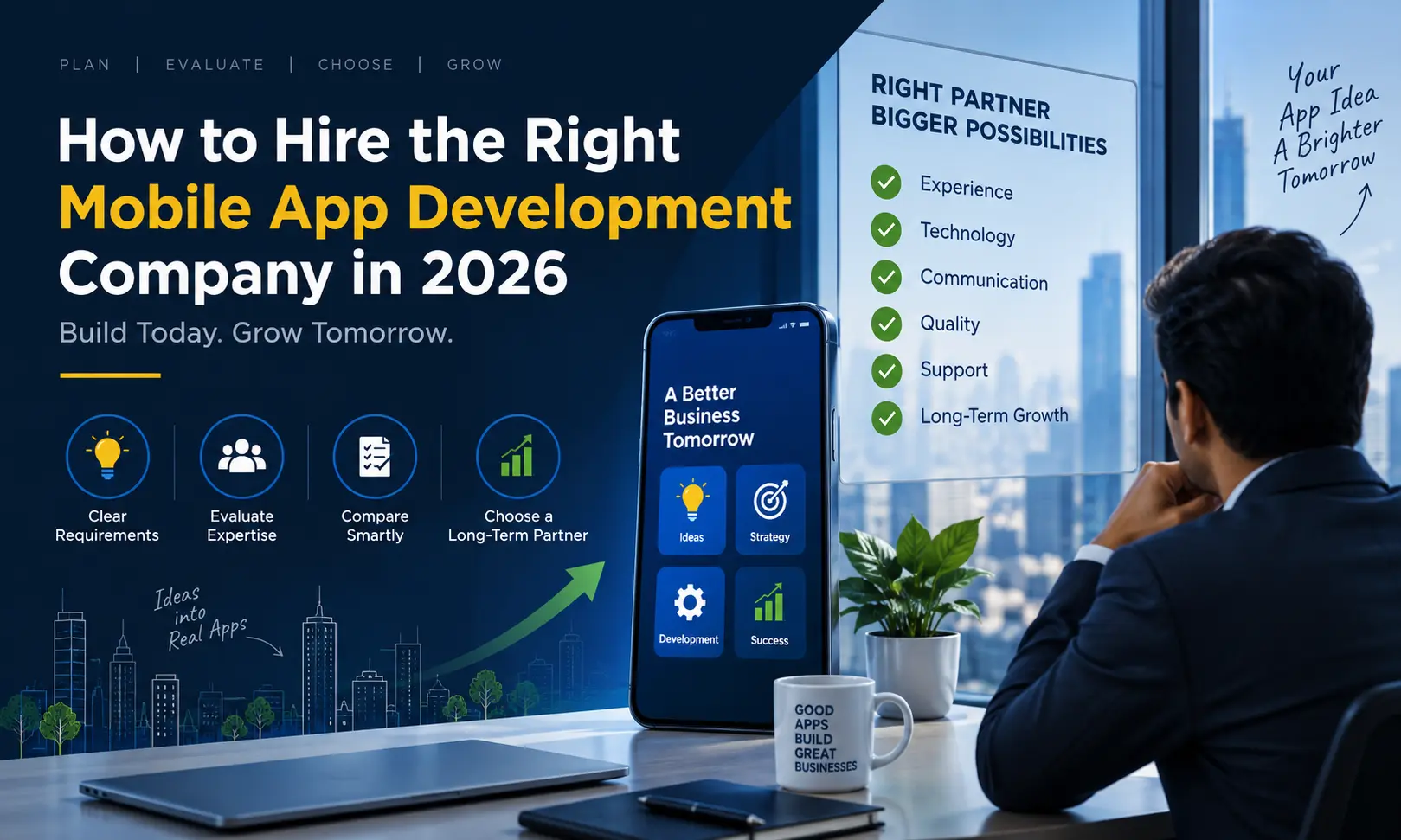
Choosing a mobile app development company in 2026 is no longer a simple exercise of collecting three quotations and selecting the lowest one. A business app can influence customer experience, internal operations, sales, payments, brand perception and even the way a company competes in its market.
That is why the company you hire matters almost as much as the app idea itself.
There are hundreds of agencies, freelancers and development companies offering Android, iOS and cross-platform app development. Their websites may look equally impressive, their portfolios may contain attractive screenshots, and their sales teams may promise quick delivery. But once development begins, the real differences start appearing in communication, technical planning, testing, documentation, project ownership and post-launch support.
If you are planning to build a mobile application in 2026, this guide will help you assess a development company before signing the agreement. The objective is not merely to find someone who can write code. It is to find a technology partner who understands what your business is trying to achieve.
Why Choosing the Right Mobile App Development Company Matters
A mobile application is rarely an isolated piece of software. It may connect with a website, admin panel, payment gateway, CRM, third-party APIs, cloud services, databases and other business systems.
A poor technical decision at the beginning can therefore become an expensive problem later.
For example, a business may initially ask for a simple booking application. During development, requirements may expand to include online payments, customer accounts, notifications, location services, vendor dashboards, coupons, reports and an administrator panel. If the development architecture was not planned with growth in mind, adding these features can become unnecessarily complicated.
The right development company should be able to look beyond today's feature list and understand where the application could go tomorrow.
Start With Your Own Requirements Before Contacting Developers
One of the biggest mistakes businesses make is approaching an app development company with only an idea.
Saying, "I want an app like this," is a starting point, but it is not a complete requirement.
Before contacting development companies, write down the basic purpose of the application. You do not need a 50-page technical document. Even a simple business note can make the initial discussions much more productive.
- What problem will the application solve?
- Who will use the app?
- Will there be customers, vendors, employees or multiple user types?
- Will the app require Android, iOS or both?
- Will users need registration and login?
- Will online payments be required?
- Will the application use GPS or location services?
- Will users upload photographs, documents or videos?
- Will there be an admin panel?
- Will the app connect with an existing website or software?
- Will notifications, chat, booking or subscription features be required?
- What would you consider a successful launch?
This simple exercise also helps you identify whether you are building a small utility app, a customer-facing business application, a marketplace, a SaaS product or a larger digital platform.
Do Not Choose a Company Only Because Its Quotation Is Cheap
Price is important. It should not, however, become the only deciding factor.
Two companies may quote ₹3 lakh and ₹7 lakh for what appears to be the same application. That does not necessarily mean the second company is overpriced.
The quotations may differ because of the technology stack, number of development hours, UI/UX work, testing, backend development, server configuration, security measures, integrations, documentation, project management and post-launch support.
A useful quotation should tell you what you are actually paying for.
Instead of asking only, "What is your app development cost?", ask:
- What features are included?
- How many user roles are included?
- Is UI/UX design included?
- Is backend development included?
- Is an admin panel included?
- Are API integrations included?
- Are payment gateway charges included or separate?
- Are app store publishing services included?
- How many testing cycles are included?
- What happens if requirements change?
- What support is provided after launch?
A detailed proposal makes comparison far easier than a single figure written at the bottom of an email.
Study the Company's Portfolio, But Look Beyond Screenshots
A portfolio can tell you a lot, but screenshots alone can tell you very little.
Ask about the projects behind those screenshots.
If a company says it has developed booking applications, ask what kind of booking system was involved. If it has worked on eCommerce applications, ask whether the project included inventory, payment processing, order management and an administration system.
You should be looking for relevance rather than simply counting the number of projects displayed on a website.
A company that has experience solving problems similar to yours may understand your requirements faster and may already be familiar with the technical complications involved.
Check Whether They Understand Your Business, Not Just Your Features
Good developers should ask questions.
If you explain your app idea and the company immediately sends a quotation without asking anything about your customers, workflow, revenue model or technical requirements, take a closer look at how the project will actually be handled.
A thoughtful discussion may include questions such as:
- How will customers use the application?
- What happens after a customer places an order?
- Who manages the information?
- What happens if a payment fails?
- What should happen when two users perform the same action simultaneously?
- Which information should be visible to each user?
- What reports will the business need?
- Will the application need to communicate with existing software?
These questions may appear small during the first meeting, but they often reveal whether the development team is thinking about the application as a working business system rather than a collection of screens.
Understand the Technology Stack Before You Sign
You do not need to become a programmer to evaluate a development company. But you should understand the broad technology choices being proposed.
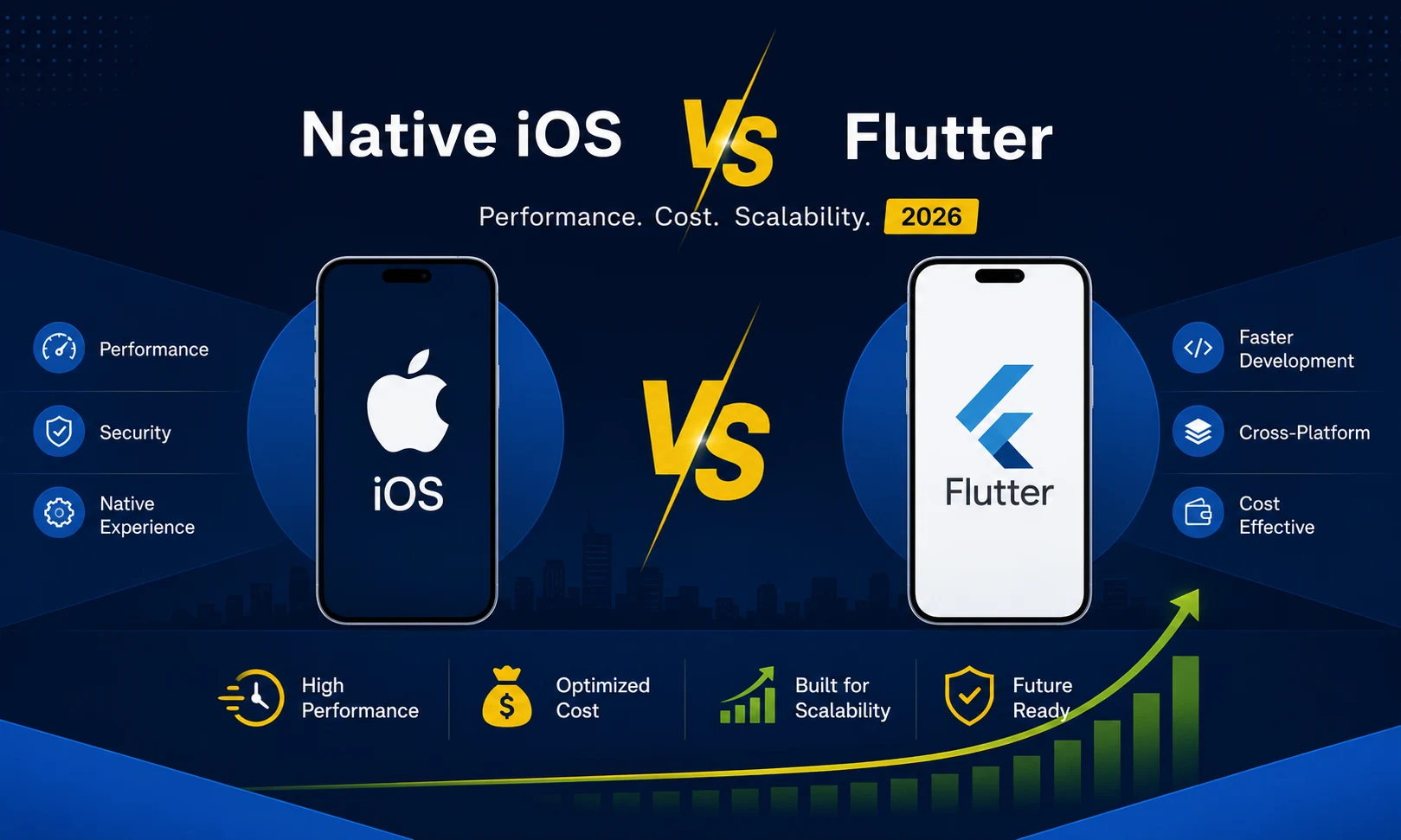
Depending on the project, the development team may recommend native Android development, native iOS development or a cross-platform framework such as Flutter or React Native.
There is no single technology that is automatically right for every business.
The appropriate choice depends on factors such as performance requirements, device features, development budget, future maintenance, team expertise and the need to share code between platforms.
Ask the company why it has selected a particular technology for your project rather than simply accepting the technology name.
Ask About Backend Development and the Admin Panel
Many businesses concentrate heavily on the mobile application and forget about what happens behind it.
The visible app is only one part of the system.
A typical business application may require a backend system to manage users, products, bookings, orders, payments, notifications, reports, permissions and other data.
An administration panel can become the operational control room of the application. It should therefore be discussed during the planning stage rather than added casually at the end.
Ask whether the proposal includes:
- Backend development
- Database design
- Admin dashboard
- User management
- Role-based permissions
- Reports and analytics
- Content management
- API development
- Notification management
- Security controls
Evaluate Their UI and UX Approach
A beautiful interface is useful, but good app design goes further than attractive colours and rounded buttons.
The user should be able to understand what to do next without constantly thinking about where to tap.
During the design discussion, ask how the company approaches user journeys, navigation, forms, error messages, loading states, empty screens and different device sizes.
Ask to see the design prototype before development begins where possible.
A clickable prototype can reveal confusing workflows much earlier than a finished application can.
Ask Who Will Actually Build Your Application
This is an important question that is sometimes overlooked during the sales process.
You may initially communicate with a senior executive or business development manager, but the people developing the application could be completely different.
Ask:
- Who will manage the project?
- Who will handle UI/UX?
- Who will develop the mobile application?
- Who will develop the backend?
- Who will perform testing?
- Who will communicate technical decisions?
If the work will be outsourced or subcontracted, ask about it before signing the agreement.
Check the Development Process
Different companies use different development methods, but there should be a clear process from requirement gathering to launch.
A typical project may move through requirement analysis, UI/UX design, development, backend integration, testing, client review, corrections, deployment and post-launch support.
Ask the company how you will review progress during development.
Regular demonstrations are particularly useful because they allow you to see the application taking shape instead of waiting until the final week to discover that something works differently from what you expected.
Ask How Requirements and Changes Will Be Handled
Requirements change. This is normal in software development.
Perhaps you initially planned five screens and later discovered that a sixth screen is necessary. Maybe a payment provider changes its integration method. Or perhaps your business team decides that a particular workflow should work differently.
The important question is not whether changes are allowed. The important question is how those changes will be handled.
Ask whether additional requirements will be estimated separately, how approval will be obtained and whether changes will affect the delivery schedule.
A written change process can prevent many uncomfortable conversations later.
Do Not Ignore App Security
Security should be discussed before development rather than after an application is completed.
Depending on the nature of the app, security considerations may include secure authentication, password handling, API security, access control, payment security, database protection, data encryption and secure server configuration.
If the application handles personal information, financial information, business records or sensitive documents, ask the development company how those areas will be protected.
You do not need a complicated security lecture. You need clear answers about what information the app stores, where it is stored and who can access it.
Ask About Testing Before Launch
An application can look perfect on the developer's phone and still behave badly on another device.
Testing should therefore cover more than simply checking whether buttons work.
Ask whether the company tests:
- Different screen sizes
- Different operating system versions
- Slow internet connections
- Login and registration flows
- Payment failures
- Form validation
- Push notifications
- App permissions
- Crashes and unexpected behaviour
- Performance under realistic usage
For applications with critical business functions, testing should be treated as a proper project phase rather than a quick final inspection.
Clarify Ownership of the Source Code
This is one of the most important contractual questions to ask.
Find out who owns the source code, design files, database structure, documentation and other project assets after payment.
You should also understand who controls important accounts such as:
- Google Play Console
- Apple Developer account
- Domain and hosting accounts
- Cloud accounts
- Payment gateway accounts
- Third-party API accounts
Where possible, businesses should maintain ownership and administrative control of their core digital assets rather than depending entirely on a vendor's personal accounts.
Understand Post-Launch Support
App development does not necessarily end when the application reaches the Play Store or App Store.
Operating systems receive updates. Devices change. Third-party APIs are modified. Payment gateways introduce new requirements. Users report bugs. Businesses request improvements.
Ask the development company what happens after launch.
- How long is the initial bug-fixing period?
- Is maintenance included?
- How are future enhancements billed?
- How quickly are critical issues addressed?
- Is server maintenance included?
- Who handles app store updates?
- What happens if the original developer is unavailable?
A clear support arrangement can save you from searching for a new technical team immediately after launch.
Compare Proposals on the Same Ground
When comparing multiple companies, create a simple comparison sheet.
Do not compare only the final price. Compare the actual scope.
- Company experience
- Relevant portfolio
- Technology proposed
- UI/UX design
- Mobile development
- Backend development
- Admin panel
- Third-party integrations
- Testing
- Deployment
- Source-code ownership
- Project timeline
- Payment terms
- Warranty or bug-fixing period
- Maintenance options
This simple comparison often exposes why two apparently similar quotations are actually very different.
Watch Out for These Red Flags
Some warning signs deserve attention before you commit your project.
- A quotation is provided without understanding the requirements.
- The company promises an unusually short delivery time without explaining the scope.
- The proposal contains only one total price with no feature breakdown.
- There is no clear person responsible for project communication.
- The company avoids discussing source-code ownership.
- There is no clear testing process.
- Post-launch support is completely undefined.
- The company guarantees that the app will become successful without discussing your business model.
- Technical decisions are presented without explaining why they are suitable for the project.
None of these points automatically means that a company is unsuitable. They are simply signals that deserve further questions before you proceed.
Think About the Total Cost, Not Just the Development Quote
The initial development quotation is only one part of the financial picture.
Depending on your application, you may also have expenses for domain and hosting, cloud infrastructure, SMS services, email services, payment gateway charges, maps and location APIs, app store accounts, third-party services, maintenance and future feature development.
Ask the development company which recurring expenses you should expect after launch.
This gives you a more realistic view of your app's first-year technology cost.
Why Bangalore Businesses Have Plenty of App Development Options
Bangalore has a large technology ecosystem, which gives businesses access to agencies, software companies, product development teams and independent developers.
For a local business, working with a Bangalore-based development company can also make face-to-face discussions easier when the project requires detailed requirement workshops or frequent business meetings.
However, geographical proximity should not be the only selection criterion. The company's portfolio, technical capabilities, communication style, development process and support arrangement should still be examined carefully.
Consider the Company You May Need Two Years From Now
This is a useful way to think about your decision.
Imagine that your application becomes successful.
Will the development company be able to add new features? Can it handle additional integrations? Can it work with a growing database? Can it improve performance? Can another developer understand the existing code if the original team changes?
The right development partner should not only be able to build version 1.0. It should be capable of supporting the application's next chapters as well.
Questions to Ask During Your First Meeting
If you are meeting a mobile app development company for the first time, these questions can help you get beyond the sales pitch:
- Have you developed an application similar to ours?
- Which technology would you recommend and why?
- Will you handle both mobile and backend development?
- Who will be working on our project?
- How will we review development progress?
- How will requirement changes be handled?
- How will the application be tested?
- Who owns the source code?
- Who owns the app store accounts?
- What support is available after launch?
- What recurring costs should we expect?
- What information do you need from us before development begins?
The answers will often tell you more than a polished sales presentation.
A Simple Hiring Checklist for Businesses
Before finalising a mobile app development company, make sure you have clarity on the following:
- Business requirements are documented.
- Features and user roles are clearly defined.
- Technology selection has been explained.
- UI/UX scope is clear.
- Backend and admin panel requirements are included.
- Third-party integrations are identified.
- Project milestones are documented.
- Payment terms are understood.
- Testing responsibilities are clear.
- Source-code ownership is confirmed.
- App store publishing responsibilities are defined.
- Post-launch support is documented.
- Future maintenance costs are understood.
Where to Begin Your Search
If you are looking for a mobile app development team in Bangalore, start by preparing your requirements and then speak with a few relevant companies. Share the same basic requirement with each company so that you can compare their understanding, technical recommendations, project approach and commercial proposal on reasonably similar ground.
W3 Dream Solutions provides mobile app development services in Bangalore for businesses looking to build customer-facing applications, business applications and custom digital solutions.
Final Thoughts
Hiring a mobile app development company in 2026 should be treated as a business decision, not simply a software purchase.
The cheapest quotation may not be the least expensive option in the long run, just as the most expensive quotation does not automatically guarantee the right outcome.
Look at the complete picture: relevant experience, technical understanding, project communication, development methodology, security, testing, ownership, support and the company's ability to work with you as the application grows.
Most importantly, do not rush into development simply because you have found a company that can start immediately. Spend time getting the requirements, scope and responsibilities clear at the beginning.
A well-chosen development partner can help turn an idea into a dependable business application. A poorly defined partnership can turn even a good idea into an expensive learning experience.
Take the time to ask the difficult questions before signing. It is usually far easier to solve a problem on paper than after thousands of lines of code have already been written.
Other Blogs
Subscribe
Get the latest blog updates directly in your inbox.