




Introduction
Many businesses planning an eCommerce platform often face one important question — should they build a single seller online store or create a multi vendor marketplace like Amazon or Flipkart?
At first glance, both models may look similar because customers browse products, add to cart, and make payments online. However, behind the scenes, the business structure, revenue flow, operational workload, and technology architecture are completely different.
Understanding these differences is essential before investing in development, especially for businesses operating in competitive markets like Bangalore and across India.
What is a Single Seller eCommerce Platform?
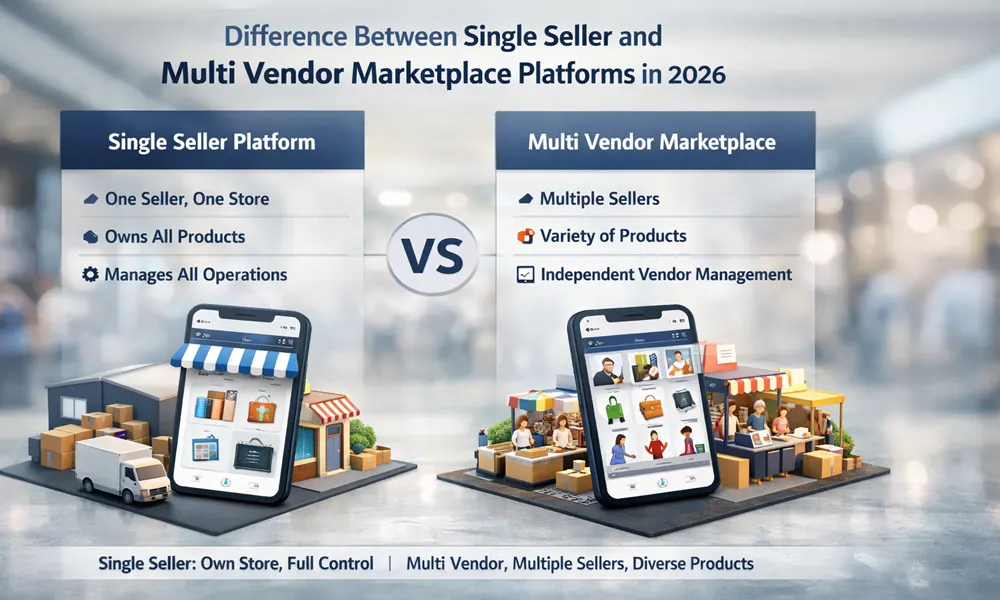
A single seller platform is a website or app where all products belong to one business or brand. Inventory, pricing, delivery management, and customer service remain under direct control of the company.
Examples include brand-owned stores, niche product websites, and D2C businesses selling their own catalogue.
Key Characteristics:
- One seller manages all products
- Centralised inventory system
- Brand-controlled customer experience
- Simplified admin structure
- Faster decision-making process
This model is ideal for businesses that manufacture products, run wholesale distribution, or focus on a specific niche.
What is a Multi Vendor Marketplace?
A multi vendor marketplace allows multiple independent sellers to register and list their products on a shared platform. The website owner acts as a marketplace operator rather than the product seller.
Famous examples include Flipkart, Amazon, and Meesho.
Core Features:
- Vendor registration and approval system
- Commission or subscription-based revenue model
- Individual seller dashboards
- Multi-source inventory management
- Advanced logistics and payment workflows
Instead of selling directly, the platform generates income through commissions, listing fees, or premium seller plans.
Major Differences Between Single Seller and Multi Vendor Platforms
1. Business Structure
Single seller platforms operate like a digital showroom for one brand. Multi vendor marketplaces function like a digital mall where many sellers compete and collaborate.
2. Revenue Model
Single seller platforms earn profits from product margins, while multi vendor platforms generate revenue through commissions, subscriptions, and promotional placements.
3. Operational Complexity
Single seller websites are easier to manage because all processes stay within one system. Multi vendor platforms require vendor onboarding workflows, commission tracking, dispute handling systems, and seller performance monitoring.
4. Technology Requirements
Single seller websites need standard eCommerce functionality. Multi vendor marketplaces demand advanced modules such as vendor dashboards, separate order flows per seller, commission automation, and multi-level admin control.
5. Marketing Strategy
Single seller businesses focus on brand visibility, while multi vendor marketplaces work on attracting both customers and sellers at the same time.
Advantages of Single Seller Platforms
- Better brand identity and consistency
- Full control over pricing and product quality
- Easier logistics management
- Lower initial investment
- Faster launch timeline
This approach suits startups testing a niche product category or businesses transitioning from offline retail to online selling.
Advantages of Multi Vendor Marketplaces
- Large product catalogue without owning inventory
- Faster scalability
- Vendor-driven growth
- Multiple revenue streams
- Increased customer engagement due to product variety
However, success requires strong planning, clear vendor policies, and scalable infrastructure.
Which Model is Better for Indian Businesses?
The right choice depends on business goals.
Single seller platforms work best for businesses that own or manufacture products, want strong brand positioning, and prefer operational simplicity.
Multi vendor platforms suit entrepreneurs who want to build a marketplace ecosystem, manage multiple sellers, and earn from platform activity rather than direct product ownership.
In cities like Bangalore, many startups begin with a single seller model and gradually expand into multi vendor marketplaces after gaining traction.
Cost and Development Considerations
Single seller platforms generally cost less because development complexity is lower, fewer integrations are required, and backend workflows remain simple.
Multi vendor marketplaces involve custom architecture planning, vendor management modules, advanced reporting systems, and stronger server infrastructure for scaling.
Choosing the wrong model can lead to unnecessary expenses or operational difficulties later.
Final Thoughts
Selecting between a single seller website and a multi vendor marketplace is not just a technical decision; it is a business strategy decision.
If your priority is brand-focused selling with controlled operations, a single seller platform makes sense. If your goal is building a large digital marketplace connecting multiple sellers and customers, then a multi vendor approach becomes the right direction.
Understanding these differences early helps avoid costly restructuring and ensures long-term growth aligned with your business vision.
If you are planning to launch either model, consult a professional Website Development Company in Bangalore to choose the right architecture based on your business goals.
Other Blogs
Subscribe
Get the latest blog updates directly in your inbox.