
When a business decides to build a website, one of the first things that often creates confusion is the difference between website design and website development. Many people use these two terms as if they mean the same thing. They do not.
Think of a website like a commercial building. The design decides how the building should look, how visitors should move through it and where everything should be placed. Development is the work that makes the doors open, lights switch on, lifts move and the entire building function as intended.
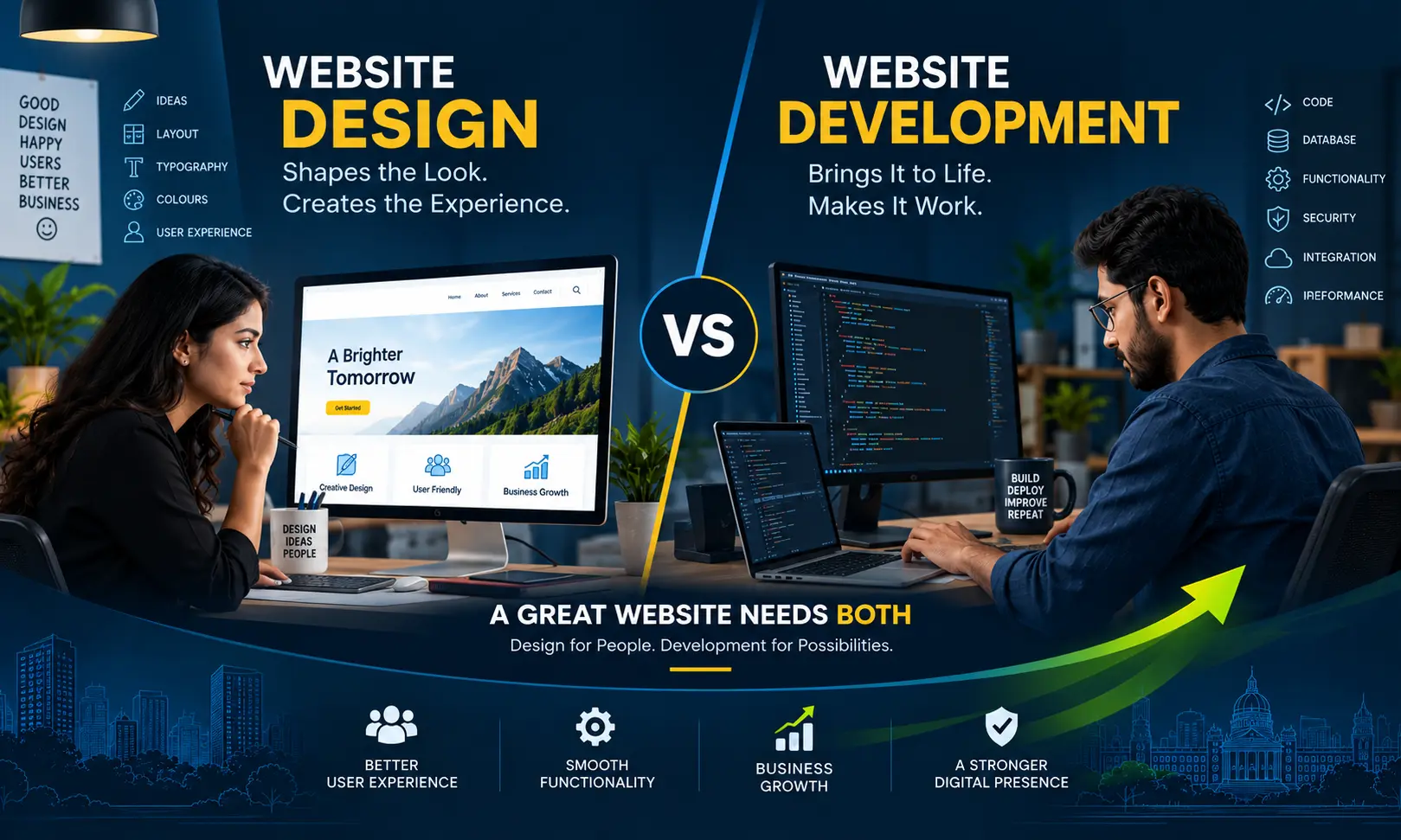
The same principle applies to a website. Design deals largely with the visual experience and user interaction, while development deals with the technical construction and functionality behind the website.
For a small business owner, startup founder or established company in Bangalore, understanding this difference is useful before discussing a website project with a web agency or development team. It helps you ask better questions, understand quotations properly and avoid paying for things you do not actually need.
More importantly, a website cannot be judged only by its appearance. A beautiful website that is slow, difficult to navigate or technically unreliable can frustrate visitors. At the same time, a technically capable website with poor layout and confusing navigation can fail to hold people's attention.
That is why website design and website development need to work hand in hand.
What Is Website Design?
Website design is mainly concerned with how a website looks, feels and behaves from the visitor's point of view.
It includes decisions about page layout, typography, colours, images, buttons, menus, spacing, visual hierarchy and the overall user experience. A designer thinks about what a visitor should notice first, where they should click next and how easily they can find the information they came looking for.
For example, consider a company selling industrial machinery. The designer may decide that the product categories should be immediately visible, enquiry buttons should be easy to spot, technical specifications should have a clean structure and important product images should receive enough visual space.
These may look like simple visual decisions, but they can have a direct effect on how comfortably a visitor uses the website.
What Does a Website Designer Usually Work On?
- Website page layouts
- Homepage structure
- Navigation menus
- Typography and font selection
- Colour combinations
- Buttons and call-to-action elements
- Images and visual presentation
- Mobile and tablet layouts
- User interface elements
- User experience and visitor flow
- Landing page layouts
- Forms and enquiry sections
- Product and service presentation
A good designer does not simply try to make a website attractive. The real question is whether the design makes the website easier to understand and use.
What Is Website Development?
Website development is the technical side of building a website.
Once the design gives a visual direction, developers work on turning that concept into a functioning website. They write code, connect databases, create forms, develop business logic, integrate third-party services and make different parts of the website work together.
For example, if a website has a product search feature, customer login, online payment, booking system or admin panel, development is responsible for making those functions actually operate.
A visitor may only see a simple login screen. Behind that screen, however, there could be database queries, authentication logic, security checks and server-side processes running in the background.
What Does a Website Developer Usually Work On?
- Frontend development
- Backend development
- Database integration
- Forms and enquiry systems
- Content management systems
- Admin panels
- Payment gateway integration
- API integration
- User registration and login systems
- Booking and reservation functionality
- Search and filtering systems
- Server-side programming
- Website security
- Performance improvements
- Testing and bug fixing
In simple words, design decides what the visitor sees, while development makes the website work.
Website Design vs Website Development: The Core Difference
The easiest way to understand the distinction is to look at the purpose of each discipline.
- Website design: Focuses on appearance, usability, layout and visitor experience.
- Website development: Focuses on coding, functionality, databases, integrations and technical performance.
However, the boundary is not always as rigid as it sounds. Modern web projects often involve designers and developers working closely from the beginning. A design decision can affect development effort, and a technical limitation can influence the final design.
For instance, a designer might create an animation that looks impressive in a prototype. The developer then needs to determine how it should be implemented without making the page unnecessarily heavy or slow.
This is why treating design and development as two completely isolated activities can create problems later.
Frontend and Backend: Where Does Development Fit In?
Website development itself has different layers.
Frontend Development
Frontend development deals with the part of the website that visitors interact with directly.
Menus, sliders, buttons, forms, product cards, animations and responsive layouts all fall within the visitor-facing side of a website.
Common technologies include HTML, CSS and JavaScript, along with frameworks and libraries used for modern web interfaces.
Backend Development
Backend development works behind the visible website.
It can handle databases, user accounts, authentication, orders, payments, admin systems, APIs and business rules.
Technologies can include PHP, Laravel, CodeIgniter, Node.js, Python and various database systems, depending on the project's requirements.
A visitor may never see the backend directly, but a large part of the website's reliability depends on it.
Why Website Design Matters to a Business
Your website is often one of the first places where a potential customer encounters your company.
Within a few seconds, visitors begin forming an impression. A cluttered layout, outdated visual style, confusing menu or difficult mobile experience can create unnecessary friction.
Good design helps visitors understand three things quickly:
- Who you are
- What you offer
- What they should do next
This becomes particularly important for service businesses. A website for a construction company, travel company, software agency or interior design firm should not merely display information. It should guide visitors towards useful actions such as making an enquiry, requesting a quotation, calling the business or submitting a form.
Design therefore has a commercial role. It is not just decoration.
Why Website Development Matters to a Business
A website can look excellent and still be a poor business tool if its technical foundation is weak.
Imagine an e-commerce website where the product pages look attractive but the checkout fails. Or a travel website where the booking form does not send enquiries. Or a corporate website where the admin team cannot update important content without depending on a developer every time.
These are development problems, not design problems.
Good development ensures that the website's functions work as expected and that the business can manage its digital operations without unnecessary headaches.
Development also becomes increasingly important as a website grows. A simple five-page company website may need relatively little backend logic. A marketplace, travel portal, educational platform or e-commerce website may require considerably more technical architecture.
Can You Have Good Design Without Good Development?
Yes, but the result may disappoint you.
A visually impressive website can be created as a design prototype. But until that design is properly developed, tested and connected to the required functionality, it is not a complete business website.
Even after development, problems can appear if the implementation does not respect the original design properly.
For example:
- The mobile layout may break.
- Images may load slowly.
- Buttons may not function correctly.
- Forms may fail to deliver enquiries.
- Dynamic content may display incorrectly.
- Third-party integrations may malfunction.
This is why the handover from design to development should not be treated as a simple file transfer. Communication between both sides matters.
Can You Have Good Development Without Good Design?
Again, yes.
A website can be technically sound, secure and fast while still being difficult for visitors to use.
It may have a properly configured database, working backend and clean code, but if the navigation is confusing or important information is buried under several pages, visitors may simply leave.
Technical correctness alone does not guarantee a good visitor experience.
That is the central reason businesses need both disciplines.
How Website Design and Development Work Together
A well-planned website project usually moves through several connected stages.
- Requirement understanding: The business explains its goals, audience, services, products and required features.
- Website planning: The page structure, navigation and functionality are mapped out.
- Design: Visual layouts and user journeys are created.
- Development: The approved design is converted into a functioning website.
- Integration: Databases, forms, payment gateways, APIs and other required systems are connected.
- Testing: Pages and features are checked across devices and browsers.
- Launch: The website is deployed on the live server.
- Maintenance: Updates, fixes, security work and future improvements are handled as required.
The process can vary from one project to another. A basic business website may have a relatively straightforward workflow, while a large portal can involve several rounds of design, development and testing.
Website Design and Development: Which One Costs More?
There is no single answer because project cost depends on what is actually being built.
A simple informational website with a few pages can require limited design and development work. An e-commerce store with hundreds of products, payment integration, customer accounts, order management and an admin panel involves a different level of effort.
Likewise, a custom travel portal with search, booking, APIs and multiple user roles cannot reasonably be compared with a five-page corporate website.
When comparing quotations, businesses should therefore look beyond the headline price.
Check what is included:
- Number of pages
- Design work
- Responsive development
- CMS or admin panel
- Database development
- Third-party integrations
- Payment gateway integration
- Content migration
- SEO-related technical setup
- Testing
- Hosting and deployment
- Maintenance or AMC
A cheaper quotation may sometimes represent a smaller scope rather than a better bargain.
Do Small Businesses Really Need Both?
Yes, although the scale of each may be different.
A local business may not need an elaborate custom platform. A clean, mobile-friendly website with well-organised content, enquiry forms and essential business information may be enough.
But even a small website needs sensible design and reliable development.
For example, a Bangalore-based interior design company may only need ten to fifteen pages, but its portfolio, enquiry form, service pages, testimonials and contact information should be presented clearly. The website should also work properly on mobile phones because many potential customers will discover the company through mobile search.
The requirement should decide the technology and complexity, not the other way around.
Design Is More Than Colours and Pictures
One common misunderstanding is that website design means selecting colours, images and fonts.
Those are certainly part of it, but good web design goes deeper.
It involves hierarchy, spacing, readability, navigation, interaction patterns, content placement and the sequence in which information is presented.
Suppose a visitor lands on a service page. Should they see a large image first? A service summary? A quotation button? Customer reviews? Frequently asked questions? A phone number?
These decisions shape the visitor's journey.
The strongest designs often feel simple because the difficult decisions have already been made behind the scenes.
Development Is More Than Writing Code
Similarly, development is not simply about writing lines of programming code.
A developer must understand how different components interact. They need to consider database structure, server configuration, security, validation, performance, browser compatibility, error handling and future maintenance.
For a business website, even something as ordinary as a contact form needs proper handling. The submitted information needs to reach the right destination, spam should be controlled, validation should be considered and the form should work correctly on different devices.
Behind a simple-looking feature, there can be a surprising amount of technical thinking.
How This Difference Helps When Choosing a Web Company
When speaking with a web design or development company, ask whether they are discussing only the appearance of your website or the complete digital system.
A useful discussion should cover both sides.
- How will the website look?
- How will visitors navigate it?
- How will the website work on mobile devices?
- What technology will be used?
- Will there be an admin panel?
- How will forms and enquiries be handled?
- Are payment or third-party integrations required?
- Who will manage website updates?
- What happens after the website goes live?
These questions can reveal whether a proposal has been thoughtfully prepared or is simply a list of generic website features.
Website Design vs Website Development: A Quick Comparison
- Main focus: Design focuses on appearance and user experience; development focuses on functionality and technical operation.
- Primary concern: Design asks how the website should look and feel; development asks how it should work.
- Typical output: Design produces layouts and interface concepts; development produces the functioning website.
- Visitor interaction: Design plans the interaction; development implements it.
- Technology: Design may involve design and prototyping tools; development involves programming languages, frameworks, databases and servers.
- Business impact: Design can influence first impressions and usability; development affects functionality, reliability and technical performance.
Why Both Matter for SEO
Search engine optimisation is not limited to adding keywords to a page.
The website's structure, mobile experience, page performance, content organisation, technical implementation and accessibility can all matter when building a search-friendly website.
Design has a role because visitors need to be able to read and navigate the content comfortably. Development has a role because the website needs technically sound implementation.
There is also an important practical point: SEO should not be treated as something that starts only after the website has been launched.
Website structure, URL planning, headings, internal links, page speed considerations and other technical elements can be considered during the build itself.
What Should a Business Decide Before Starting a Website Project?
Before approaching a web development company, it is worth preparing a basic requirement document.
You do not need a twenty-page technical specification. Even a simple list can save considerable time.
- Purpose of the website
- Target customers
- Required pages
- Products or services to display
- Features required
- Need for an admin panel
- Payment requirements
- Third-party integrations
- Content and images available
- Reference websites you like
- Approximate launch timeline
- Future expansion plans
This gives the designer and developer something concrete to work with instead of building the project around assumptions.
Website Design and Development in Bangalore
Bangalore has a broad mix of startups, IT companies, manufacturers, professional service firms, retailers, educational businesses and growing local brands. Their website requirements can therefore be dramatically different.
A startup may need a sharp company website to explain its product. A manufacturer may need a catalogue website with technical specifications. A travel company may need enquiry and booking functionality. An e-commerce business may require product management, payments and order processing.
For this reason, there is no universal website formula that works for every Bangalore business.
The right starting point is the business requirement, followed by the appropriate combination of design, development and technology.
For businesses looking for website design and development services in Bangalore, W3 Dream Solutions works on business websites, custom web development and different types of web-based solutions based on project requirements.
Should You Hire a Designer and Developer Separately?
That depends on the size and nature of your project.
For a large digital product, having dedicated UI/UX designers, frontend developers, backend developers and other specialists can make sense.
For a small or medium-sized business website, working with a capable web development company that can manage both design and development may make the process easier. It reduces communication gaps between separate teams and can keep the project moving in one direction.
The important point is not whether there are two people or ten people involved. What matters is whether the project receives proper attention on both the visual and technical sides.
The Real Question Is Not Design vs Development
Perhaps the biggest takeaway is that businesses should not think of website design and website development as competing choices.
They solve different problems.
Design answers questions such as:
- What should visitors see?
- How should information be organised?
- How can navigation be made clearer?
- How should the brand be represented online?
Development answers questions such as:
- How will the website function?
- Where will information be stored?
- How will users submit forms or make payments?
- How will the admin manage the website?
- How will different systems communicate?
A successful website needs answers to both sets of questions.
Final Thoughts
Website design and website development are different disciplines, but neither works at its best in isolation.
A well-designed website can create a strong first impression, guide visitors and make information easier to consume. Good development gives that design a working engine, allowing forms, databases, integrations, content management and other functions to operate properly.
For a business owner, the goal should therefore not be to choose between design and development. Instead, understand what your website actually needs and make sure both sides receive adequate attention.
Whether you are planning a simple company website, an e-commerce store, a service portal or a larger custom web application, a clear combination of thoughtful design and dependable development can make the difference between a website that merely exists and one that genuinely supports day-to-day business activity.
And before approving any website proposal, ask one simple question: “What exactly am I getting on the design side, and what exactly am I getting on the development side?” That one question can make the entire project much clearer.
For businesses in Bangalore looking to discuss a new website, redesign an existing website or build a custom web solution, you can visit W3 Dream Solutions to learn more about the services and solutions offered.
Other Blogs
Subscribe
Get the latest blog updates directly in your inbox.