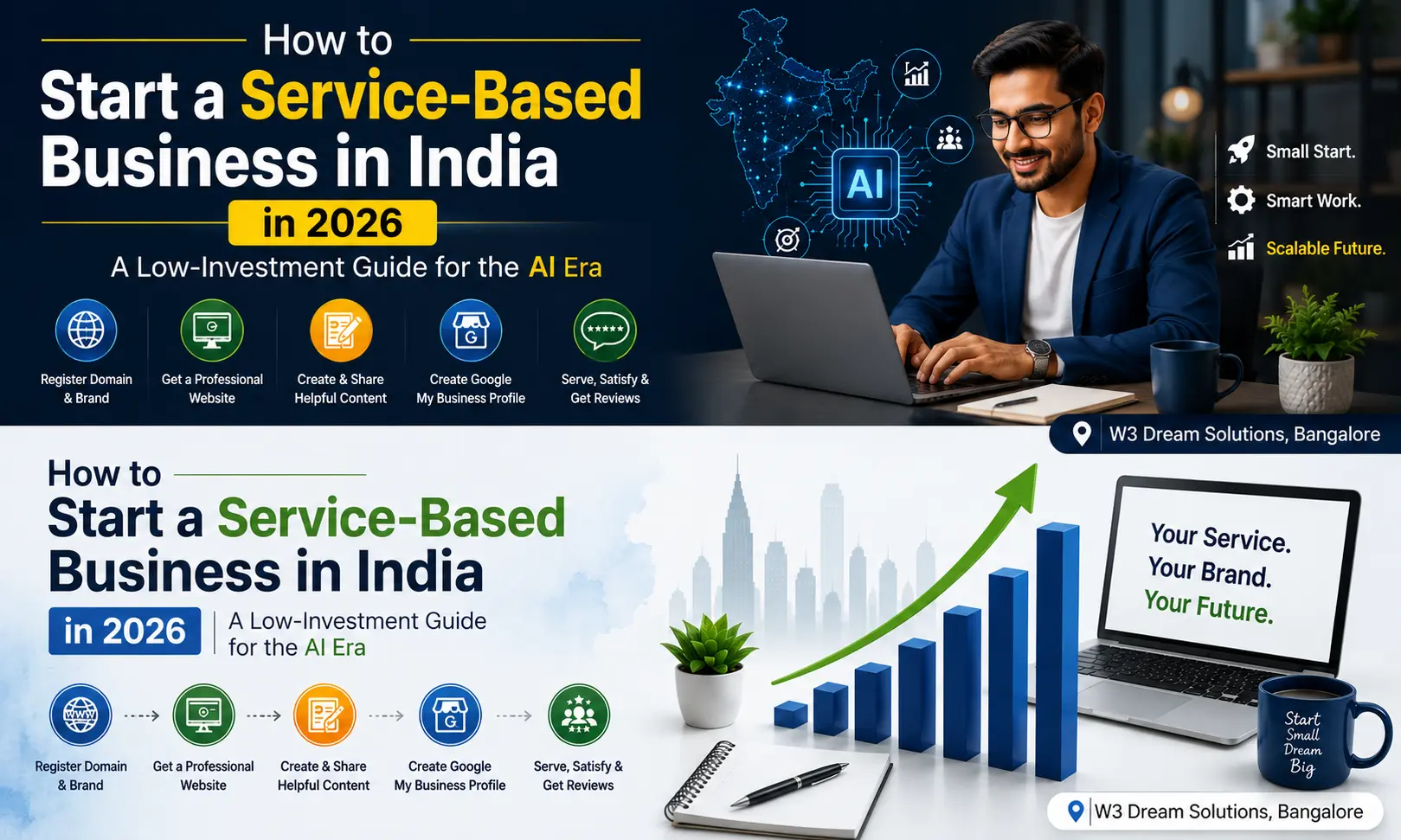

How to Start a Service-Based Business in 2026: A Low-Investment Guide for the AI Era
Starting a business does not always mean renting an office, hiring a team and investing lakhs of rupees before getting your first customer.
In 2026, a skilled individual can start a service-based business with a laptop, internet connection, a professional identity and a useful skill.
The bigger change is artificial intelligence.
AI tools have made many tasks faster and easier. Research, content ideas, design assistance, coding support, customer communication, marketing and several other activities can now be handled with the help of AI. But there is one thing AI has not removed from business: the need for someone who understands the customer's problem and can deliver a result.
That is where a service-based business still has a strong place.
Whether you are a web developer, designer, digital marketer, consultant, photographer, accountant, trainer, video editor, software professional or someone with a specialised skill, 2026 can be a good time to turn that skill into a business.
The trick is not to chase every new AI tool.
The trick is to build a real service around a real customer problem and use AI as a productivity partner.
This guide explains how to start a small service-based business in India with relatively low investment and build it step by step.
What Is a Service-Based Business?
A service-based business sells expertise, time, skill or a result rather than a physical product.
For example:
- Website design and development
- Digital marketing
- SEO services
- Graphic design
- Video editing
- Social media management
- Accounting and bookkeeping
- Business consulting
- Photography and videography
- Interior design
- Content writing
- Recruitment services
- IT support
- Training and coaching
- Travel planning and consultancy
- Home maintenance services
- Event management
The investment required can vary significantly depending on the service. Some businesses can begin from home with a laptop, while others may require equipment, licences or a small office.
The biggest advantage is that you can start small and increase your investment as the business begins generating revenue.
Why 2026 Is an Interesting Time to Start a Service Business
The business landscape has changed considerably.
Earlier, a small business owner might need to spend considerable time and money on tasks such as preparing marketing material, researching competitors, creating content, organising information and handling repetitive administrative work.
AI can now assist with many of these activities.
That does not mean every business should become an "AI business".
Instead, think of AI as a business-side accelerator.
A website developer can use AI to speed up research and coding tasks.
A digital marketer can use AI to generate initial content ideas and analyse information.
A designer can use AI during brainstorming and concept development.
A consultant can use AI for research and documentation.
A video professional can use AI for scripting, subtitles and editing assistance.
The customer is still paying for the final outcome, judgement, communication and responsibility.
That distinction is important.
Start With a Skill, Not a Business Name
One common mistake beginners make is spending weeks deciding on a business name before deciding what they are actually going to sell.
Reverse the process.
Start with your skill.
Ask yourself:
- What am I good at?
- What problem can I solve?
- Who needs this service?
- Can businesses or individuals pay for it?
- Can I deliver the service consistently?
- Can the service be provided remotely?
- Can I eventually hire someone else to help deliver it?
For example, "I know Photoshop" is a skill.
"I create professional social media creatives for small businesses" is a service.
"I help Bangalore restaurants create monthly social media content and promotional creatives" is an even clearer business proposition.
The more clearly you define the problem you solve, the easier it becomes to market yourself.
Choose a Service People Are Already Paying For
Do not select a business only because something is trending on Instagram or YouTube.
Look for an existing demand.
Technology Services
- Website development
- Mobile app development
- Software development
- Website maintenance
- WordPress development
- Custom portals
- CRM development
- Business automation
- AI integration services
Marketing Services
- SEO
- Local SEO
- Social media management
- Digital advertising
- Content marketing
- Email marketing
- Lead generation
Creative Services
- Graphic design
- Video editing
- Reels production
- Product photography
- Branding
- Presentation design
Professional Services
- Accounting
- Recruitment
- Business consulting
- Documentation services
- Training
- Coaching
The goal is not to offer everything.
A small business often becomes easier to remember when it is known for a specific service.
Find a Niche Instead of Trying to Serve Everyone
Suppose you start a digital marketing business.
You can say:
"We provide digital marketing services."
Or you can say:
"We help local interior designers generate enquiries through Google and social media."
The second statement immediately tells a potential customer what you do and whom you serve.
You do not necessarily have to remain in that niche forever.
But starting with a defined customer group can make your marketing much sharper.
- Restaurants
- Real estate companies
- Interior designers
- Construction companies
- Clinics
- Travel companies
- Educational institutions
- Local retailers
- Manufacturers
- Professional consultants
- Startups
- Small online businesses
Start narrow enough to become memorable.
Expand later.
Decide How Much You Can Invest
A service business does not automatically require a huge starting budget.
Your initial expenses may include:
- Domain name
- Professional website
- Business email
- Branding
- Laptop or computer
- Internet connection
- Software subscriptions
- Accounting and compliance
- Marketing
- Business registration, where applicable
- Professional photography or promotional material
Do not spend your entire budget on appearance.
At the beginning, your biggest asset is your ability to get a customer and deliver good work.
A simple rule is useful:
Spend enough to look trustworthy, but not so much that you need customers immediately just to recover your setup cost.
Build a Proper Brand From Day One
This is one area where many small businesses cut corners.
They create a random Instagram page, use one name on Facebook, another name on WhatsApp and a completely different name on their website.
Avoid this.
Choose one business name and try to maintain the same brand identity everywhere.
Register Your Domain and Secure Your Brand Name
Once you finalise your business name, check its availability across important platforms.
Consider securing:
- Your domain name
- Instagram username
- Facebook page name
- LinkedIn company page
- YouTube channel
- X or other relevant social platforms
- Google Business Profile
- Relevant business directories
- Industry-specific directories
- Classified and local business listing websites
The exact platforms will depend on your industry.
The important point is consistency.
If your company is called "ABC Digital", try to use the same or very similar identity everywhere.
A customer should not have to wonder whether two different profiles belong to the same company.
Why Consistent Branding Matters
Imagine seeing:
- Website: ABC Digital
- Instagram: ABC_Digital_123
- Facebook: Best Web Solutions Bangalore
- Google listing: ABC Web Technologies
- WhatsApp: Rahul Website Services
This creates unnecessary confusion.
A consistent name, logo, profile image, phone number, email address and website address creates a much cleaner business footprint.
Your online identity should look like one company, not five disconnected experiments.
Get a Professional Website
Your website is not just an online visiting card.
For a service business, it can act as your 24-hour sales assistant.
A potential customer may discover you through Google, Instagram, LinkedIn, a referral or a business directory and then visit your website before contacting you.
That moment matters.
Do Not Depend on a Free Website
If you are serious about building a business, do not make a free website your long-term identity.
Free website builders can be useful for testing an idea, but a professional service business should eventually have its own domain and a proper website.
Also, think carefully before asking a friend to build your business website simply because they can create websites.
Your business website represents your company to strangers.
It should communicate:
- What you do
- Who you serve
- Your experience
- Your services
- Your work
- Your contact details
- Your location
- Your credibility
- Why someone should contact you
If you do not have the technical knowledge to create this properly, consider getting it developed by an experienced professional.
A poorly planned website can make even a good business look inexperienced.
For example, if you are looking for professional website development for your service business, you can explore the website development services offered by W3 Dream Solutions, a Bangalore-based web development company.
Your Website Should Answer One Question Quickly
When someone lands on your homepage, they should understand within a few seconds:
"What does this company do for me?"
Avoid filling the first screen with complicated corporate language.
Instead, make the value clear.
For example:
"We build websites for small and growing businesses."
is easier to understand than:
"We provide next-generation digital ecosystem solutions for modern enterprises."
Simple language often sells better.
Create Service Pages
Do not put every service into one giant paragraph.
If you offer multiple services, create separate pages where appropriate.
- Website Development
- Ecommerce Development
- SEO Services
- Digital Marketing
- Software Development
- Website Maintenance
Each page can explain:
- What the service is
- Who needs it
- What you provide
- Your process
- Common questions
- Examples of work
- How customers can contact you
This also gives search engines more relevant pages to understand.
Create a Portfolio Before You Have Many Customers
A new business faces a classic problem:
"I need customers to build a portfolio, but customers want to see a portfolio before hiring me."
You can break this loop.
Create sample projects.
If you are a graphic designer, create sample brand identities.
If you are a website developer, build demo websites for different industries.
If you are a video editor, create sample reels.
If you are a photographer, build a portfolio from suitable projects you have permission to display.
Do not pretend that sample work belongs to a real customer.
Simply label it as concept or sample work.
A strong portfolio can communicate your ability even before you have a long customer list.
Use Your Existing Network to Get the First Projects
Your first customers may not come from Google.
They may come from people you already know.
Tell your friends, former colleagues, relatives, business contacts, local shop owners and professional network what service you have started offering.
Do not simply say:
"I have started a business. Please give me work."
Explain exactly what you do.
For example:
"I have started offering website development for small businesses. If you know a business owner who needs a new website or wants to improve an existing website, please connect us."
That is easier for someone to remember and refer.
Give Your First Services to Known People — But Do It Professionally
This is another practical way to build your initial reputation.
You can provide your service to friends, relatives or known business owners.
However, avoid doing everything for free.
If a genuine project requires significant work, charge a reasonable introductory price.
If you decide to provide a free service, clearly define what is included.
Most importantly, use the project to create:
- Portfolio material
- A case study
- A testimonial
- A Google review
- Referral opportunities
The first few projects are not only about revenue.
They are also about creating proof that you can deliver.
Ask Happy Customers for Google Reviews
Reviews are extremely valuable for a local service business.
Once you have completed a project successfully and the customer is genuinely happy, ask them for an honest Google review.
Do not buy fake reviews.
Do not create reviews yourself.
Do not ask people who never used your service to pretend they are customers.
Instead, build real reviews from real work.
A simple message after successful project completion can be enough:
"Thank you for choosing us. If you are happy with our service, we would really appreciate an honest Google review. It will help other customers understand our work."
A few genuine reviews can make a new business look much more established.
Create a Free Google Business Profile
If your business serves a particular city or local market, setting up a Google Business Profile should be high on your checklist.
It can help people discover your business when they search for relevant services locally.
Keep your profile accurate.
Add:
- Business name
- Correct category
- Phone number
- Website
- Business hours
- Business description
- Photos
- Logo
- Service information
- Location or service area, as appropriate
Keep the information consistent with your website and other business profiles.
Google Business Profile is free, but the real value comes from keeping it active and credible.
Keep Posting Service-Based Content Everywhere
Opening social media accounts is easy.
Keeping them alive is the difficult part.
A service business should regularly demonstrate what it knows.
You do not have to post motivational quotes every day.
Create content around your actual service.
For example, a website development company could publish:
- Common website mistakes
- Website speed tips
- Mobile-friendly design tips
- Before-and-after website examples
- Website security advice
- SEO basics
- Small business website ideas
- Ecommerce mistakes
- AI and website development
- Website cost explanations
- Client success stories
A digital marketing company could publish:
- Google Business Profile tips
- SEO mistakes
- Social media ideas
- Advertising tips
- Local marketing strategies
A designer could show:
- Design breakdowns
- Logo concepts
- Colour combinations
- Before-and-after designs
- Branding mistakes
Your content should repeatedly answer one silent question:
"Does this person actually know what they are doing?"
Do Not Post Only Promotional Content
If every post says "Contact us today", "Best service in town", "Call now" or "Limited offer", people will eventually ignore you.
Mix promotional posts with useful posts.
A good content pattern can include:
- Educational content
- Industry observations
- Practical tips
- Case studies
- Customer results
- Behind-the-scenes content
- Common mistakes
- Frequently asked questions
- Service explanations
- Promotional content
Teach first.
Sell naturally.
Use AI — But Do Not Let AI Become Your Business
This is one of the biggest lessons for service businesses in 2026.
AI can help you work faster.
But if your entire business is simply copying AI-generated content and selling it without expertise, competition will become brutal.
Use AI to assist with:
- Research
- Brainstorming
- Drafting
- Data organisation
- Coding assistance
- Content ideas
- Customer communication drafts
- Documentation
- Internal workflows
- Repetitive tasks
But add your own judgement.
Your customer does not need another AI-generated paragraph.
They need someone who understands their business.
That is the part you should sell.
Think of AI as Your Small Team's Extra Pair of Hands
A one-person business can now accomplish tasks that previously required several people.
That can be powerful.
But there is a trap.
When AI makes something easy, everyone can start offering the same service.
So your competitive advantage should not simply be:
"I use AI."
Instead, it should be:
"I understand this industry, I know the customer's problem and I can deliver the final result."
AI may help you get there faster.
Your expertise is what makes the result valuable.
Build a Simple Pricing Structure
Do not randomly decide prices for every customer.
Create a basic pricing structure.
Basic Package
For customers who need a simple service.
Standard Package
For businesses that need additional features or support.
Premium Package
For customers requiring more advanced work, customisation or ongoing support.
The exact pricing depends on your industry, experience, market and delivery cost.
Do not compete only by being the cheapest.
There will almost always be someone willing to quote less.
Instead, communicate what the customer receives for the price.
Always Define Your Scope
Many small businesses lose money because they agree to a project without clearly defining what is included.
Before starting work, document:
- Services included
- Number of revisions
- Delivery timeline
- Customer responsibilities
- Payment terms
- Additional charges
- Cancellation terms
- Support period
- Ownership and licensing, where relevant
A simple written proposal can prevent many future misunderstandings.
Ask for an Advance Payment
For project-based services, consider collecting an advance before beginning significant work.
The percentage can depend on your industry and project size.
The principle is simple:
Do not invest weeks of your time into a project without a clear commercial commitment from the customer.
Your time is also an investment.
Separate Business Money From Personal Money
Even when your business is very small, start developing good financial habits.
Track:
- Revenue
- Expenses
- Customer payments
- Pending invoices
- Software subscriptions
- Advertising expenses
- Taxes
- Contractor payments
- Profit
Do not treat every amount received in your bank account as profit.
Revenue is not profit.
Register the Business Properly
As your business starts getting traction, understand the registration and compliance requirements applicable to your structure and state.
Depending on your business, you may consider structures such as:
- Sole proprietorship
- Partnership
- LLP
- Private limited company
The appropriate structure depends on factors such as ownership, liability, taxation, investment plans and business scale.
For important legal and tax decisions, consult a qualified professional rather than relying only on generic online advice.
Build Trust Before You Need It
One of the smartest things a new service business can do is build credibility before aggressively chasing customers.
Your online footprint should gradually contain:
- Professional website
- Consistent branding
- Service pages
- Portfolio
- Google Business Profile
- Genuine reviews
- Social media activity
- Helpful content
- Business email
- Professional proposals
- Clear contact information
When someone searches your business name, you want them to find evidence that you are real, active and capable.
Learn to Sell Without Sounding Desperate
Selling a service does not mean repeatedly asking, "Sir, do you have any work?"
Instead, understand the customer's situation.
Ask questions such as:
- What are you currently using?
- What problem are you facing?
- What result are you looking for?
- What is your current process?
- What is stopping you from achieving that result?
Then explain how your service can help.
Good sales conversations feel more like problem-solving than begging for an order.
Start Local, Think Bigger
If you are starting in India, your first customers may be from your city.
That is completely fine.
For example, a service business based in Bangalore can initially target Bangalore businesses.
Once the process is working, it can expand to:
- Other Indian cities
- Other states
- Remote customers
- International clients
The internet has removed much of the geographical limitation for many professional services.
But do not rush to become "global" before you can reliably serve your first local customers.
Build the machine first.
Then increase the distance.
Create a Referral System
A happy customer can be more valuable than one advertisement.
After completing a successful project, ask whether they know another business that may need your service.
You can also create a formal referral programme if it makes commercial sense for your industry.
Keep the system simple and transparent.
Turn One Customer Into Multiple Opportunities
A customer who buys one service may need several others later.
Suppose you build a website for a business.
The customer may subsequently need:
- Website maintenance
- SEO
- Google Business Profile management
- Social media content
- Hosting
- Security
- Landing pages
- Digital advertising
- Software integration
This does not mean you should force unnecessary services on customers.
Instead, understand their business and identify genuine future requirements.
A good service business does not chase a transaction.
It builds a useful business relationship.
Measure the Right Numbers
Do not judge your business only by Instagram followers.
Track numbers that affect your business.
- Number of enquiries
- Number of qualified leads
- Proposals sent
- Projects won
- Average project value
- Repeat customers
- Referral customers
- Monthly revenue
- Monthly expenses
- Profit
- Outstanding payments
- Customer reviews
A page with 50,000 followers and no customers is not necessarily healthier than a business with 500 followers and a steady stream of paying clients.
Avoid These Common Beginner Mistakes
1. Spending Too Much Before Getting Customers
Do not build a luxury office before validating the service.
2. Trying to Offer Everything
A business that does websites, SEO, accounting, photography, app development, construction and catering can become difficult to understand.
3. Having an Unprofessional Online Presence
Broken links, outdated social pages and poor-quality websites can damage trust.
4. Working Without Clear Terms
Verbal promises can create confusion later.
5. Taking Every Customer
Some customers are simply not a good fit.
6. Underpricing Everything
Low pricing may get attention but can create an unhealthy business.
7. Depending Completely on One Platform
Do not build your entire business on Instagram, Facebook or any single platform.
Build assets you control, especially your website, customer relationships and brand.
8. Buying Fake Reviews
Fake reviews can damage credibility and may violate platform policies.
Build your reputation through actual work.
9. Copying Competitors
Study competitors, but create your own positioning and voice.
10. Using AI Without Checking the Output
AI can make mistakes.
Always review important information before sending it to a customer or publishing it publicly.
A Practical 90-Day Plan
Days 1–15: Decide
- Select your service
- Identify your target customer
- Choose your business name
- Check domain availability
- Secure your important usernames
- Define your basic pricing
- Prepare your service packages
Days 16–30: Build
- Register your domain
- Create your professional website
- Set up business email
- Create your Google Business Profile
- Create social media business profiles
- Prepare your portfolio
- Create your proposal and quotation format
Days 31–60: Get Your First Customers
- Contact your network
- Approach local businesses
- Publish useful service-based content
- Reach out through appropriate channels
- Offer introductory projects where sensible
- Ask satisfied customers for genuine reviews
- Collect testimonials and case studies
Days 61–90: Improve
- Analyse which service is getting enquiries
- Improve your website
- Publish more useful content
- Build stronger case studies
- Improve pricing
- Create referral opportunities
- Develop repeat-service packages
- Automate repetitive internal tasks with suitable tools
At the end of 90 days, you may not have a huge company.
That is not the objective.
The objective is to have a functioning business system.
How Much Can You Earn From a Service Business?
There is no fixed answer.
Your income can depend on:
- Service type
- Pricing
- Number of customers
- Customer quality
- Delivery capacity
- Operating expenses
- Repeat business
- Sales ability
- Market demand
For example, five customers paying ₹10,000 each gives ₹50,000 in revenue.
Ten customers paying ₹25,000 each gives ₹2.5 lakh in revenue.
But revenue should never be confused with profit.
As the business grows, you need to understand delivery costs, salaries, tools, taxes, marketing and other expenses.
The real objective is to build a business that produces healthy and repeatable profit, not simply impressive revenue screenshots.
The Biggest Advantage of Starting Small
Starting small gives you room to learn.
You can test:
- Which customers respond
- Which services sell
- Which marketing channels work
- Which pricing makes sense
- Which tasks consume too much time
- Which customers become repeat buyers
You do not need to have everything perfect before starting.
You need to start intelligently and improve as you learn.
Final Thoughts
Starting a service-based business in India in 2026 does not require a massive office or a huge investment.
It requires a useful skill, a clearly defined service, a professional identity, disciplined execution and the patience to build trust.
AI has changed the way work gets done, but it has not changed the basic business equation.
People still pay for problems to be solved.
Businesses still need customers.
Customers still want reliability.
And companies still prefer working with people they can trust.
So use AI.
Use technology.
Use social media.
Use Google.
Use your network.
But do not forget the foundation: good service, clear communication and genuine customer satisfaction.
Start with one service.
Get one customer.
Deliver excellent work.
Get one genuine review.
Then find the next customer.
That is how a small service business begins, not with a grand announcement, but with one useful service delivered well.
Other Blogs
Subscribe
Get the latest blog updates directly in your inbox.