
Smart Parking Management System in India: Why Does It Matter in 2026?
Finding a parking space in a busy Indian city can sometimes take longer than reaching the destination itself.
Picture a Saturday evening at a crowded shopping mall in Bangalore. Vehicles are lining up near the entrance, drivers are moving between parking floors, security staff are issuing tickets, and visitors are searching for an empty space without knowing where one is available.
The parking area may have sufficient capacity, but poor visibility and manual operations turn a routine activity into a frustrating experience.
This is the everyday problem a smart parking management system aims to address.
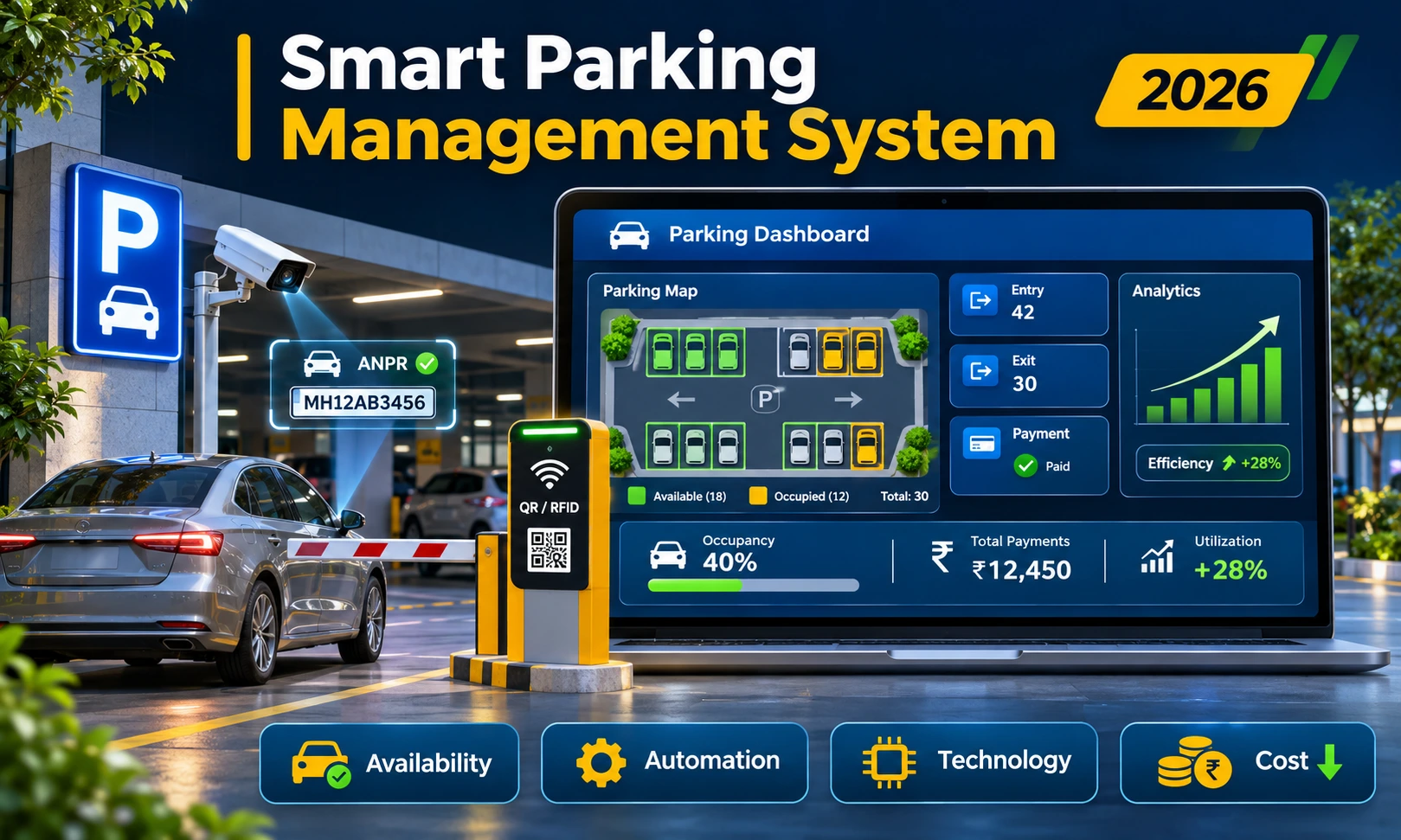
Instead of depending entirely on security guards, paper tickets and manual vehicle counting, smart parking technology uses connected devices, cameras, automation and management software to organise parking operations.
A properly implemented system can identify vehicles, monitor parking occupancy, calculate charges, manage payments and provide useful operational information through a central dashboard.
For shopping malls, hospitals, IT parks, commercial buildings, residential communities and paid parking operators, the benefits extend beyond convenience. Better parking management can improve vehicle movement, reduce billing disputes and help operators understand how their parking facilities are being used.
In India, custom parking management software development may cost approximately ₹75,000 to ₹15,00,000 or more, depending on the functionality. A complete system involving ANPR cameras, boom barriers, IoT sensors and physical installation can require a substantially higher investment.
This guide explains smart parking system features, benefits, development technologies, hardware requirements, software costs and the factors businesses should consider before starting a project in 2026.
What Is a Smart Parking Management System?
A smart parking management system is a software-driven solution that helps businesses monitor, control and organise vehicle parking operations.
It connects parking activities such as vehicle entry, space availability, ticket generation, payment collection and exit verification through a single management platform.
Depending on the project, the system may use Automatic Number Plate Recognition (ANPR), RFID technology, IoT sensors, QR codes, cameras, mobile applications and cloud-based software.
For example, when a car enters a commercial parking facility, an ANPR camera can read its registration number. The software records the entry time and creates a parking session.
When the vehicle leaves, the system calculates the parking duration, applies the applicable tariff and processes the payment through an available method.
At the same time, the administrator can monitor vehicle movements, occupied spaces, daily collections and operational activity.
More advanced systems can also guide drivers towards available parking areas, manage pre-bookings and coordinate several locations through one dashboard.
The real purpose of smart parking is not simply to automate the gate. It is to make the entire parking operation easier to manage, measure and improve.
How Does a Smart Parking Management System Work?
A smart parking system combines physical equipment with digital software. The exact process depends on the technology installed at the parking facility.
Here is how a typical automated parking system operates.
Step 1: Vehicle Detection at the Entrance
When a vehicle approaches the parking entrance, a camera, RFID reader, loop detector or other supported device identifies its presence.
In an ANPR-enabled system, the camera captures the vehicle registration plate and sends the recognised information to the software.
For a basic ticketing system, an attendant may instead enter the vehicle details or issue a QR-based parking ticket.
Step 2: Entry Verification and Recording
The software checks applicable access rules, including whether the vehicle has a valid parking pass or permission to enter.
Once the entry is authorised, the system creates a digital record containing information such as the vehicle number, entry time, parking category and gate location.
Step 3: Parking Availability Update
The system updates parking occupancy based on entry-exit counts, individual parking sensors or camera-based space detection.
If individual bays are monitored, drivers can receive more precise information about available spaces.
In simpler systems, the software may display only the total number of available parking spaces.
Step 4: Parking Space Guidance
Depending on the installation, digital displays or a mobile application can guide drivers towards available parking zones.
For example, a multi-storey parking facility may display how many spaces are available on each floor.
This helps reduce unnecessary movement through parking aisles.
Step 5: Parking Fee Calculation
When the vehicle is ready to leave, the system calculates the applicable parking fee according to the configured pricing rules.
These rules may include hourly charges, fixed tariffs, grace periods, vehicle categories, monthly passes or special parking rates.
Step 6: Payment and Vehicle Exit
The customer can complete payment using supported options such as UPI, cards, cash or an approved FASTag parking integration.
After successful payment and exit authorisation, the barrier can open automatically or through an attendant-controlled process.
Step 7: Management Reporting
The software records completed parking sessions, payment details and operational events.
Administrators can review daily collections, occupancy trends, vehicle movement, operator activity and other useful reports.
For larger parking facilities, this information can support staffing, pricing and capacity decisions.
Essential Features of a Smart Parking Management System
A parking application should not be designed around technology names alone. Its features should reflect the daily problems faced by drivers, security teams and facility operators.
The following features are particularly useful for modern parking operations.
1. Real-Time Parking Space Availability
One of the most useful features is the ability to display current parking availability.
The system can monitor occupied and vacant spaces through entry-exit counting, sensors or camera-based detection.
Drivers may see available spaces on digital signboards or through a mobile application.
For administrators, real-time occupancy information makes it easier to identify overcrowded areas and understand capacity utilisation.
2. Automatic Number Plate Recognition (ANPR)
ANPR technology uses cameras and image-processing software to identify vehicle registration numbers.
It can support automated entry, exit verification, parking session creation and vehicle movement records.
For example, a registered employee entering an IT park may be identified by the system without presenting a physical access card.
However, number plate recognition is not always accurate. Poor lighting, damaged plates, unusual fonts and camera positioning can affect results.
A reliable parking system should therefore support manual verification and correction when necessary.
3. RFID-Based Vehicle Identification
Radio Frequency Identification, or RFID, allows the system to identify vehicles using compatible tags and readers.
It is commonly considered for residential communities, office campuses and facilities managing regular vehicles.
When an authorised RFID tag is detected, the software can check its validity and permit entry according to configured access rules.
This can reduce the need for manual verification of registered vehicles.
4. Automated Boom Barrier Integration
Automatic boom barriers physically control the movement of vehicles entering and leaving the premises.
They can work with RFID readers, ANPR cameras, QR scanners and parking management software.
The system may open the barrier after successful authentication or payment verification.
Safety devices, manual release arrangements and emergency operating procedures are important parts of barrier installation.
5. QR Code-Based Parking Tickets
QR tickets provide a digital alternative to traditional paper-based parking records.
A ticket may contain a unique parking session identifier that can be scanned during payment or exit.
This feature can work well for commercial parking facilities that want a lower-cost entry system without full vehicle recognition hardware.
6. Digital Payment Integration
Customers increasingly expect convenient digital payment options.
A smart parking system can integrate supported UPI payment methods, payment gateways, card terminals and other approved payment services.
Digital receipts and transaction references can help operators reconcile collections and respond to payment disputes.
FASTag-based parking payments may also be possible through the appropriate authorised provider and technical arrangements.
7. Online Parking Slot Booking
For selected facilities, customers can reserve a parking space before reaching the destination.
A mobile application or website may allow users to choose a location, select an available time slot and confirm a booking.
This feature is particularly relevant to airports, event venues, commercial facilities and paid parking locations with controlled reservations.
Accurate booking availability requires dependable synchronisation between the reservation system and actual parking occupancy.
8. Dynamic Parking Fee Management
Different parking facilities follow different pricing structures.
A useful parking management system should allow authorised administrators to configure pricing rules without repeatedly changing application code.
Possible options include:
- Hourly parking rates
- Daily charges
- Two-wheeler and four-wheeler pricing
- Monthly parking subscriptions
- Grace periods
- Weekend and event tariffs
- Penalty or overstay charges
- Discounts and authorised exemptions
Where variable pricing is permitted, configurable tariffs can help operators manage different occupancy conditions and business requirements.
9. Parking Pass and Subscription Management
Residential societies, corporate offices and other facilities may need parking access for regular users.
The software can manage employee passes, resident permissions, monthly subscriptions and authorised vehicle lists.
Expiry notifications and renewal records can reduce repetitive administrative work.
10. Centralised Administrator Dashboard
A central dashboard allows parking operators to monitor activity without checking every entry register manually.
Depending on the system, the dashboard may display:
- Current vehicle occupancy
- Available parking capacity
- Daily entry and exit counts
- Parking revenue
- Active parking sessions
- Monthly pass activity
- Device connectivity
- Operator actions
- Payment exceptions
For businesses managing several locations, a central dashboard can provide an overall operational view while allowing individual location reporting.
11. Mobile Application for Drivers and Parking Staff
A mobile application can provide additional functionality for both customers and operational teams.
Drivers may use the application to find parking, view booking details, make payments and access digital receipts.
Parking attendants may use a separate application to register vehicles, scan tickets, verify payments and manage exceptions.
Not every project needs a customer mobile application. For smaller facilities, a web dashboard and attendant application may be sufficient.
12. Reports, Audit Logs and Revenue Monitoring
Accurate reporting is essential for facilities collecting parking fees.
The system can generate reports for completed sessions, daily collections, cancelled tickets, refunds, payment methods and operator shifts.
Audit logs can record important administrative actions and pricing changes.
These features make it easier to investigate discrepancies and maintain accountability.
Benefits of Smart Parking Management Systems for Indian Businesses
The advantages of parking automation are different for drivers, parking operators and property owners.
A well-planned system can improve operations in several ways.
1. Reduced Waiting at Entry and Exit Gates
Automated identification and payment processing can reduce repetitive manual activity at busy gates.
The improvement depends on traffic volume, equipment reliability and the number of entry and exit lanes.
2. Better Use of Existing Parking Space
Parking operators can monitor available capacity and identify areas that are frequently underused or overcrowded.
This information may help improve space allocation without immediately expanding the physical parking facility.
3. More Accurate Parking Collections
Digital ticketing, tariff calculation and payment records can reduce manual billing mistakes.
Revenue reports and transaction reconciliation can also help identify unexplained differences between parking sessions and collections.
4. Improved Customer Convenience
Drivers can benefit from faster entry procedures, clearer parking information and additional payment options.
Where parking guidance is available, visitors may spend less time searching for an empty space.
5. Better Vehicle Movement Records
Entry and exit records can support operational reviews, authorised vehicle identification and incident investigations.
However, vehicle data should be protected and retained only according to legitimate business requirements and applicable privacy obligations.
6. Reduced Dependence on Manual Registers
Digital records can replace repetitive handwritten entries and reduce the administrative workload associated with paper tickets.
Staff members can focus more on vehicle guidance, exception handling and site safety.
7. Multi-Location Parking Management
Businesses operating parking facilities across several properties can manage authorised users, pricing rules and reports through a connected system.
This can be useful for property management companies, commercial building operators and large parking service providers.
8. Better Planning Through Operational Data
Historical parking information can reveal peak hours, frequently used areas, average parking duration and seasonal demand.
These insights can help operators plan staffing, maintenance and future infrastructure requirements.
Technologies Used in Smart Parking Management System Development
Smart parking projects combine several technologies rather than depending on one application or device.
The appropriate technology depends on parking capacity, location, budget and expected functionality.
1. Internet of Things (IoT)
IoT connects physical parking devices with software applications through communication networks.
Parking sensors, controllers and connected equipment can transmit operational information to a central application.
For example, an occupancy sensor may detect whether a parking space is occupied and update the corresponding status in the software.
IoT is especially useful for facilities that require individual parking-bay monitoring.
2. Artificial Intelligence and Computer Vision
AI and computer vision can support vehicle identification, number plate recognition, camera-based occupancy detection and selected traffic analysis tasks.
These technologies process images or video to identify relevant vehicle information.
For example, a camera-based system may identify whether a monitored parking bay is occupied without installing a separate sensor in every space.
Accuracy depends on camera positioning, image quality, lighting and the environment.
3. RFID Technology
RFID is useful for identifying registered vehicles through compatible tags and readers.
It can support access control for employees, residents, monthly pass holders and other authorised users.
4. Cloud Computing
Cloud infrastructure allows parking information to be accessed by authorised users from different locations.
It can support centralised reporting, device monitoring, data backups and multi-location operations.
Some parking facilities may prefer local servers or hybrid architectures, particularly when internet connectivity is unreliable.
5. GPS and Location Services
GPS can help users find parking facilities, navigate towards selected locations and view nearby parking options.
However, GPS alone is generally not suitable for identifying individual spaces inside underground or multi-storey parking facilities.
Indoor positioning may require additional technologies or facility-specific mapping.
6. APIs and Payment Gateway Integration
Application Programming Interfaces, or APIs, allow parking software to communicate with external services and supported hardware systems.
They may be used for payment processing, vehicle recognition, notifications, booking systems and connected business applications.
7. Database and Analytics Technologies
A database stores information about parking sessions, vehicles, users, pricing plans, transactions and system activity.
Reporting tools can then analyse this information to provide useful operational insights.
Suggested Technology Stack for a Smart Parking System
There is no single technology stack suitable for every parking project.
The following options are commonly considered for custom parking management software.
| Component | Technology Options |
|---|---|
| Admin Dashboard | HTML, CSS, JavaScript, React or Vue |
| Backend Development | PHP, Laravel, Node.js, Python or Java |
| Database | MySQL, PostgreSQL or suitable managed databases |
| Android Application | Kotlin, Java or Flutter |
| iOS Application | Swift or Flutter |
| IoT Communication | MQTT, HTTP APIs or compatible device protocols |
| Vehicle Recognition | ANPR software, OpenCV and compatible computer vision models |
| Cloud Infrastructure | AWS, Microsoft Azure, Google Cloud or suitable hosting infrastructure |
| Payment Integration | Supported Indian payment gateway and UPI services |
| Notifications | Email, SMS or approved messaging APIs |
A PHP and MySQL backend can be suitable for parking applications involving ticket management, payments, subscriptions, reporting and administrative operations.
However, hardware compatibility, transaction reliability and connectivity requirements matter more than choosing a programming language based on popularity.
For systems involving cameras and IoT devices, the software architecture should also account for local controllers, offline operation and reliable communication between physical equipment and the application.
Different Types of Smart Parking Management Systems
Not every parking facility requires the same level of automation.
Understanding the different system categories can help businesses select the right development scope.
1. RFID-Based Parking Systems
These systems identify authorised vehicles through RFID tags and compatible readers.
They are commonly useful for residential communities, staff parking and controlled-access premises.
2. ANPR-Based Parking Systems
ANPR systems use cameras to identify vehicle registration plates.
They can support automated entry, exit tracking, registered vehicle recognition and ticketless parking workflows.
3. IoT Sensor-Based Parking Systems
These systems use occupancy sensors or connected devices to monitor parking spaces.
They are useful for facilities requiring detailed parking availability information.
4. QR Code Parking Management Systems
QR-based systems use digital tickets and scanning workflows to record parking activity.
They may be appropriate for businesses wanting to replace paper registers without investing immediately in extensive hardware automation.
5. Cloud-Based Parking Management Systems
Cloud-based applications allow authorised operators to manage parking information through a central online platform.
They can support multiple locations, remote reporting and connected applications.
6. Smart Parking Reservation Systems
Reservation systems allow customers to book parking spaces in advance where the operator supports such arrangements.
They are useful for selected commercial facilities, airports, hotels and event venues.
Smart Parking Management System Development Cost in India (2026)
The development cost depends on whether the business needs only parking management software or a complete hardware-integrated solution.
These two categories should be estimated separately.
A software-only project may include a web dashboard, ticketing system, payments and reporting.
A complete smart parking installation may also require cameras, sensors, barriers, controllers, networking equipment, power backup and on-site commissioning.
1. Custom Parking Management Software Development Cost
| Software Type | Estimated Development Cost |
|---|---|
| Basic Parking Ticketing and Billing Software | ₹75,000 – ₹2,00,000 |
| Web-Based Parking Management System | ₹2,00,000 – ₹4,00,000 |
| ANPR/RFID Integrated Parking Software | ₹3,00,000 – ₹7,00,000 |
| Parking System with Mobile App and IoT | ₹5,00,000 – ₹12,00,000 |
| Enterprise Multi-Location Parking Platform | ₹10,00,000 – ₹25,00,000+ |
These are indicative 2026 planning estimates for custom software development in India, not fixed market prices or official quotations. Hardware, installation, hosting, third-party fees and maintenance may be additional.
2. Smart Parking Hardware Cost in India
Hardware expenses depend on the number of parking spaces, entry and exit lanes, equipment specifications and installation conditions.
| Hardware Component | Approximate Cost |
|---|---|
| Ultrasonic Parking Sensor | ₹2,500 – ₹4,500 per unit |
| Magnetic Parking Sensor | ₹3,000 – ₹6,000 per unit |
| ANPR Camera | ₹15,000 – ₹40,000+ per unit |
| Automatic Boom Barrier | ₹35,000 – ₹1,20,000+ per unit |
| RFID Readers and Controllers | Depends on range and specifications |
| Networking, Cabling and Power Backup | Depends on site requirements |
| Installation and Commissioning | Depends on equipment and location |
Equipment prices may vary significantly between vendors. Industrial-grade cameras, high-speed barriers, specialised readers and civil installation work can increase the total project cost.
For facilities monitoring every individual parking space, the number of sensors can become one of the largest hardware expenses.
3. Complete Smart Parking System Installation Cost
For initial planning, the following ranges may help businesses understand the investment required for different types of deployments.
| Project Category | Indicative Total Budget |
|---|---|
| Basic Single-Gate Parking Automation | ₹1,50,000 – ₹4,00,000 |
| Small Commercial Parking Facility | ₹3,00,000 – ₹8,00,000 |
| Medium Commercial Parking Facility | ₹8,00,000 – ₹20,00,000 |
| Large IoT-Enabled Multi-Level Parking Facility | ₹20,00,000 – ₹50,00,000+ |
| Multi-Location or City-Level Parking Network | Custom Estimation |
These are broad implementation scenarios, not standard package prices. Total costs depend on lane counts, bay-level monitoring, civil works, equipment brands, existing infrastructure and software licensing. A basic bundled solution may cost less, while complex city-scale projects can cost substantially more.
Example: Cost of Developing a Smart Parking System for a Shopping Mall
Consider a shopping mall in Bangalore with approximately 100 parking spaces.
Suppose the management wants digital ticketing, vehicle recognition, automatic barriers, UPI payments and a central reporting dashboard.
For this example, assume two entry lanes and one exit lane, without installing a dedicated occupancy sensor in every parking bay.
| Project Component | Illustrative Budget |
|---|---|
| Parking Management Software | ₹2,50,000 |
| ANPR Cameras and Integration Equipment | ₹1,00,000 |
| Three Boom Barriers | ₹2,10,000 |
| Payment and Ticketing Equipment | ₹60,000 |
| Networking, Installation and Testing | ₹80,000 |
| Illustrative Total Investment | ₹7,00,000 |
This ₹7 lakh example is a hypothetical project budget, not a supplier quotation. It excludes recurring operating charges, applicable taxes and any additional civil works or major power infrastructure changes.
Installing a dedicated sensor in every parking space, adding a customer mobile application or introducing more advanced automation would increase the investment.
The important point is that the project should be estimated according to its actual requirements rather than simply multiplying the number of parking spaces by a fixed amount.
What Factors Affect Smart Parking System Development Costs?
Several technical and operational factors influence the final project quotation.
1. Number of Parking Spaces
Parking capacity affects the amount of equipment and monitoring infrastructure required.
If every parking space needs a sensor, a 500-space facility will require significantly more hardware than a 50-space facility.
2. Number of Entry and Exit Gates
Each automated gate may require barriers, cameras, controllers, safety devices, networking and installation.
Additional lanes increase equipment costs and integration work.
3. Type of Vehicle Identification
QR tickets, RFID readers and ANPR cameras have different hardware and software requirements.
The chosen identification method should reflect traffic volume, operational needs and budget.
4. Mobile Application Requirements
A basic parking dashboard may be sufficient for some businesses.
Others may require Android and iOS applications for parking discovery, reservations, payments and customer notifications.
Developing and maintaining these applications increases software costs.
5. Payment Gateway Integration
Digital payment integration requires transaction handling, payment status verification, receipts, refunds where applicable and reconciliation.
The payment provider may also charge transaction or service fees.
6. Cloud Hosting and Data Storage
Hosting expenses depend on application usage, data volume, system architecture and monitoring requirements.
Systems storing vehicle images or video may require additional storage infrastructure.
7. Existing Infrastructure
A property with compatible CCTV cameras, networking and barriers may be able to reuse some equipment.
However, integration compatibility must be verified before including reused hardware in the project plan.
8. Custom Business Rules
Multiple vehicle categories, dynamic tariffs, staff exemptions, reserved spaces and special access permissions can increase application complexity.
What Is the Monthly Maintenance Cost of a Smart Parking System?
The initial development and installation budget should not be confused with recurring operational expenses.
Smart parking systems may require hosting, technical support, hardware servicing, network connectivity and periodic software updates.
For a small commercial installation, recurring costs may begin at a few thousand rupees per month.
For larger facilities, a planning allowance of ₹10,000 to ₹50,000 or more per month may be appropriate, depending on the number of devices, service agreements and support arrangements.
Common recurring expenses include:
- Software hosting and database services
- Internet and network connectivity
- Hardware servicing and replacement
- Cloud storage and backups
- Software maintenance
- Payment gateway charges
- SMS and notification services
- Technical support and monitoring
Some vendors offer annual maintenance contracts, while others charge separately for software support and hardware servicing.
Businesses should request a clear recurring-cost estimate before approving the initial project.
How Long Does It Take to Develop a Smart Parking Management System?
Development timelines depend on software complexity, available hardware APIs and the installation environment.
| Project Type | Estimated Timeline |
|---|---|
| Basic Parking Management Software | 3–5 Weeks |
| Web-Based Parking Management Application | 5–8 Weeks |
| ANPR/RFID Integrated Parking System | 8–12 Weeks |
| IoT Parking System with Mobile Applications | 3–5 Months |
| Enterprise Multi-Location Parking Platform | 5–9 Months or More |
These are indicative custom-development timelines. Hardware-led installations using existing software can sometimes be completed faster.
Physical installation, equipment delivery, network preparation, site access and acceptance testing may affect the overall project schedule.
Industries That Can Benefit from Smart Parking Management Software
Shopping Malls and Retail Centres
Shopping malls can use parking software to manage visitor traffic, monitor capacity, calculate parking fees and reduce congestion near entry and exit points.
Hospitals and Healthcare Facilities
Hospitals may need organised parking for patients, visitors, doctors, ambulances and staff members.
A smart parking system can support access permissions, visitor parking records and better management of available spaces.
Emergency vehicle access must remain a priority when designing automated controls.
IT Parks and Corporate Offices
Corporate campuses can manage employee vehicles, visitor passes, authorised access and multiple parking zones.
RFID or ANPR technology can help automate entry for registered vehicles.
Residential Apartments and Gated Communities
Residential communities can use digital parking systems for resident access, visitor records and assigned parking permissions.
For smaller communities, a simple RFID or QR-based system may be more practical than extensive IoT monitoring.
Airports and Railway Facilities
Large transport facilities can use parking automation for visitor traffic, fee calculation, vehicle tracking and capacity management.
Reservation systems and digital payment options may also be useful depending on operational requirements.
Hotels and Event Venues
Hotels, convention centres and event venues may use parking applications for guest vehicles, valet operations, reservations and temporary event traffic.
Municipal and Public Parking Facilities
Urban parking operators can use digital systems for ticketing, payment collection, occupancy monitoring and centralised reporting.
Public parking projects may require additional permissions, enforcement workflows, procurement procedures and integration with local authority systems.
Challenges in Smart Parking System Development
Smart parking projects involve physical environments, moving vehicles and financial transactions. Development teams must therefore consider operational reliability alongside software functionality.
1. Internet Connectivity Problems
Basement parking areas and remote facilities may have unstable internet connectivity.
Where necessary, local controllers and offline transaction queues can allow selected operations to continue until connectivity is restored.
2. Number Plate Recognition Errors
Rain, glare, vehicle speed, dirty number plates and poor camera angles can affect ANPR accuracy.
The system should include exception handling and authorised manual correction procedures.
3. Hardware Compatibility
Not all cameras, barriers and RFID readers support the same communication interfaces.
Hardware specifications and available integration documentation should be verified before purchasing equipment.
4. Payment Verification Failures
Payment transactions may occasionally remain pending or fail to update immediately.
The software must handle duplicate notifications, delayed confirmations and payment disputes without incorrectly releasing or blocking parking sessions.
5. Data Security and Privacy
Vehicle registration numbers, customer information and parking records require appropriate access controls and retention policies.
Businesses should follow applicable Indian privacy requirements and avoid collecting information that is not necessary for legitimate parking operations.
6. Power Interruptions
Parking gates and connected devices depend on reliable electrical power.
Uninterruptible power supplies, safe barrier behaviour and manual operating procedures should be considered during installation.
How to Develop a Smart Parking Management System: Step-by-Step Process
Step 1: Study the Parking Facility
Begin by understanding the number of parking spaces, entry lanes, exit lanes, vehicle categories and existing operational problems.
A physical site assessment is especially important when hardware integration is required.
Step 2: Define the Software Requirements
Prepare a feature list covering ticketing, vehicle identification, payments, access control, reporting and administrator permissions.
Separate essential functions from features that can be introduced later.
Step 3: Select Suitable Hardware
Choose compatible cameras, barriers, sensors and controllers according to the facility layout and traffic volume.
Obtain equipment documentation and confirm the availability of integration interfaces.
Step 4: Plan the Application Architecture
Design the database, software backend, APIs, device communication and user interfaces.
Consider how the application will operate during network interruptions or hardware failures.
Step 5: Develop the Core Software
Build the parking session management system, tariff engine, access controls, payment workflows, administrative dashboard and reporting features.
Step 6: Integrate Parking Equipment
Connect the software with supported ANPR cameras, RFID readers, boom barriers, ticket printers and other required devices.
Test equipment using the actual models selected for deployment.
Step 7: Perform Real-World Testing
Test vehicle entry, exit, payment confirmation, duplicate sessions, expired passes and equipment failures.
Where appropriate, also test night-time operation, poor connectivity, power interruptions and busy traffic conditions.
Step 8: Launch and Monitor the System
Deploy the software, configure the equipment, train parking staff and monitor early operations.
Review actual usage and system reports before introducing additional automation features.
Future Trends in Smart Parking Technology
Parking management technology continues to develop as connected devices, payment systems and computer vision become more accessible.
Some developments worth watching include the following.
AI-Based Parking Occupancy Detection
Camera-based detection may reduce the need for individual bay sensors in selected environments.
However, accuracy, camera coverage and data processing requirements must be evaluated before adopting this approach.
Connected Parking and Electric Vehicle Charging
Parking applications may increasingly coordinate available parking spaces with compatible EV charging infrastructure.
Such systems may allow customers to view charging bay availability and manage related booking or payment workflows.
Predictive Parking Demand Analysis
Historical occupancy information can help operators forecast busy periods and plan staffing or parking allocations.
Prediction quality depends on the amount and accuracy of available data.
Contactless Vehicle Access
ANPR, RFID and supported payment integrations can reduce the number of manual steps required at parking entrances and exits.
Appropriate safety controls and exception-handling procedures will remain necessary.
Centralised Multi-Property Management
Property management companies may increasingly prefer platforms that provide reporting and operational visibility across several parking facilities.
Such applications can support shared administration while maintaining location-specific rules and permissions.
Is Smart Parking Management Software Worth the Investment?
Whether a smart parking system is financially worthwhile depends on the facility's operating conditions.
For example, consider a commercial parking facility recording 300 paid vehicle visits per day.
If operational improvements help identify and recover an average of ₹5 per parking session that would otherwise be lost through billing mistakes or unrecorded collections, the illustrative recovery would be:
300 vehicles × ₹5 × 30 days = ₹45,000 per month.
Over 12 months, this would equal ₹5,40,000 before operating expenses.
This is a hypothetical calculation, not a prediction or guaranteed return. It assumes that the identified collection difference exists and can actually be recovered.
A real financial evaluation should consider existing revenue leakage, staffing requirements, hardware maintenance, software subscriptions and the cost of capital.
For some facilities, better customer experience and traffic management may justify the investment even when direct financial savings are difficult to measure.
For others, a lower-cost ticketing system may be more sensible than installing a fully automated IoT network.
How to Choose a Smart Parking Management System Development Company
Before selecting a development partner, businesses should evaluate both software capabilities and practical hardware integration requirements.
Important questions include:
- Can the software support our existing parking layout?
- Which ANPR cameras, RFID devices and barriers are compatible?
- Does the system support offline operations?
- Can administrators configure parking tariffs?
- How are payments and refunds handled?
- Can we manage multiple parking locations?
- Will the application include operator activity logs?
- Who owns the software code and hosting accounts?
- Are hardware installation charges included?
- What maintenance and technical support are available?
A clear project scope should identify which responsibilities belong to the software development company, hardware supplier and parking facility operator.
This is particularly important when equipment and software are supplied by different vendors.
Smart Parking Management Software Development in Bangalore
Bangalore has a wide range of commercial properties, technology campuses, residential developments, hospitals and retail facilities where organised parking operations matter.
Businesses planning parking automation should begin by identifying the exact operational problems they want to solve.
Some facilities may need only digital ticketing and payment records. Others may require ANPR-based vehicle identification, IoT occupancy monitoring, automatic barriers and connected applications.
W3 Dream Solutions is a Bangalore-based website and software development company offering custom digital development services for business requirements.
Organisations exploring a smart parking application can discuss their software requirements, administrator dashboards, mobile application needs and possible third-party integrations.
For more information about the company's development services, visit W3 Dream Solutions.
Final Thoughts: Smart Parking System Development in India (2026)
Smart parking management is not simply about replacing a security guard with an automatic barrier. It is about creating a more organised way to manage vehicle movement, parking availability, customer payments and operational information.
For businesses in India, the investment can range from a relatively affordable digital ticketing application to a large connected parking infrastructure project.
Basic custom parking software may cost around ₹75,000 to ₹2,00,000, while advanced applications involving IoT devices, mobile apps, vehicle recognition and multiple locations may require several lakhs or more.
Hardware and installation expenses should always be calculated separately.
The right solution depends on parking capacity, vehicle movement, existing infrastructure, customer requirements and long-term operating costs.
Instead of beginning with the most advanced technology, businesses should identify their biggest operational difficulties and develop a system that addresses those problems first.
Good parking management is not about filling every empty space. It is about keeping vehicles, information and operations moving in the right direction.
With a clear development plan, compatible equipment and well-designed software, smart parking technology can become a useful long-term investment for Indian commercial and residential facilities.
Other Blogs
Subscribe
Get the latest blog updates directly in your inbox.